RINA and the Future of Yachting: Matteo Magherini on Nuclear Energy as the Next Frontier
RINA and the Future of Yachting: Matteo Magherini on Nuclear Energy as the Next Frontier


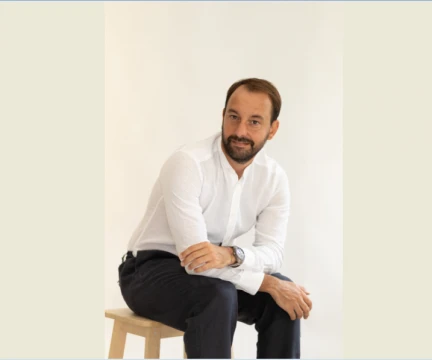
At the cutting edge of innovation for the superyacht sector, Matteo Magherini leads the North Europe Yachting Centre of RINA, where his mandate covers advanced energy systems, decarbonisation strategies and the certification of new-generation vessels.
In early 2025 he authored RINA’s white paper “Application of Nuclear Technology for Superyachts,” which positions nuclear propulsion not as science fiction but as a credible pathway for ultra-long-range, low-carbon yachting. On the occasion of the Monaco Yacht Show (24–27 September 2025), RINA presented its innovation agenda and, through Magherini’s team, spotlighted the early feasibility work on safe marine modular reactor solutions.
With roots in Italy and an operational base in Northern Europe, Magherini works at the intersection of regulation, safety and vision: he is steering the dialogue about how classification, engineering and sustainability converge to shape the next generation of superyachts.
Below is our interview about the Nuclear Energy Systems project.
Balancing Safety and Innovation
PressMare - Given the strict regulatory, safety, and environmental concerns around nuclear propulsion, how would you balance innovation with risk—both for the owner/user and for broader reputational or regulatory exposure for the yacht designer/shipyard?
Matteo Magherini - New nuclear is very safe. The underpinning concepts behind advanced nuclear reactors (the so-called 4th generation) are to focus on safety and efficiency. For example, in the case of operating out of the design range, the reactors have the capacity to shut down without the need for any external intervention.
Moreover, 4th generation reactors work at atmospheric pressure, enhancing safety levels compared to first-generation reactors. For regulators to keep up with rapidly evolving technologies, new rules need to focus on goal-based objectives rather than prescriptive guidelines. However, a balanced view between the opposing schools of thought is likely to be the best way forward. Clearly, an atomic yacht is for an owner with a deep understanding and appetite for undertaking technical development risks against the potential reward of being early adopters and among the protagonists propelling global technology advancements.
Integration with Owner’s Vision and Usage Profile
PM - When owners commission yachts, they often have strong ideas about usage (Mediterranean cruising, expedition, speed, comfort, services). How would nuclear propulsion fit into different usage profiles—in what scenarios do you think it makes the most sense (e.g., long-range expedition vessels, icebreaking, etc.), and when might it be overkill or impractical?
MM - A nuclear-powered superyacht will be ideal for long passage makers, for owners dreaming of remote navigations requiring long autonomy capacity and off-grid explorations. A significant part of the energy may be reserved for additional capabilities, amenities, and toys on board (dynamic positioning, HVAC, heated pool, moving platforms, energy storage devices, electric tenders, etc.). With regard to main propulsion, in the last decade particularly, the industry has matured in accepting lower top-speed requirements in favor of higher focus and optimization on cruising speeds. Nuclear will disrupt the current narrative, enabling higher speeds and longer ranges. For coastal operations or for fast and short journeys, alternative fuels remain a more attractive choice for their specific design requirements and regulatory compliance (international and local) implications.
Regulation and Classification Hurdles
PM - What do you see as the main regulatory or classification challenges that must be addressed before nuclear propulsion can become viable in the superyacht sector—both in terms of international maritime law and classification societies? And what steps would you consider most important to move those conversations forward?
MM - The marine nuclear technological developments are advancing faster than rules and guidance. The regulatory framework needs to be updated. The “Nuclear Code” and SOLAS Chapter VIII will be updated by the IMO, with initial work planned to take place during 2026. This work will be led by Member States (i.e., Flags) who will dictate the level of priority. In parallel, Class Societies will update their current guidelines about nuclear.
Technological and Design Implications
PM - From a design and naval architecture perspective, what are the key technological obstacles with nuclear propulsion (e.g., reactor size, shielding, safety systems, maintenance, crew training, waste disposal)? How might these affect yacht layout, weight distribution, habitable spaces, costs, and lifecycle management?
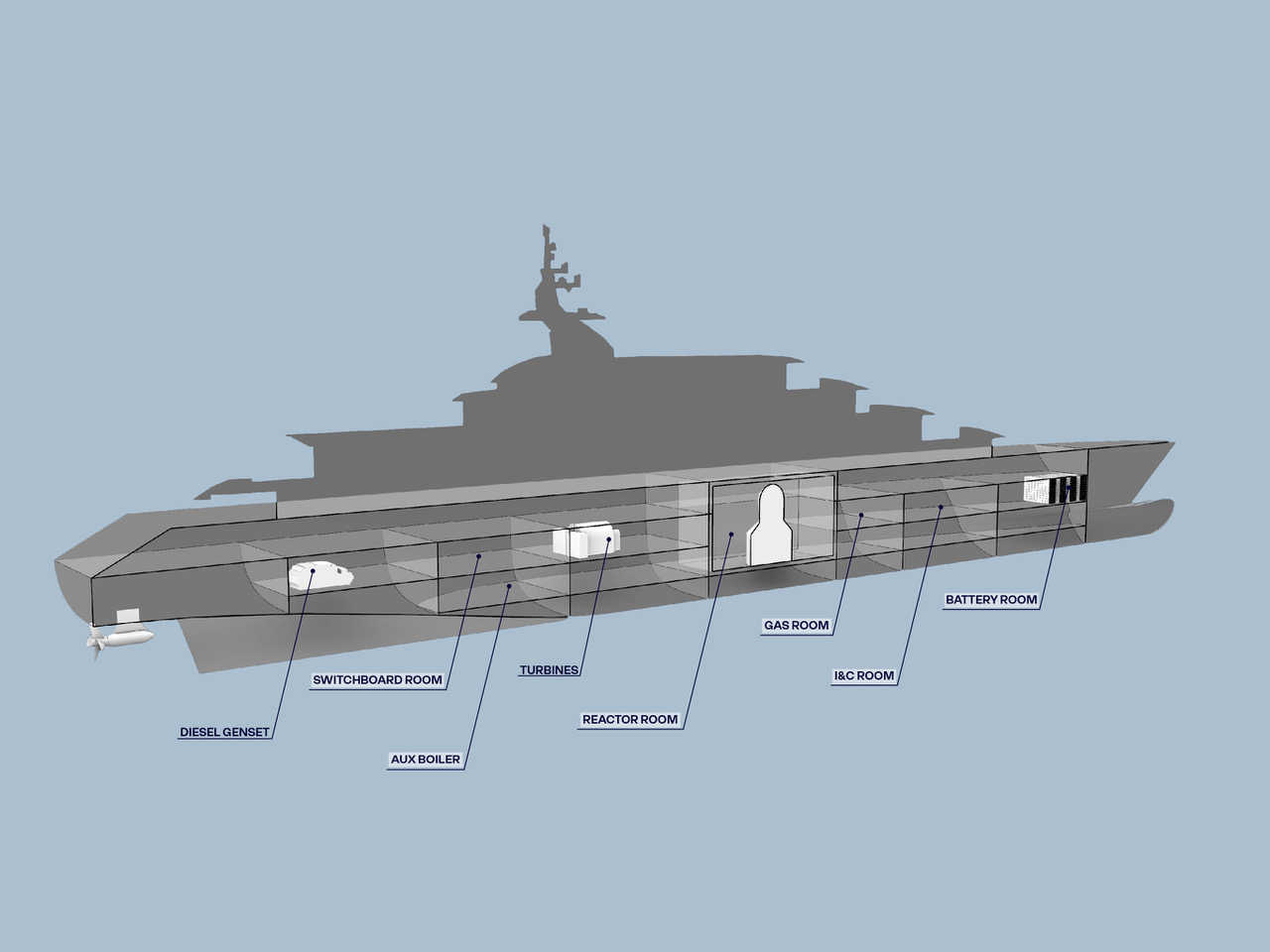
MM - A nuclear-powered yacht will have a significantly different layout compared to a traditional yacht platform. Due to the necessary auxiliary equipment required for a nuclear-powered yacht, to minimize the impact of technical space allocation over the total usable space, nuclear technology will be mostly feasible for larger yachts only (100m+ and beyond). One of the key impacts on the engineering of the platform against traditional designs will be on the structural design due to the weight concentration around the reactor position. The weight distribution of the vessel will be particularly high around the reactor due to the required shielding material. Clearly, CAPEX for the machinery will be multiple times higher than for a traditional yacht. OPEX will also likely be higher initially; however, with a lifecycle of 10–15 years, the reactor will result in significant savings on fuel bills, which are typically among the highest running costs for large yachts.
The current ownership structures assume the reactor to be lent by the vessel, therefore keeping specialized expertise on nuclear with the reactor manufacturer. However, a level of nuclear qualification on board will be required, increasing qualification levels and therefore driving costs up.
Market Demand & Owner Acceptability
PM - What is your sense of owner demand for truly zero-emission or radically low-emission propulsion systems? Do you think there are owners who would accept nuclear propulsion on yachts not only from a performance but also from a perception standpoint? What communication challenges do you foresee (public concerns, insurance, port access, etc.)?
MM - In recent decades, there is an increasing number of end clients showing genuine interest and curiosity about technologies aiming for zero emissions. However, public perception remains the hardest obstacle for nuclear application in any civil application. Superyachts are generally suffering from adverse public perception, likely due to the disconnection between the general public and their owners. Therefore, it can be argued that linking nuclear technologies with superyachts may be a challenging combination from a social acceptance perspective.
This could be seen as a unique opportunity for communicating a positive narrative about large yachts. Public concern about nuclear is typically derived from the association of nuclear technology with the documented accidents of the recent past. Education about new nuclear is ongoing and needs to be continued. Campaigns about the potential use for the surplus energy by the reactor will need to be strategized: there are many appealing potential outcomes that can be designed around a low-carbon energy source such as a nuclear reactor on a yacht (e-fuel local production, providing clean energy to remote local communities, etc.).
With Magherini, RINA is turning nuclear propulsion from a futuristic concept into a tangible opportunity, opening new possibilities for innovative yacht owners and shipyards.
Filippo Ceragioli
©PressMare - All rights reserved