Seaquip Advisory Board: Italian Shipyards Outline the Challenges Shaping the Future of Yachting


A trade fair can simply bring together supply and demand, or it can become a strategic tool that contributes to the development of an entire industrial supply chain. It is this latter vision that gave rise to the Seaquip Advisory Board, the new strategic forum established by Easyfairs to support the growth of the B2B exhibition dedicated to marine equipment and components, scheduled for March 2027.
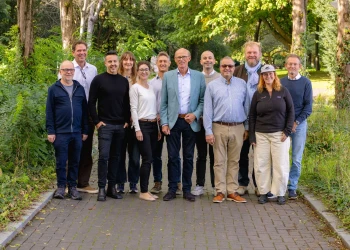
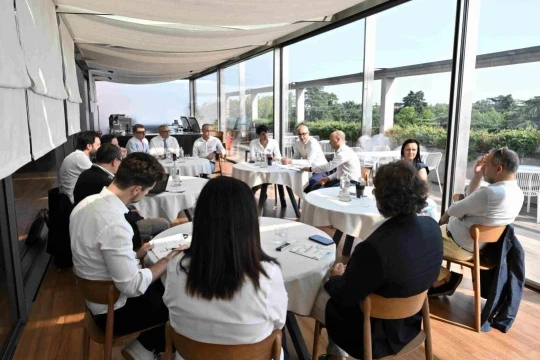
The inaugural meeting, hosted at the Triennale Milano and moderated by the author, brought together representatives from Azimut/Benetti Group, Antonini Navi, Baglietto, Groupe Beneteau, Ferretti Group, Rio Yachts, Sanlorenzo Group, Solaris Yachts, Valdettaro Group and WOSA Yacht Refit & Survey. Rather than being an organizational meeting, it became a discussion among professionals who design, build, source components, manage production and deal daily with the practical challenges of Italian yacht building. This is precisely what made the discussion particularly valuable: not a theoretical debate, but a highly realistic snapshot of the priorities the industry will have to address over the coming years.
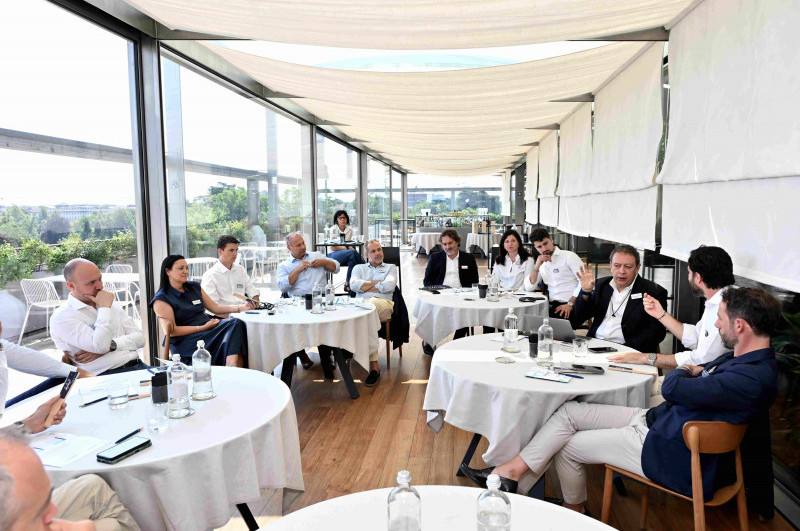
The discussion covered a wide range of topics, from innovation and digitalization to sustainability, supply chain management and the growing shortage of skilled workers. Different issues, yet all linked by a shared awareness: after the exceptional expansion experienced during the post-pandemic years, the yachting industry has entered a phase of market normalization that requires shipyards to continue investing in order to preserve their international competitiveness. Several participants pointed out that periods of slower market growth often represent the best time to accelerate investment in research and development, recalling how companies that continued to innovate during the 2008-2012 financial crisis emerged stronger than many of their competitors.
One of the most interesting points raised during the discussion concerned the very way innovation is generated within the yachting industry.
According to several participants, the challenge is not simply finding new suppliers. Companies capable of manufacturing components are plentiful, and the market offers a wealth of expertise. The real difficulty lies in identifying innovative businesses that remain largely unknown but have the potential to become development partners for new solutions.
This is a fundamental distinction.
Calling a long-established supplier is relatively straightforward. Much more challenging is discovering a small company that may already be successfully operating in another industrial sector, possesses an interesting technology, yet has never had the opportunity to engage with the marine industry. In such cases, the obstacle is not technical but relational: there is often no opportunity to build the trust that is essential when developing products together.
This also led to a broader reflection on Seaquip’s role. More than a traditional trade exhibition, the event aims to become a place where supply and demand can meet long before a product reaches the market, when ideas, engineering requirements and development opportunities are still being shared.
The discussion inevitably turned to the role of major international trade fairs.
The reference was naturally METS Amsterdam, universally recognized as the world’s leading exhibition for marine equipment and components. No one questioned its importance, but its sheer size prompted an interesting discussion.
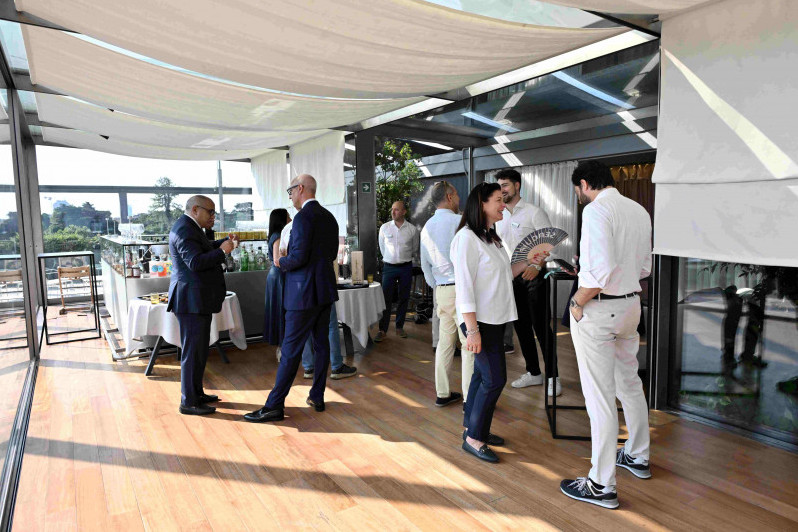
With more than 1,200 exhibitors, participants observed, it has become virtually impossible to explore the entire exhibition over just a few days. Those looking for a specific technology partner often manage to visit only a fraction of the available exhibitors, while many highly innovative companies risk going unnoticed. It is precisely this consideration that underpins the idea of developing a more focused event, where qualified networking, technical content and meaningful business meetings take precedence over simply walking through exhibition halls.
Among all the topics discussed, digitalization undoubtedly generated the broadest consensus.
It is no longer viewed simply as an enhancement of the owner’s onboard experience or as the integration of new digital technologies. Instead, it is increasingly regarded as a tool capable of supporting the entire lifecycle of a yacht.
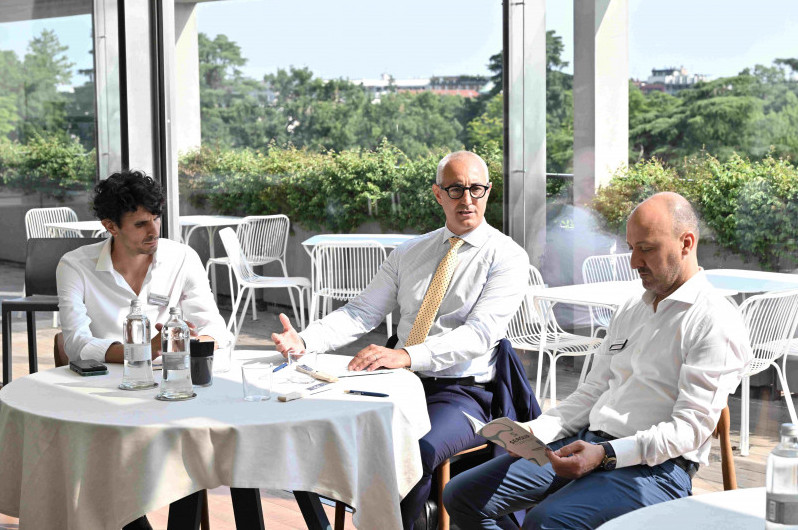
For shipyards, this means improving warranty management, implementing predictive maintenance, collecting information on technical issues and building comprehensive digital records that become valuable engineering assets for the design of future yacht generations.
Operational data therefore acquires strategic value, allowing builders to understand how yachts are actually used and which components require greater attention throughout their service life. A vast amount of information that until only a few years ago was often lost can now be transformed into engineering knowledge.
The analysis of operational data also highlighted one of the most thought-provoking aspects of the entire meeting.
According to studies referenced during the discussion, a yacht spends most of its life moored in the marina, is underway for only around 10% of its lifetime, and operates at maximum engine power for only a very small fraction of its service life.
These findings are expected to significantly influence future yacht design.
If this accurately reflects real-world usage, increasing importance must be given to onboard energy efficiency, air-conditioning systems, hotel load management, automation and reducing energy consumption while yachts remain alongside for extended periods. At the same time, it highlights the limitations of applying environmental regulations originally developed for commercial shipping to recreational boating, where operating profiles are fundamentally different. Several participants therefore called for environmental performance indicators specifically designed for the leisure marine sector.
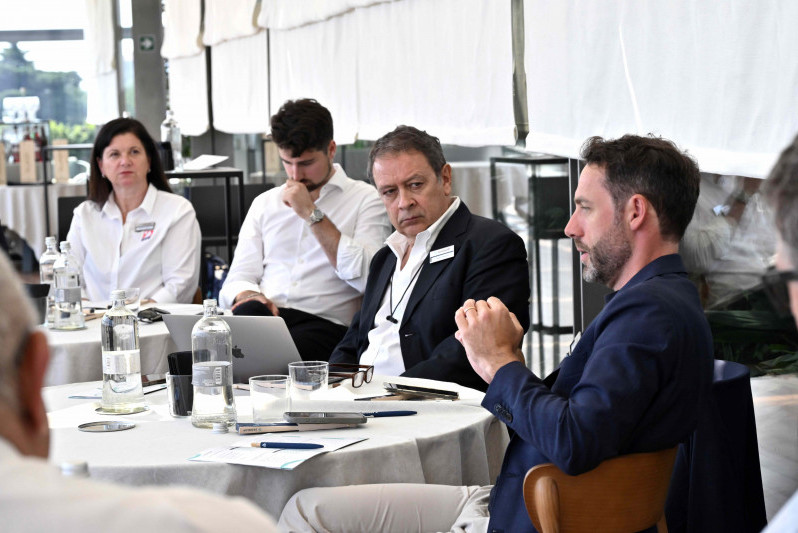
The discussion on sustainability also revealed a highly pragmatic approach.
Direct demand from owners for “green” yachts remains relatively limited. However, participants agreed that this should not lead shipyards to postpone investments. On the contrary, there was broad consensus that new yachts should already be designed to accommodate the energy technologies likely to emerge over the coming years, regardless of which propulsion solution eventually prevails.
This is the concept behind “Future Ready” yachts: designing engine rooms, onboard systems and energy distribution architectures that are flexible enough to accommodate future technological developments without requiring complete redesigns.
At the same time, sustainability was seen as the result of numerous incremental improvements: lighter structures, improved thermal insulation, waste heat recovery, lower air-conditioning loads, more efficient materials and increasingly optimized production processes. No single revolutionary breakthrough, but rather the cumulative effect of many practical engineering improvements.
Among all the issues discussed, perhaps the most significant concerned the yacht’s overall lifecycle. Participants noted that approximately 80% of the CO₂ emissions associated with a yacht are generated during its construction phase. If this figure becomes the starting point for future assessments, sustainability can no longer be evaluated solely by considering what happens once the yacht is in operation. Materials, manufacturing processes, industrial organization, waste recovery and factory efficiency become just as important as the propulsion systems installed onboard.
While innovation represents a major opportunity, the supply chain continues to be one of the most critical challenges facing Italian yacht building.
Shipyards increasingly rely on complex supplier networks that directly influence product quality, delivery schedules and manufacturing capacity. Supplier selection is no longer based solely on price or technical expertise, but also on the ability to integrate digitally with the CAD and ERP systems used by shipyards. As a result, digital integration throughout the supply chain is becoming a genuine competitive advantage, while several builders are considering bringing selected manufacturing activities back in-house whenever the market is unable to guarantee the required levels of quality or cost competitiveness.
If there was one issue on which all participants fully agreed, however, it was the importance of human capital.
The shortage of skilled laminators, welders, carpenters, systems technicians, painters and other highly specialized professionals continues to represent one of the main constraints on the growth of the Italian yachting industry. In several production districts, competition among shipyards to attract qualified workers has become increasingly intense, while many traditional trades are now largely supported by foreign labour.
Participants also noted that the challenge extends well beyond the labour market itself. Italy’s vocational education system is still considered insufficiently effective in preparing the specialized skills required by today’s yacht-building industry. As a result, greater efforts are needed to introduce younger generations to marine professions from an early stage, enhancing careers that remain one of the defining strengths of Italian yacht building.
Among the operational recommendations emerging from the Advisory Board was the need to strengthen cooperation with other industrial sectors. Automotive, aerospace, interior design and even open-source research platforms were all identified as fields from which the yachting industry could draw technologies, materials and established expertise. At the same time, participants highlighted the importance of developing permanent digital tools capable of maintaining relationships between exhibitors and visitors well beyond the duration of the exhibition itself.
The objective is clear: to transform Seaquip from a conventional trade fair into a permanent platform for relationships, innovation and technology transfer, connecting the Italian marine supply chain with new partners and leading international players.
More than an organizational meeting, the first Seaquip Advisory Board provided a unique opportunity to hear directly from the professionals who design, build and innovate Italian yachts every day. The discussion painted a clear picture of an industry that continues to invest in innovation, approaches sustainability and digitalization with pragmatism, and still recognizes that skilled people and a strong supply chain remain the decisive factors underpinning Italy’s global leadership in yacht building.
©PressMare - All rights reserved