

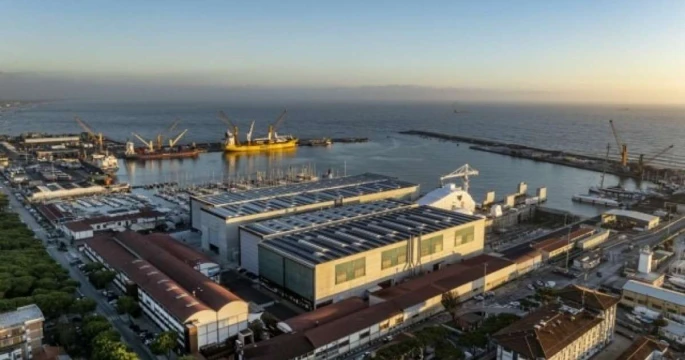
The Italian Sea Group, Marina di Carrara
The Italian Sea Group: The Numbers Exposed – €266 Million in Overdue Debt as the Reckoning Approaches


€7.5 million in cash against more than €266 million in overdue liabilities. More than any other figures, these two numbers capture the financial position of The Italian Sea Group. The disclosure released at Consob’s request, received by our editorial office late yesterday evening and updated as of May 31, 2026, does not fundamentally change the picture that has emerged over recent months. Instead, it provides a far clearer assessment of the Group’s financial condition, leaving little room for interpretation: the restructuring process remains at its most critical stage, and the coming weeks are likely to prove decisive.
The Group’s consolidated net financial position stands at €178.8 million. Total bank debt is just under €155 million, largely consisting of medium- and long-term borrowings (€124 million, including the current portion), while the remaining €37.2 million relates to short-term financial exposure. Two additional items complete the non-current indebtedness: the €25 million shareholder loan granted by controlling shareholder GC Holding and €11.4 million in lease liabilities arising from the application of IFRS 16.
Even more significant is the composition of the Group’s overdue obligations. As of May 31, they totalled €266.8 million, including nearly €43 million owed to financial institutions, €77.7 million to suppliers, almost €99 million to factoring companies, €29.4 million in tax liabilities and €18.2 million in social security obligations. One figure stands out in contrast: the company reports no overdue liabilities towards employees.
The banking relationships also reveal an important aspect of the restructuring process. Total debt owed to lending institutions amounts to €149.9 million, of which €42.7 million is already overdue. Under the financing agreements, the banks would have been entitled to accelerate repayment and demand immediate settlement of loans that have not yet reached maturity. So far, however, they have chosen not to exercise that right, remaining engaged in negotiations as part of the negotiated restructuring process. This indicates that discussions with the banking system remain active and that room for a consensual solution still exists.
A similar approach is being pursued with suppliers, with negotiations continuing to reschedule part of the outstanding debt or reach settlement agreements. For tax and social security liabilities, TISG intends to pursue a tax settlement with the Italian Revenue Agency and, where possible, repayment plans with the relevant authorities.
Meanwhile, creditor pressure has not subsided. Since March 16, the company has received 30 payment orders totalling approximately €2 million. Twenty-two have already been settled, while the remainder are either under appeal, under negotiation or expected to be addressed as part of the broader financial restructuring with the banking pool. Subsidiary Celi S.r.l. has also received two payment orders, one of which has already been resolved. For the time being, the situation remains stabilised by the protective measures granted by the Florence Court, which suspend creditors’ enforcement actions until July 14, 2026—a deadline that is now rapidly approaching.
Among related-party transactions, GC Holding’s support continues to play a central role. The €25 million shareholder loan is interest-free, carries no fees or commissions, is subordinated to the claims of the banking pool and is repayable by December 31, 2032. It represents a significant commitment by the controlling shareholder at a time when confidence has become one of the company’s most valuable assets.
Another crucial milestone lies ahead. On May 21, the Board of Directors acknowledged that accumulated losses had reduced the company’s share capital below the legal minimum. As a result, the shareholders’ meeting convened for July 22 will be required to address the situation under Article 2447 of the Italian Civil Code and decide on the measures needed to restore the company’s capital.
Against this backdrop, it is hardly surprising that industry sources have begun circulating a scenario that, until only a few months ago, would have seemed unlikely: the possible sale of the Picchiotti shipyard in La Spezia, historically known as the Beconcini yard. This is far from an ordinary asset. Several domestic and international shipbuilding groups reportedly consider the facility strategically valuable for expanding their operations, making it a potentially attractive acquisition. According to information gathered by PressMare, the yard could have a market value of between €30 million and €40 million. Should such a transaction materialise, it would provide a meaningful injection of liquidity into TISG’s finances. Nevertheless, even a sale of this magnitude would not, by itself, resolve a debt burden of the scale now facing the Group.
Two dates now dominate the calendar: July 14, when the Court’s protective measures expire, and July 22, when shareholders will decide how to address the erosion of the company’s capital. Together, those milestones are expected to shape the next phase of TISG’s restructuring and determine whether one of Italy’s leading superyacht builders can preserve business continuity.
The official document released last night by The Italian Sea Group is attached to this article.
©PressMare - All rights reserved