McIntyre Golden Globe! So Far, So Good! Day 11, 301 to Go


A masthead repair for the leader, an Irish pursuer arriving seven hours later, and a chasing fleet finally finding its stride: the McIntyre Golden Globe Race 2026 has reached Lanzarote with plenty of stories already written—and another weather challenge taking shape. The fleet departed Les Sables-d’Olonne on 6 September 2026.
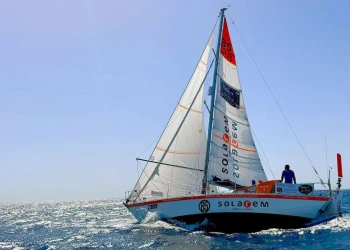
France’s Damien Guillou, aboard SOLAREM, was happy to discover he was leading for the first time, and Ireland’s Pat Lawless, sailing SILVERMINES HYDRO, was shocked and excited to find himself second, just hours behind the leader. He was convinced all the Rustler 36 yachts would be in front. Both completed their first film-drop rendezvous at Marina Rubicón on 16 September. Both are heading south again at speed, having turned their early escape from the Bay of Biscay into a substantial advantage. Behind them, a renewed breeze is producing some of the strongest sailing of the opening fortnight. But the opportunity may be short-lived. The race’s weather outlook points to fading winds around 20–21 September, potentially trapping the trailing boats while those farther south continue to pull away. After eight days of alternating frustration and fast sailing, the Atlantic is threatening another division.
Lanzarote: Marina Rubicón film drop, a mast climb—and straight back to sea
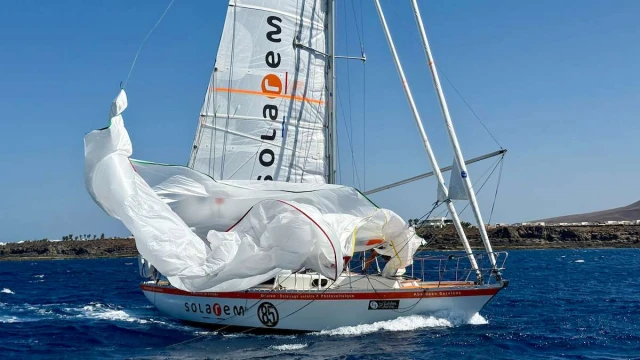
Guillou reached the Marina Rubicón film-drop buoy at 12:15 local time on Wednesday, 16 September. Following his 20-minute interview with the GGR team, he anchored for approximately an hour to tackle a job best completed before returning to the open ocean. The Frenchman climbed the mast to replace a sheave in the masthead spinnaker block, taking advantage of the relatively calm conditions to complete the repair himself. Then it was back to the race. Anchoring for unaided repairs is permitted under the GGR’s rules. Bringing in a shore team to do the work is not. Even within sight of a marina, self-reliance remains central to the challenge.
At 19:15 local time, Lawless followed. With one reef in his mainsail, he furled his headsail and eased the pace—but was still making approximately five to six knots as the race team’s rigid inflatable boat kept station alongside for his interview. These are rendezvous, not conventional stopovers. They mimic the efforts of the 1968 entrants hoping to pass letters and films. The film gate provides a brief opportunity to collect footage, recordings and letters, and hear the sailors’ stories before they continue south. There is no compulsory rest at Lanzarote.
By 17 September, the leading pair were away again, choosing different routes around the islands. Guillou’s accomplished spinnaker drop had provided another memorable moment for followers ashore. Ahead lay the next question: could either skipper turn the passage beyond the Canaries into a further escape?
“This is exactly what makes the Golden Globe such an extraordinary adventure! Damien anchors, climbs his mast, fixes the problem himself and gets straight back into the race. Pat is chasing hard, the boats behind are finally flying, and now another windless trap threatens to split the fleet again. It’s not just about sailing fast—it’s about solving problems, making good decisions and keeping yourself and your boat going.” — Don McIntyre, GGR Founder
The Biscay breakaway that changed the race
The foundations of their advantage were laid on 9 September, when a high-pressure system began spreading lighter winds across the Bay of Biscay. Guillou’s position close to the Spanish coast offered a favourable angle towards Cape Finisterre, while Lawless was also well placed to retain the breeze. Farther north, the opportunity to get south before the wind disappeared was narrowing. By the following day, the contrast was striking. Guillou had recorded 162 nautical miles in 24 hours. Britain’s Henry Wootton, aboard PRIVATEER, had managed just 24 nautical miles, while Canada’s Isa Rosli, sailing OLLEANNA, was almost stationary at the time of the report. The leading boats were escaping around Finisterre. Others were rolling in the remaining swell, trying to keep their sails drawing and their boats moving.
Yet even at the front, the advantage refused to settle. On 13 September, Guillou’s lead over Lawless stood at approximately 83 nautical miles. By 15 September, lighter winds had slowed the Frenchman and Lawless had recovered around 30 miles in a single day, reducing their separation to roughly 50 miles. Guillou was hand-steering under spinnaker, working for every fraction of a knot. Both men have unfinished business. Mechanical problems ended their previous GGR campaigns in 2022. Their return has now put them at the front of the same race that previously stopped them.
Close encounters in a very big ocean
Behind the leaders, the chasing fleet has been anything but passive. Italy’s Andrea Lodolo, aboard BIBI, established himself at the head of the pursuit, while Britain’s Ertan Beskardes, sailing MISS BEAGLE, remained firmly in contention. As the leaders approached Lanzarote, stronger northerly winds began reaching the boats behind, bringing the prospect of recovering some lost ground.
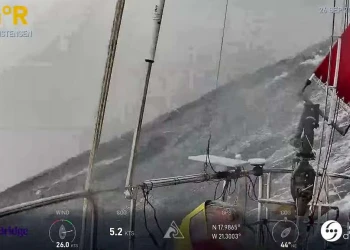
Some contests have been close enough to watch without a tracker. On 11 September, Switzerland’s Etienne Messikommer, aboard BERNARD, and Italy’s Guido Cantini, sailing HANNAH OF COWES, were separated by only about half a nautical mile. A day later, GGR Window Live footage showed Messikommer pushing through strong following winds, with Cantini visible on the horizon and boat speeds briefly exceeding nine knots. Cantini subsequently posted a 163-nautical-mile day in the 16 September report, demonstrating the pace available as the breeze filled in.
By 17 September, another close pairing had developed: Messikommer and Israel’s Daniel Pinsky, aboard EXODUS, were just 1.9 nautical miles apart—potentially close enough to see one another.
One important qualification concerns Lodolo. His displayed tracker position was out of date in the 17 September update, and the race team was working to obtain a fresh YB position. They are tracking his AIS via satellite too. His ETA in Lanzarote is approximately 22:00 UTC on 17 September.
DeBoer’s comeback meets another test
For American Guy deBoer, approaching the Canaries aboard SPIRIT carries particular significance. His 2022 race ended when the yacht grounded on Fuerteventura after the Lanzarote film drop. The rebuild and return have been a major undertaking. “But from that moment, I promised I’d rebuild and return,” he recalled in his official skipper profile before this year’s race. His opening Atlantic passage has already shown how quickly fortunes can change. The 11 September report recorded just 27 nautical miles of progress over the preceding day. The next report credited him with 177 nautical miles, one of the standout performances of the week.
Now there is another practical challenge. According to the 17 September update, deBoer is using his backup Windpilot following problems with his Hydrovane mounting brackets. France’s Louis Kerdelhué, aboard IE CHARGE, has also had to improvise. His early Hydrovane fastening problem required a temporary repair, allowing him to continue south rather than abandon the passage for a return to port. In this race, making the boat fast and keeping it functioning are inseparable tasks, and windvanes are critical.
Wootton accelerates; Mara makes her move
After his frustrating opening in the light winds, Henry Wootton is showing a very different pace. The latest 17 September update credits PRIVATEER with 172 nautical miles in 24 hours. The change is not simply numerical. In a recent safety call, Wootton spoke candidly about the emotional difficulty of the opening days after years of preparation—a reminder of the personal adjustment behind every tracker symbol.
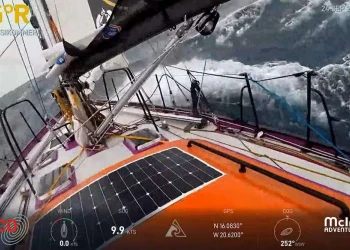
Norway’s Helga Marie “Mara” Løvenskiold Kveseth, aboard SHOWGIRL, has also been gaining momentum. Her more offshore positioning paid dividends earlier in the week: the 13 September report recorded 143 nautical miles, compared with deBoer’s 102 miles on a more inshore track. By 17 September, Mara was making another strong showing with 161 nautical miles in 24 hours, accompanied by lively sailing on GGR Window Live. There have been quieter moments, too. Between sail handling and the demands of living alone offshore, her onboard updates have included reading Kirsten Neuschäfer’s book—an appropriate companion for someone following the GGR route herself.
“The fascinating thing is that we can see the whole picture ashore, but the sailors can’t simply open the tracker and check who is catching them! They’re trusting their navigation, their seamanship and themselves. The leaders have earned their advantage, but there’s a whole world still to sail. Nobody can afford to get comfortable—this adventure is only just beginning!” — Don McIntyre, founder of the McIntyre Golden Globe Race
Elsewhere, Rosli, Americans Gunnar Christensen aboard POMPOEN and Matt Woodside aboard TIPI HAERE, and the surrounding boats are making the most of the renewed breeze. After the stop-start passage down the Atlantic coast, there are finally miles to be earned.
At the back, a race against the disappearing wind
For Sweden’s Pär Nyman, aboard LAZY OTTER, the opening challenge was simply getting back to sea after repairs in Les Sables-d’Olonne. His delayed departure left him pursuing a fleet already stretched across Biscay. Turkey’s Selim Yalçın, sailing HELP DISABLED CHILDREN, has also been balancing forward progress with work aboard. Earlier reports explained that some of his slow sailing reflected time spent completing preparations and making the boat more comfortable. Now the weather threatens to make their pursuit more difficult.
Nyman is dealing with confused seas, while Yalçın has smoother conditions but less speed. Both could be exposed to the approaching loss of breeze around 20–21 September. The 16 September outlook suggested several days of very light winds on the northern approach to the Canaries. That remains a forecast, not a certainty—but for the trailing boats, the risk is clear: a slow approach to Lanzarote while the boats ahead gain still more distance.
Alone at sea, visible to the world
Through GGR Window Live, followers are watching the contrast between hard-driving sailing and the ordinary routines of life aboard LIVE. The system provides one-way live coverage: it brings the sailors’ world ashore without giving them an equivalent window into the outside world. That distinction matters. The GGR remains a race built around traditional navigation and individual decision-making. Organisers can follow satellite tracking information that the competitors themselves cannot consult during normal racing.
From Biscay’s calms to the Lanzarote sail-pasts, the past eight days have shown how differently the same ocean can treat boats separated by relatively modest distances. The leaders have cleared the first film gate. The chasing fleet is accelerating. Farther back, two sailors are trying to reach the islands before their breeze disappears.
The boats are moving fast again. The question now is how many can keep moving if the wind switches off.