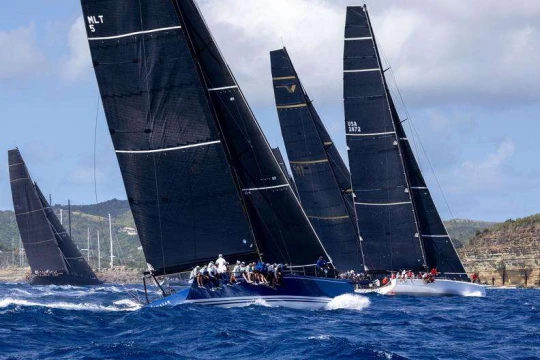
The 2026 RORC Nelson’s Cup Series returns to Antigua with an impressive fleet © Tim Wright/Photoaction.com
RORC Nelson’s Cup Series 2026: Race ready in Antigua


Race ready in Antigua
The 2026 RORC Nelson’s Cup Series returns to Antigua with racing from Tuesday 17 February 2026. As the final inshore proving ground before the start of the RORC Caribbean 600, the series blends short, intense coastal racing with one of the most distinctive courses in the region, the Antigua 360. Over two days of tight coastal races, followed by a full circumnavigation of the island, the RORC Nelson’s Cup has become an essential part of many teams’ Caribbean programme.
For crews preparing for the RORC Caribbean 600, starting on February 23, the RORC Nelson’s Cup offers something no amount of training miles can replicate: proper racing, against real opposition, in the same conditions and on the same race areas they will soon face offshore. The Series is also open to teams not competing in the RORC Caribbean 600, including mighty maxis and local heroes.
Maxi experience meets Caribbean reality
The IRC Maxi Class for the RORC Nelson’s Cup has formidable opposition: Farr 100 Leopard 3 sailed by Joost Schuijff, Chris Flowers’ RP100 Galateia and Mills 100 V sailed by Karel Komárek form a trio of 100-footers. Further top-end competition comes from Wendy Schmidt’s Botin 85 Deep Blue and Mills 72 Balthasar sailed by Louis Balcaen. The IRC Maxi Class will enjoy an additional day of racing in the RORC Nelson’s Cup, with, Leopard 3 and Balthasar continuing on to compete in the RORC Caribbean 600 following the RORC Nelson’s Cup Series.
Ken Read brings one of the most decorated résumés in professional sailing to the RORC Nelson’s Cup Series, with multiple world championships and decades at the highest level of the sport, including winning the Admiral’s Cup for USA. Sailing master and tactician aboard the 100ft maxi V, Read gives a powerful insight into the IRC Maxi Class for the RORC Nelson’s Cup.
“What really defines IRC Maxi racing right now is the ownership. These are people who are hugely successful in their own worlds, who expect excellence, and who genuinely love operating at this level. They are deeply invested in the detail and that creates a level of pressure that the sailors actually thrive on. The expectations are real, the owners want to win and you have to deliver.
“The boats themselves have evolved to an extraordinary level and the margins are tiny. One small mistake and it’s over. The Nelson’s Cup puts all of that under a microscope because the racing is close, intense and unforgiving. Add Antigua’s big breeze and proper waves and those loads become a true test of judgement as much as speed. You are constantly balancing how hard you push with keeping the boat in one piece. That combination of committed owners, refined machines and demanding conditions is what makes this some of the best racing anywhere.”
Few sailors bring more offshore experience to Antigua than Bouwe Bekking, who lines up on the Mills 72 Balthasar with Louis Balcaen at the helm. Balthasar is racing in the IRC Maxi Class and at 72ft is the second smallest. With eight round-the-world races to his name, Bekking sees the Maxi Class for the RORC Nelson’s Cup as a regatta that delivers exactly what serious teams need.
“It’s the venue,” Bekking explains. “Antigua has been delivering good racing for many, many years. You know there will be wind, you know it will be well organised, and you know the conditions will test the boat. That’s why we keep coming back.”
Bekking highlights the difference between maxi racing in the Caribbean and the Mediterranean circuit. “There is more strain on the boat here. The waves are bigger, the loads are higher and everything has to be strong and robust. If you want to be competitive in races like the Nelson’s Cup and the Caribbean 600, the boat has to stay in one piece.”
For Balthasar, the RORC Nelson’s Cup is about precision. “It comes down to doing the right manoeuvres, sailing the boat well and making the right decisions. The difference between the boats is much smaller now than it used to be. It’s all about detail,” added Bekking.
Rán: Dialling the details
At the sharp end of IRC Zero, Niklas Zennström’s Carkeek 52 Rán returns with Steve Hayles navigating. Hayles sees the Nelson’s Cup as an evolved form of preparation.
“The great thing about the Nelson’s Cup is that you get two days of inshore racing with lots of different angles,” says Hayles. “You’re constantly refining targets, sail choices and manoeuvres.”
Rán’s rivals, such as Frederic Puzin’s Daguet 5 and James Neville’s Ino Noir, are also from the Carkeek drawing board. The three boats are close in concept but different in size and rating. Hayles explains that the inshore format exposes crucial differences. “Upwind it might look simple, but a few degrees of angle or a small change in wind speed can make a big difference. Inshore racing lets you really see the fine detail.
“Of course it’s nice to win races, but for us this series has become the best way of training. Nothing sharpens a team like racing, especially inshore. Then you add the Antigua 360 and suddenly you are thinking about open angles, sail crossovers and different ways of getting down the track,” concluded Hayles.
Dee Caffari: From round the world to round the island
Fresh from racing around the world in under 58 days, Dee Caffari will be racing in Antigua aboard Woody Cullen’s Swan 58 WaveWalker. Caffari was co-skipper of The Famous Project CIC, becoming the first exclusively female crew to complete a non-stop circumnavigation. The contrast between the Southern Ocean and Antigua, she admits, is stark but valuable.
“It’s such a hardship to come to Antigua and sail a beautiful boat in warm weather with great people,” Caffari jokes. “But actually, this is active recovery. The racing is tough, the competition is strong and it really sharpens your skills.”
Caffari believes the RORC Nelson’s Cup format accelerates learning. “With short races you can debrief quickly, learn from mistakes and put things right straight away. That’s very hard to do in a long offshore race. By the time you learn something offshore, it’s often too late.
“For international crews, the heat, the sea state, and the physical demands can catch you out. Having enough days to experience a range of conditions before the Caribbean 600 is hugely valuable,” commented Caffari.
Mike Hennessey: Class40 with character
Adding a wildcard element to the RORC Nelson’s Cup fleet is Mike Hennessey’s Class40 Scowling Dragon. Racing under IRC against boats optimised for the rule, Hennessey embraces the challenge with humour.
“Why would you not add a few more days of racing in paradise?” says Hennessey. “If you’ve gone to the effort of getting the boat to Antigua you should maximise the return. We’ve spent exactly zero seconds optimising for IRC. Racing a Class40 against boats of all shapes and sizes is a bit like watching an elephant dance, but that’s part of the fun.”
The RORC Nelson’s Cup, he says, is about reconnecting. “The whole point for us is to get the crew reacquainted with the boat and have some fun getting properly tested. That said, we’ve had a few surprising results recently, so you never know.”
Looking ahead to the Caribbean 600, Hennessey is optimistic. “The scow bow can really light up in the right conditions. We’re still refining the sail programme, but this will be our first proper test against European competition.”
Pwllheli Pride: Mojito, Jackknife and Faenol
The RORC Nelson’s Cup continues to attract strong Corinthian representation, including a notable contingent flying under the burgee of the Welsh Dragon from Pwllheli Sailing Club. Vic Cox returns aboard the J/122 Mojito with partner Peter Dunlop, renewing rivalries forged in Welsh waters.
“There’s always great camaraderie in Pwllheli,” Cox says. “And a small amount of friendly rivalry, which usually produces some quality racing. The Nelson’s Cup is the prequel to the IRC Welsh Championships in Pwllheli this September!”
This year, that rivalry plays out in Antigua against Andrew and Sam Hall’s J/125 Jackknife and Steve Goddard’s First 36 Faenol. Jackknife was in fine form for the RORC Transatlantic Race, winning their class and placing third overall under IRC. “I’m not sure what I have the most trepidation for,” Cox laughs, “the racing against our Pwllheli rivals, or the partying with them afterwards!”
Jackknife’s Sam Hall believes that the RORC Nelson’s Cup offers something special. “You’re racing against world class teams on the same racecourse. That’s not something you get very often, and it’s what makes this event so appealing. On Jackknife we are a young amateur and inclusive team, most of us are under 30 and we have more women sailors than men. Lining up with world class boats like Rán gives us one hell of a buzz.”
Steve Hayles on Rán echoes that value of diversity on the race course: “One of the great strengths of this regatta and offshore racing is that everyone is out there together,” he says. “You’ve got well-resourced professional programmes, but you’ve also got incredibly smart and capable amateur teams making their own decisions and racing the same course. There’s absolutely no guarantee that the so-called professional teams will get it right more often than anyone else. That mix is what makes the racing fascinating and it’s something I really enjoy about the RORC Nelson’s Cup. It’s brilliant to see so many different programmes lining up, all tackling the same challenges in their own way.”
Racing at the 2026 RORC Nelson’s Cup Series starts Tuesday 17 February on the south coast of Antigua. The regatta promises Caribbean racing at its very best.