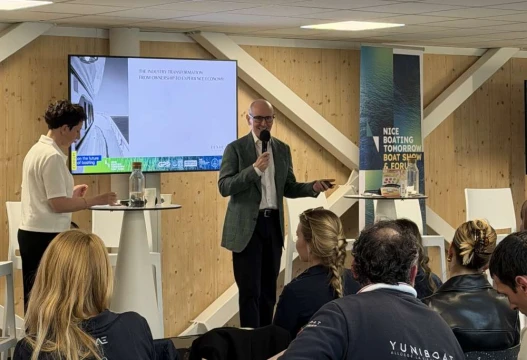
Nice Boating Tomorrow: keynote by Prof. Dr. Phil Klaus, co-founder of Lexden Luxe
Nice Boating Tomorrow: future yacht owners shaped by experience and AI


On the 19th of March 2026 at Nice Boating Tomorrow, Prof. Dr. Phil Klaus, co-founder of Lexden Luxe, delivered a keynote that challenged long-standing assumptions within the nautica and yachting industry. His intervention focused on a structural shift that is already underway: the transition from a product-driven sector to an experience-driven ecosystem.
However, the industry is not evolving at the pace of its clients and expectations are changing faster than business models.
The vacation business
One of the defining insights of the keynote was the declining centrality of ownership. While yacht ownership remains a powerful symbol, it is no longer the sole aspiration. Charter and fractional ownership, or shared access models are expanding rapidly, opening the market to a broader client base.
This shift introduces a new dynamic, because clients who enter through charter expect the same level of service and personalisation as long-standing owners. In practical terms, the distinction between “owner” and “guest” is becoming less relevant in shaping expectations.
As highlighted during the presentation, boats are increasingly perceived as lifestyle platforms rather than standalone assets. Hence, the benchmark is now being set by the wider luxury hospitality ecosystem.
Converging expectations
A second key finding addressed a deeper behavioural shift. Across segments, from mass affluent clients to ultra-high-net-worth individuals, expectations are converging.
Despite differences in spending power, clients now align around a common set of demands, such as transparency in communication, high levels of personalisation, seamless service delivery, and above all, the removal of friction.
Time has indeed become the defining currency. Clients seek integrated experiences that allow them to maximise the value of their time on and off the water. This expectation extends across the entire ecosystem, from booking and itinerary planning to onboard service and post-charter engagement.
AI as a defining force
Looking ahead, Prof. Klaus highlighted the growing role of artificial intelligence in nautica and yachting.
By 2030, it is projected that 70% of ultra-high-net-worth charter bookings will involve AI touchpoints. Beyond automating processes, these systems will enable predictive personalisation, matching clients with vessels, destinations, as well as experiences based on deeply embedded preference data.
AI will also facilitate the integration of yachting into a broader lifestyle ecosystem, connecting maritime experiences with private aviation and hospitality for broader concierge service opportunities.
The implication is clear: technology is becoming central to how value is created and delivered in the industry.
A changing ecosystem of influence
Yet, this transformation does not happen in isolation. As AI reshapes how experiences are designed and delivered, it also redefines who holds influence within the yachting journey.
New decision-makers are rising. Family offices, charter brokers, captains, and lifestyle curators are playing an increasingly influential role in shaping client choices.
These “gatekeepers” act as trusted advisors, often determining which yachts are considered, how experiences are curated, and which brands gain access to clients. As a result, managing relationships across this network becomes as critical as engaging directly with the end client.
©PressMare - All rights reserved