Ferretti Group 2014–2026: Alberto Galassi’s era between product, industry and global growth
These are crucial hours for the future of Ferretti Group. Today marks the closing of the partial tender offer launched by KKCG, a step that represents only the first stage of a broader process set to continue in the coming days with the presentation of the lists for the renewal of the Board of Directors.
It is within this tight sequence — offer acceptances, definition of shareholding structures and proposals for new governance — that the group’s future balance will be determined. On one side stands reference shareholder Weichai, on the other the group led by Karel Komárek, with a middle ground where institutional investors and private shareholders may prove decisive.
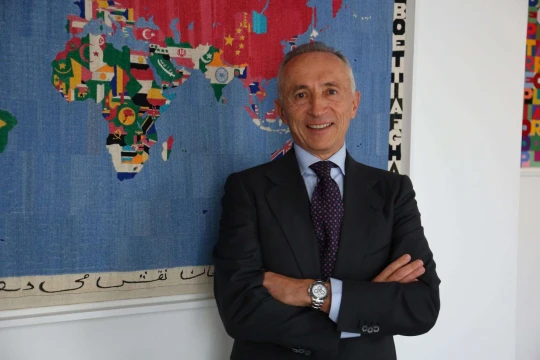
In this context, the position of CEO Alberto Galassi takes on particular relevance. In the confrontation between the two blocs, the manager has so far maintained a formally neutral stance, avoiding direct exposure in the clash between the Chinese shareholder and the Czech entrepreneur’s group. However, beyond formal neutrality, it is evident that his future at the helm of Ferretti Group is one of the implicit — yet central — elements in defining the new balance.
The closing of the tender offer and the subsequent submission of board lists will therefore mark the transition from a predominantly financial phase to a fully industrial and strategic one, where not only the composition of the board but also the group’s operational direction for the coming years will be defined.
It is precisely in light of this transition that revisiting the twelve years of Galassi’s management, from 2014 to today, becomes particularly relevant: a period that saw Ferretti Group move from financial distress to a position of leadership in the international yachting industry, through a structured path of industrial recovery, product development and global growth.
When the Chinese group Weichai acquired Ferretti in 2012, the company was heavily indebted and close to default. The financial intervention — approximately half a billion euros — proved decisive in preventing its collapse. However, the deal was structured with a clear objective: preserving the Italian identity of its brands. The market would not have accepted a luxury yacht perceived as “Chinese”. The strategy was therefore clear: capital and financial strength from China, identity, design and nautical culture from Italy.
Under the leadership of CEO Alberto Galassi, the Italian management safeguarded the product’s DNA: craftsmanship, build quality and the Italian lifestyle that remains a key factor in sales. The model worked. The group regained competitiveness and in 2025 recorded revenues of approximately €1.23 billion, with an order book at historic highs.
When Galassi took over in 2014, the group was in a complex phase, with negative margins and financial results far from balance. Revenues stood at €281 million, while losses exceeded €50 million, clearly indicating the need for structural intervention beyond mere financial rebalancing.
The starting point of the turnaround was twofold: on one hand, the strengthening of capital supported by Weichai, with an €80 million capital increase and additional resources; on the other, an industrial strategy focused on product development and design capabilities as the main lever to regain competitiveness.
It is precisely on product that the first shift took place. As early as 2015, the group launched an unprecedented development plan, investing heavily in new ranges and bringing 27 models into production. This was not just a quantitative expansion, but a redefinition of the industrial platform, covering a wider range of sizes and segments - from flybridge yachts to sports models and long-range displacement vessels.
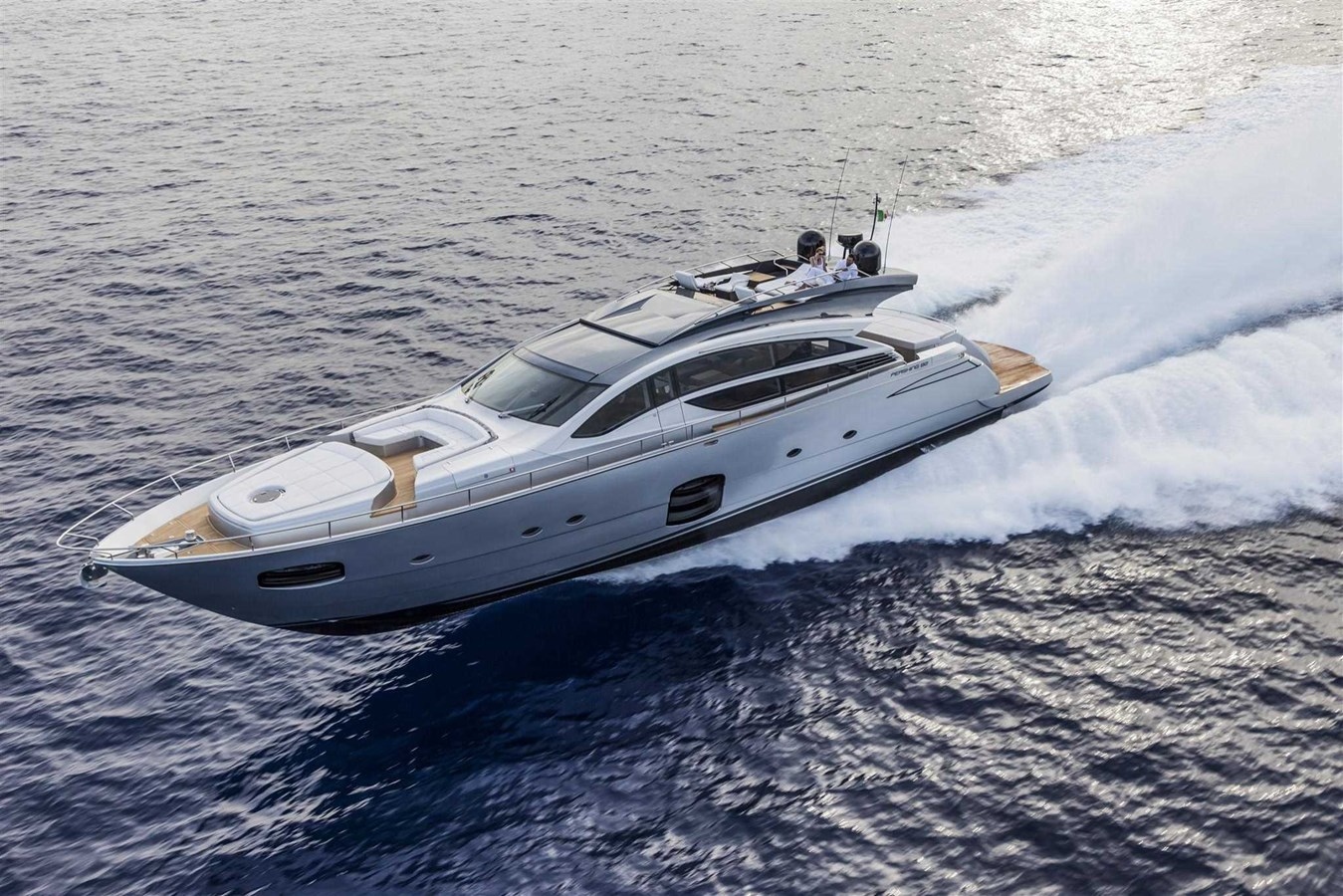
Projects such as the Pershing 82, introduced in 2016, embody this new phase, combining planing hulls, surface drives and speeds exceeding 45 knots with automated trim systems that optimize efficiency and dynamic performance.
At the same time, in the displacement and semi-displacement segment, Custom Line developed platforms such as the Navetta 33, designed for long-range cruising, focusing on autonomy, stability and onboard volume.
This dual trajectory — performance on one side, comfort on the other — became a defining element of Ferretti’s positioning, allowing the group to cover multiple segments without losing design coherence.
Results quickly followed. EBITDA turned positive in 2015, while in 2016 the group returned to profit for the first time since 2008, with €14 million and EBITDA exceeding €50 million. Production value surpassed €560 million, confirming that the turnaround was supported by real industrial recovery.
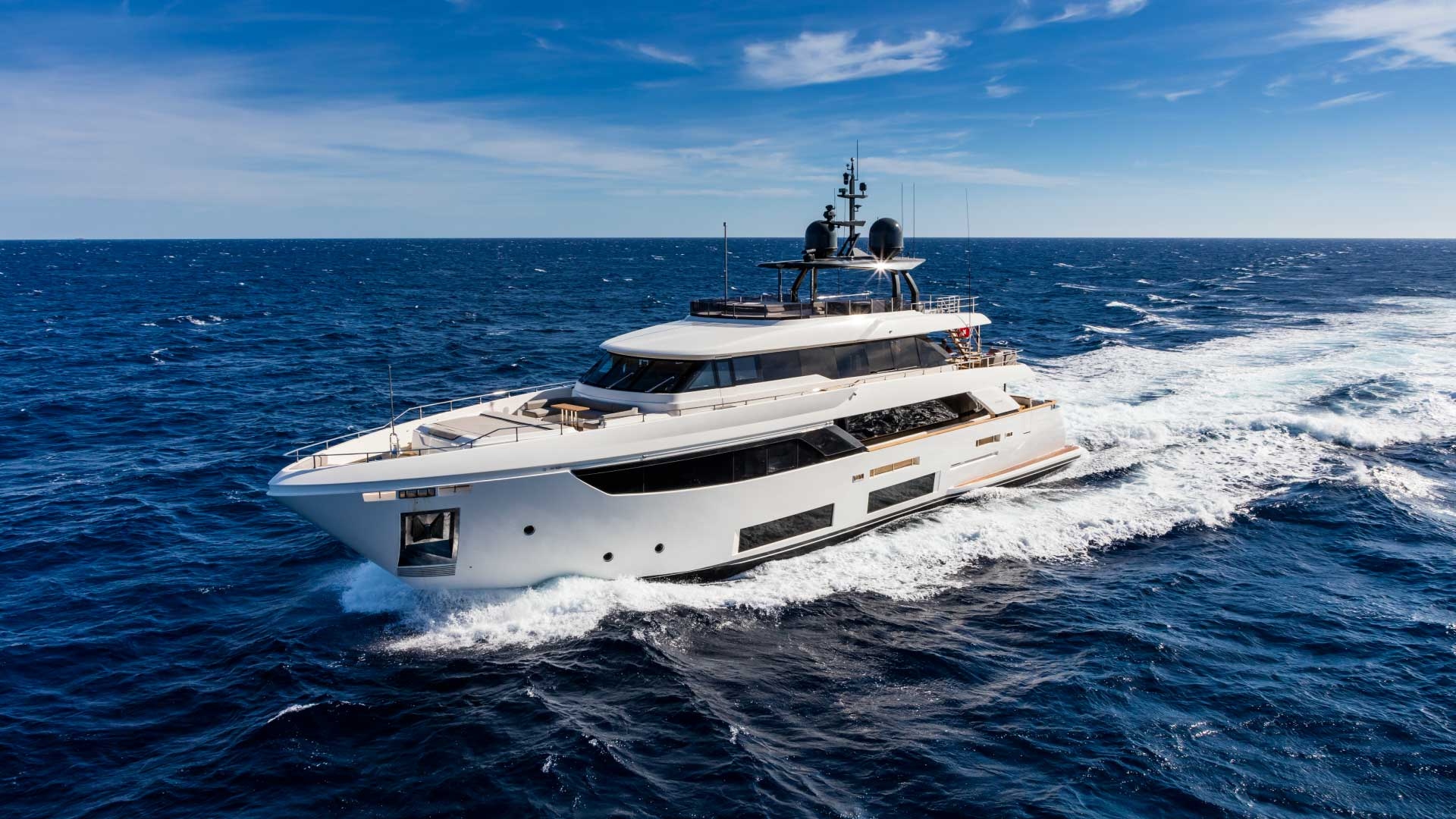
At the same time, in the displacement and semi-displacement field, Custom Line developed platforms such as the Navetta 33, designed for long-range cruising. Here the focus shifted to range, stability and interior volumes, with optimized hulls and multi-deck layouts reflecting growing attention to onboard livability.
This dual trajectory — performance on the one hand and comfort on the other — became one of the structural elements of Ferretti’s positioning, allowing the group to cover different segments without losing design consistency.
The results of this strategy became visible in a short time. In 2015 EBITDA returned to positive territory, while in 2016 the group recorded its first net profit since 2008, at €14 million, with EBITDA above €50 million. The growth in production value, which exceeded €560 million, confirmed that the turnaround was not merely accounting-based, but supported by a real industrial recovery.
At the same time, a plan to strengthen the production structure took shape. The Ancona shipyard, intended for the larger units, was progressively developed as an industrial hub for composite, steel and aluminium yachts, with an increasing concentration of the activities linked to the group’s brands. This process marked an important transition: from a fragmented structure to a more integrated production platform, capable of handling complex programmes and increasing economies of scale.
The years 2017 and 2018 represented a period of consolidation. The main financial indicators continued to improve, with net profit rising above €30 million and production value approaching €700 million.
But it was above all on the industrial and strategic side that the group made a further leap. The acquisition of Wally, completed in 2018, brought into the portfolio a brand characterized by a strongly innovative design approach, capable of anticipating trends and influencing the group’s other ranges as well.
This operation was not an isolated one, but part of a broader vision that in the following years would lead to stronger vertical integration of the supply chain, also through the acquisition of strategic suppliers and the direct development of production expertise.
By the end of 2018, Ferretti Group was no longer simply a company in recovery mode, but a business that had rebuilt its own industrial identity. The turnaround was based on a combination of factors: a renewed range, a stronger production structure and a coherent strategy that placed product at the centre, as the point of synthesis between design, engineering and market positioning.
At the end of the 2014–2018 four-year period, Ferretti Group had completed a key transition: from a phase of financial difficulty to a newly solid industrial structure, supported by a renewed range, substantial investments and a clear strategic direction.
The turnaround was now behind it. But it was precisely from that moment that the most interesting phase began.
In the following years, the group accelerated further, bringing to market models destined to redefine their respective segments — from Riva open yachts to new-generation Ferretti Yachts platforms and Pershing’s sporting evolution — while on the industrial side a more integrated production system took shape, with expanded shipyards and new acquisitions within the supply chain.
It was also the period in which Ferretti strengthened its presence in international markets and laid the foundations for the step change that would, within a few years, lead it to exceed one billion euros in revenues and achieve a dual listing on the financial markets.
In the second part, we analyse this expansion phase: the most representative models, the evolution of the shipyards and the strategic operations that transformed Ferretti into a global player in yachting.
©PressMare - All rights reserved