
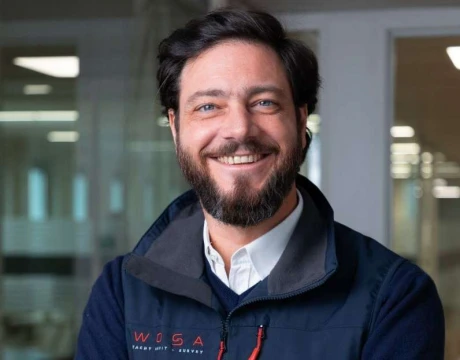
Stefano de Vivo, Executive Chairman of WOSA and President of the Superyacht Life Foundation
Sustainability in yachting, Stefano de Vivo: a lot has already been done, but it is poorly communicated
The panel “Redefining Luxury, Episode 2: From ambition to implementation - How Italian excellence is shaping the path toward responsible interiors”, organized by Smart Interiors Horizon, featured Stefano de Vivo, Executive Chairman of WOSA and President of the Superyacht Life Foundation.
SIH, a committee under the Water Revolution Foundation, brought the topic of sustainability in interiors and the yachting supply chain to SEAQUIP Milano 2026, offering a clear assessment of the concrete steps already taken by the industry, yet still poorly communicated.
PressMare - Stefano, during the panel you highlighted how the yachting industry has already made concrete progress in sustainability, but that this is not being communicated properly. Why?
Stefano de Vivo - Often because we take it for granted. There is a tendency to focus on stronger messages, such as net zero, while many concrete actions are undervalued. Yet those are precisely the ones that make a real difference.
In recent years, many shipyards, both large and small, have invested in reducing environmental impact not only of the final product, but also of the production process. For example, the evolution of paints, which are now far less impactful than in the past, or the materials used in fiberglass, which have become significantly less aggressive.
At the same time, several shipyards have invested in autonomous energy production, solar panels and systems to reduce consumption during construction. The problem is that all this is rarely communicated.
PM - So is it more a matter of communication or priorities?
SdV - Both. Communicating these activities requires time and resources, and often does not generate an immediate commercial return. As a result, budgets are allocated to activities more directly linked to sales.
In the yachting sector, most communication investments are concentrated around boat shows, where the finished product is presented. That is where the commercial game is played. However, I believe a change of approach is necessary. If we do not communicate what we do, we risk leaving space for distorted narratives.
PM - How important is the role of initiatives such as the Superyacht Life Foundation in this context?
SdV - It is fundamental. Yachting depends directly on the marine environment. Without the sea, the industry simply would not exist. This should be a shared starting point.
Initiatives like the Superyacht Life Foundation help build awareness, both within the industry and externally. It is about laying the foundations for the future of the sector.
PM - In your daily work, how do you integrate these principles?
SdV - In a very practical way. In refit projects, for example, we propose solutions to owners and captains that can reduce environmental impact, both in terms of emissions and onboard environmental quality.
We try to work with local suppliers, between Livorno and La Spezia, to reduce transportation. When we use temporary covers, we collaborate with partners who recycle materials. These are small actions, but collectively they make a difference.
We also connect clients with specialists and technologies that can improve the environmental performance of the vessel.
PM - When choosing between different solutions, what really drives the owner’s decision?
SdV - More than cost, it is often time. Refit work must be completed during the winter months, when the yacht is not in use. That is the real constraint.
That said, owners are becoming increasingly aware. If the cost difference is not excessive, they tend to accept solutions that improve environmental impact or onboard quality of life.
There is also a very concrete aspect: the internal environment. Materials, paints and finishes directly affect onboard comfort, and the owner is the first to benefit from that.
PM - What role do certifications play in material selection?
SdV - They are a prerequisite. In our work we constantly interact with classification societies such as RINA, Lloyd’s or DNV, so compliance with certifications is part of the process.
Beyond mandatory certifications, we also verify aspects such as material origin, use of certified resources and supply chain sustainability.
We do this regardless of whether the client explicitly requests it. It is part of our approach and of the type of clientele we work with.
PM - During the panel, the “social” dimension of sustainability was also discussed. Is it still underestimated?
SdV - Definitely. There is a lot of focus on the environment, but much less on people. Yet in our sector, it is a central element. The quality of what we deliver depends directly on the workforce. Achieving such high levels of craftsmanship requires a healthy, safe and well-organized working environment.
Many owners, during construction, pay attention to this: working conditions, yard organization, overall atmosphere. All these elements influence their perception of the project.
There is also a strong link with the territory. In Italy, we have a tradition, a culture of craftsmanship and a network of skills that are not easily replicable elsewhere.
The change is already underway, often in a quiet and not very visible way.
Today, the real difference lies in the ability to communicate it, because giving visibility to what actually works also helps redefine the perception of the entire sector.
And that is where the real challenge lies: between what is done and what is understood.
Rebecca Gabbi
©PressMare - All rights reserved