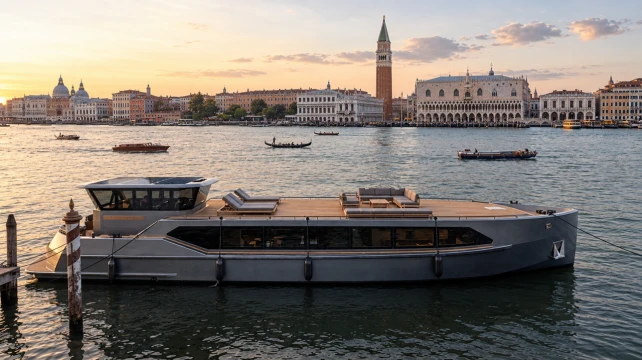
Contemporary Barge: Gian Paolo Nari Brings Yacht Design Language to Europe’s Canals


A 19.90-metre by 4.85-metre project conceived to move between inland waterways and the sea. The Contemporary Barge was born from an idea by yacht designer Gian Paolo Nari and Lorenzo Cappugi, consultant and surveyor, with the aim of reinterpreting a historically functional type of vessel through the language of contemporary yacht design. Cantieri Navali di Termoli was subsequently brought into the project as a potential construction partner.
A barge capable of cruising Europe’s canals, reaching the heart of a capital city and, at the same time, leaving inland waterways to undertake coastal navigation. This is the idea behind The Contemporary Barge.
The concept emerged from the combined expertise of Gian Paolo Nari, a yacht designer with extensive experience in exterior styling and custom projects, and Lorenzo Cappugi, consultant and surveyor. From the outset, the objective was to rethink the barge not only from a design perspective, but also by considering the technical and operational aspects that determine how and where such a vessel can actually be used.
At a later stage, Cantieri Navali di Termoli was brought into the project as a potential construction partner. The shipyard contributes its experience in building steel and aluminium vessels, ranging from commercial craft to large yachts.
The starting point is a type of vessel far removed from the conventional yacht. Historically, barges have been craft in which functionality, cargo capacity and compatibility with inland navigation have taken precedence over design. Nari chose to work precisely on this characteristic, applying the language of contemporary yacht design to what is essentially a highly rational platform.
This approach is consistent with the designer’s experience in yacht design, exterior styling and custom projects, including the exterior design of the 59-metre explorer yacht Akula.
The objective is to move beyond the traditional yacht concept, combining the strength of established shipbuilding methods with modernity, comfort, design and Made in Italy elegance.
19.90 x 4.85 metres: dimensions become part of the design
One of the most interesting aspects of Nari’s work is not immediately apparent from the renderings: the dimensions are not simply dictated by the desire to maximise space on board.
The four concepts developed during the initial phase measure 19.90 metres in overall length and 4.85 metres in beam, with a full-load draft of 1.20 metres and an indicative air draft of 3.40 metres from the waterline to the hardtop. Together with careful control of the vessel’s overall proportions, these dimensions were selected to make the project compatible with the Freycinet gauge and navigation across the European canal network.
A constraint therefore becomes a design parameter.
There remains considerable scope for customisation, but dimensions, draft, height and overall configuration also have to be defined according to the routes on which the barge is actually intended to operate. This principle is integral to the project philosophy: the dimensional and architectural constraints associated with navigating European canals become part of the vessel’s design from the outset.
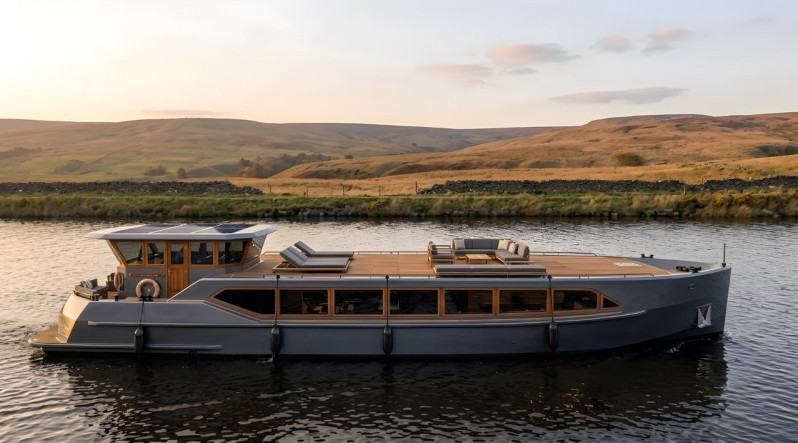
From the canals to the Mediterranean
This is where The Contemporary Barge moves furthest away from the image of a traditional houseboat.
According to the design specifications provided by Nari, the steel hull and hull form are being conceived with CE Category C/B certification in mind, with the objective of allowing mixed use between inland waterways and marine navigation.
The principle is straightforward: a vessel could, for example, cross France using the inland waterway network before entering the Mediterranean and continuing along the coast or undertaking short sea passages, such as a crossing to the island of Elba.
The propulsion concept follows the same philosophy. The configuration currently under study envisages a series-hybrid electric system, either diesel-electric or fully electric, with two 80 kW electric motors and a 45 kW generator/range extender. The projected cruising speed is between 7.5 and 8.5 knots, with an indicative maximum speed of 10.5 knots. A traction battery pack, roof-mounted photovoltaic panels and shore power connection complete the proposed energy architecture.
The transition from inland waterways to the sea is therefore not a secondary capability, but one of the elements around which the project has been conceived. The official presentation also emphasises this evolution: the barge is no longer intended exclusively for rivers and inland waterways, but as a nautical platform capable of extending its operating range to marine navigation.
The result is a vessel that does not fit easily into traditional categories. It is not intended to replace a motor yacht in terms of performance, nor is it simply a floating home. Instead, the concept focuses on the possibility of using the same platform in very different environments.
A “floating penthouse” in the heart of the city
This is perhaps the characteristic that best explains the concept envisioned by Nari and Cappugi.
A barge of this kind can be considered a floating penthouse, capable of becoming a temporary or permanent private residence within cities crossed by major waterways.
Paris and London are two immediate examples of the type of use envisaged: an owner or executive could have a private base on the water while retaining the ability to relocate it and use it as a genuine cruising vessel.
The project is also conceived to be operated and enjoyed directly by its owner, without necessarily requiring a permanent professional crew. Owner autonomy and the freedom to choose routes, timing and ways of using the vessel are among the defining elements of this new interpretation of the barge.
The GA reveals a home as much as a boat
The general arrangement developed for one of the concepts makes this approach particularly clear.
The main accommodation is arranged on the lower deck around a large central living area with lounge and dining space, alongside the galley. The sleeping area comprises two cabins, with the owner’s cabin positioned forward.
One of the more unusual features is the relationship between the master cabin and the bow: the owner’s area provides access to a private outdoor lounge, creating a clearly separated space from the larger communal areas on the upper deck.
Aft, the technical equipment and engine room are concentrated in a dedicated area, separating the vessel’s machinery from its residential spaces.
The wheelhouse is positioned on a raised level towards the stern, a choice driven primarily by the requirements of inland navigation and the need for good visibility during manoeuvring and when negotiating confined passages.
Above, the deck becomes almost entirely a large terrace. A dining area, sofas, chaise longues and generous open spaces turn the sun deck into the vessel’s principal outdoor living area.
The 4.85-metre beam creates an effect quite different from what would normally be experienced aboard a yacht of around 20 metres: the available surface is used according to a logic closer to residential architecture than to the conventional division of spaces aboard a yacht.
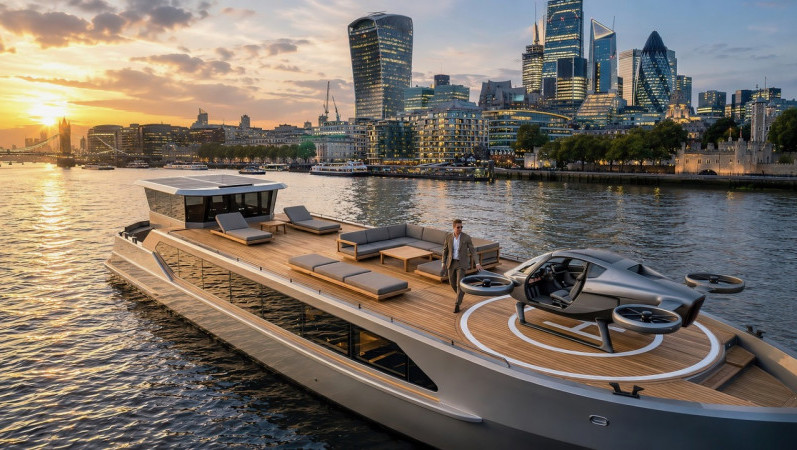
The sun deck is also conceived with eVTOL in mind
Nari also introduces an element deliberately looking towards a possible future scenario.
One of the configurations studied includes an area on the upper deck conceived for the landing of a passenger drone/eVTOL, anticipating a possible future integration between the barge and new forms of urban mobility.
This does not mean turning the barge into an operational aviation platform today. Rather, the rendering explores a design scenario. If these technologies become part of future urban mobility systems, a floating residence could potentially become one of the nodes in a multimodal transport network connecting water, land and air.
It is a visionary element, but one that remains consistent with the idea behind the project: taking a vessel type deeply rooted in the history of European navigation and using it to explore much more contemporary ways of living and moving.
A custom platform, not a standard boat
The Contemporary Barge is conceived as a custom platform, allowing exterior styling, interiors, space distribution, intended use and navigation characteristics to be adapted to the requirements of each individual owner.
Cantieri Navali di Termoli, subsequently brought into the project as a potential construction partner, contributes its experience in steel and aluminium vessel construction, while the design brings a language closer to contemporary yachting to this technical platform.
The strength of steel remains one of the central elements of the project, accompanied by the intention to incorporate solutions aligned with the emerging principles of sustainable navigation and green yachting.
The result is therefore neither simply a yacht shaped like a barge nor a more luxurious version of a traditional barge.
The idea is to use the constraints of European inland navigation as design parameters for a new type of vessel, capable of combining navigation, residential space and mobility within the same platform.
Not a floating home adapted for navigation, then, but a vessel designed to transform navigation itself into a new way of living.
Filippo Ceragioli
©PressMare - All rights reserved