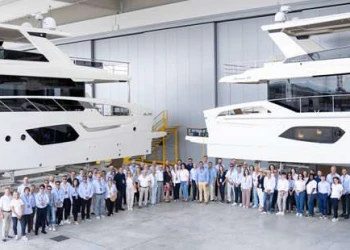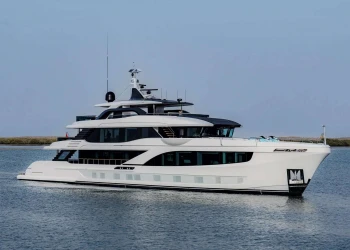
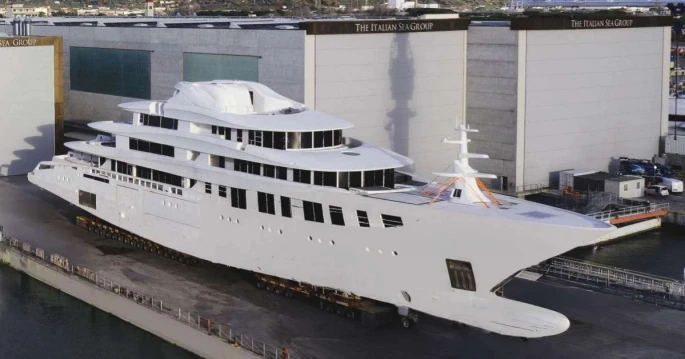
Galileo is a line of 82-metre steel and aluminium megayachts currently under construction at TISG
TISG, two paths for the shipyards: Azimut Benetti targets a restart, SRI Global a relaunch of the brands


For The Italian Sea Group, the outcome will not be decided on price alone. The two binding offers for the entire business, from Azimut Benetti and from SRI Global, reflect two different views of the shipyards’ future: integrating the facilities into an established group, or relaunching the historic brands from scratch. The picture became clearer with an article by Raoul de Forcade in Il Sole 24 Ore, which sets out the plan under which the group led by Giovanna Vitelli would take over the operations of TISG, the company founded by Giovanni Costantino and now in a court-supervised composition with creditors (concordato preventivo). The article confirms the identity of the two parties interested in the whole company, following PressMare’s report on 20 October on SRI Global’s offer, valued at around €260 million, and yesterday’s confirmation by Baglietto of its interest in the La Spezia yard.
According to the financial daily, Azimut Benetti’s project would unfold in two phases. The first involves an immediate restart of production, with priority given to the existing order book, to owners with yachts under construction and to employees, including those in the supply chain. This would be helped by a supplier base already rooted in the area: around 85% of TISG’s suppliers also work with Azimut Benetti, and 70% of the turnover of Azimut, Benetti and Lusben, the group’s refit division, is generated in Tuscany. The overlap would shorten the time needed to reorganise supplies and restart work on the orders. The second, longer-term phase aims at expansion in large custom yachts, a segment in which Benetti already has an established production, and at strengthening refit through Lusben. The sites would be specialised: large custom new builds at Marina di Carrara, refit by Lusben at La Spezia, while the Celi joinery in Terni, which handles fit-out and furniture, would remain in operation. Financially, Azimut Benetti has more than €500 million in its own cash and an order book of around €3 billion as of 31 August, resources that would allow it to fund both the acquisition and the development without external financing.
SRI Global Limited, a holding company linked to Giulio Gallazzi and Bernardo Vacchi, whose offer was first reported by T24, takes a different approach. The roughly €260 million would cover both the acquisition of the assets and the industrial relaunch, but the split between the two has not been disclosed, and that figure is precisely what would show how much money is earmarked for restarting production. The project covers the whole of TISG, with Marina di Carrara, La Spezia and the Celi joinery in Terni, and the absorption of the 485 employees. A central role would go to Vincenzo Poerio, a manager with long experience in large yachts, former CEO of Benetti and now CEO of Tankoa Yachts.
This is where the two operations really diverge. SRI Global would have to invest not only in the facilities and in completing the orders, but also in repositioning Admiral, Perini Navi, Picchiotti and Tecnomar: a heritage of history and technical expertise whose recovery would require rebuilding the trust of owners first, and also that of the brokers who have to sell the boats. Azimut Benetti would instead bring established brands, a structured sales network running at full speed and a working industrial organisation, so that TISG would mainly mean additional production capacity. The first model could preserve identities that matter to Italian shipbuilding and a differentiated offer; the second promises immediate synergies in procurement, organisation and continuity of orders. The difference also shows in the figures: according to information obtained by PressMare, Azimut Benetti’s offer is said to be significantly lower than SRI Global’s, but the two amounts are not comparable, because SRI’s figure includes the budget for relaunching TISG and its brands, which Azimut Benetti’s plan, based on established names, would not require to the same extent. Once that share is deducted, the gap could narrow considerably, although until the breakdown of the €260 million is known the comparison remains an estimate.
The consequences of the choice go beyond the company itself. Suppliers of metal fabrication, systems, propulsion, electronics and fit-out need continuity of production, certainty of payment and a credible order book; how outstanding claims would be handled has yet to be clarified. Owners with a yacht under construction want a counterpart able to guarantee delivery, compliance with specifications and after-sales service, while for new clients the builder’s financial strength weighs directly on contracts worth several tens of millions. As for the workforce, the commitment to maintaining jobs stated in the offers is only a starting point: employment will depend on the buyer’s ability to guarantee stable workloads in the medium and long term.
Initial reactions from the trade unions help to define the differences between the two projects. After meeting first Vincenzo Poerio, for SRI Global, and then Marco Valle, CEO of Azimut Benetti, representatives of the metalworkers’ unions Fim-Cisl, Fiom-Cgil and Uilm expressed a particularly positive view of the latter’s plan. As reported on 21 October by Blue Economy, Bruno Casotti, Umberto Faita and Giacomo Saisi stressed its concreteness: an immediate start of new Benetti-branded builds and of Lusben refit activities, with the prospect of keeping the yards fully loaded for the next five years. The assessment is consistent with what the same unions had been calling for in previous days: avoiding the break-up of TISG and favouring projects able to guarantee orders, investment and industrial continuity as well as jobs. The public statements available so far do not show a formal preference for either bidder for the whole group, but the approval of the Azimut Benetti project is a signal that carries weight in the climate in which the decision will be made.
Five binding offers were received by 19 October: two for the entire business and three for individual assets. Among the latter is the bid from Sanlorenzo, through Polo Nautico Carrara, for the La Spezia yard, alongside Baglietto’s, confirmed yesterday by the builder to Boat International’s BOATPro. According to earlier reports by T24, Fincantieri is also said to be interested in the La Spezia facility. The selection rests with the TISG board of directors, assisted by advisers Meti Corporate Finance and KPMG Advisory and under the supervision of the court-appointed commissioners. It will have to weigh price together with the resources actually committed to the restart, the sustainability of the plans, the guarantees for owners and the employment outlook. More than the headline figure, the decision will turn on the credibility of the industrial project and the strength of the guarantees that accompany it.
©PressMare - All rights reserved