
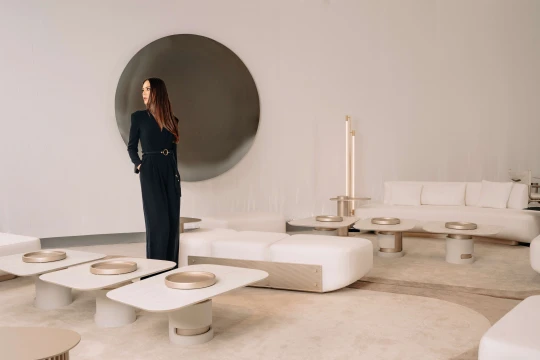
Carla Guilhem, founder and creative director of Carla Guilhem Design. Courtesy of Carla Guilhem Design
Carla Guilhem on designing for the way people live


Ask Carla Guilhem, founder and creative director of Carla Guilhem Design -award-winning interior design studio with offices in Miami and Rome, working across residential and superyacht interiors- to describe her style and she will politely decline. Her work across yachts, residences and developments does not share a signature look; it shares a method. That method started in Brazil, inside her family’s furniture and millwork business. Studying and working in Europe then opened her eyes to the history of architecture, art and design, and to the dialogue between traditional craftsmanship and contemporary design.
Today she moves between superyacht interiors, private residences and her Essenza furniture collection, developed in collaboration with Artefacto Beach & Country.
PressMare: You grew up around your family’s furniture and millwork business in Brazil, then studied and worked in Europe. What did that early experience teach you about materials that still guides your decisions today?
Carla Guilhem: Growing up surrounded by furniture manufacturing gave me a very different relationship with design. I learned to understand not only how something looks, but how it’s made, how materials behave, and how every detail affects the final result. I was exposed to craftsmanship from a very young age, and that gave me a deep appreciation for proportions, construction and the possibilities of different materials.
Europe expanded that perspective, particularly in terms of design history, architecture, and the relationship between traditional craftsmanship and contemporary design. Today I still approach every project with that combination of technical understanding and creativity. I don’t like to design something simply because it looks beautiful. I want to understand how it works, how it feels, and how it will age over time.
That curiosity about how things work shapes the way she listens to clients, too.
© Stuart Pearce / YachtShot
PM: Your practice puts a strong emphasis on reflecting each client’s personality. Can you describe a moment when you challenged a client’s original brief and the result felt more personal to them than what they had imagined?
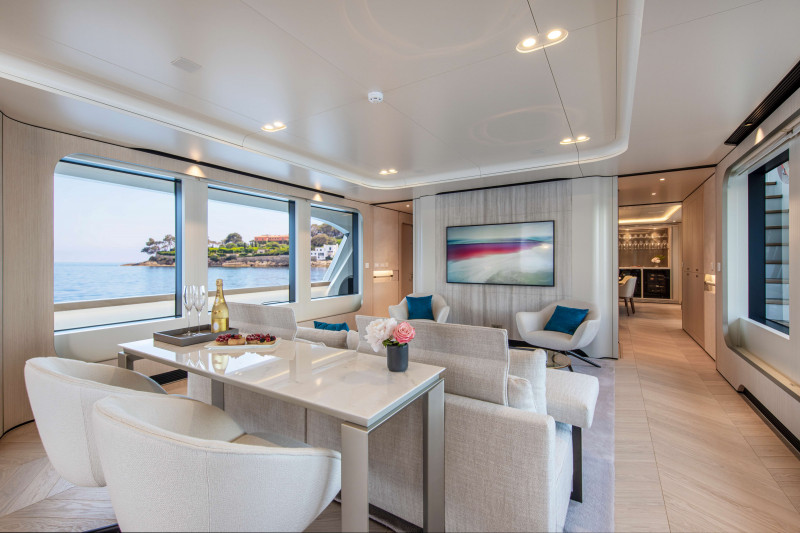
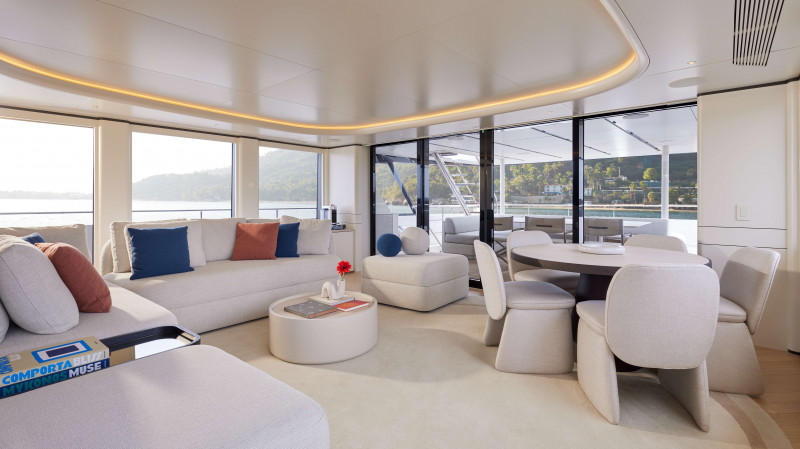
CG: One of the most important parts of my work is understanding what clients want, even when they don’t necessarily know how to express it. Very often they arrive with images of interiors they admire, but those images don’t always represent how they actually want to live. So I like to understand their routines, personalities, habits, and even the things they don’t like. For instance, On ONE, the clients initially came to us with ideas involving strong, hard lines. When I proposed a softer, more comfortable direction, they embraced it and gave us the freedom to develop the concept further.
There was a time when many architects had “a style” and clients came to them for it. I don't impose a fixed aesthetic. Each project develops around the client's way of living and the character of its setting. A house in Aspen will be completely different from a house in Bali or a boat. What matters most is how our design improves the client's everyday life. The most rewarding moment is when a client sees the finished space and realizes it’s something they would never have imagined themselves, but that it reflects exactly who they are.
PM: Nowhere was this tested more than on Lady Lene, a yacht where wheelchair accessibility was one requirement shaping everything. What design decision best illustrates how that requirement helped you create a better interior for everyone on board?
CG: I believe good design should make people’s lives easier without making them constantly aware of the solutions behind it.
On Lady Lene, accessibility was central to the brief. We integrated grab bars into the architecture so they felt like a natural part of the interior, supporting ease of movement while preserving the warmth and comfort of a home. When you design with movement, comfort and accessibility in mind from the beginning, you often create spaces that are more intuitive and comfortable for everyone. The technical solutions should be almost invisible, while the experience of living in the space feels effortless.
PM: If Lady Lene was about making function disappear, the next project was about creating a feeling. ONE draws on references to the Moon and Mars, with sculptural furniture and imperfect geometric forms. How did you turn that otherworldly inspiration into somewhere people would feel comfortable living for weeks at a time?
CG: For ONE, the idea was never to create a futuristic interior in the traditional sense. I wanted to explore the feeling of being somewhere different, almost disconnected from the outside world, but still completely comfortable. The references to the Moon and Mars came through shapes, textures and materials rather than literal interpretations.
I worked with sculptural forms, soft curves and a very controlled colour palette, built on oval, not-quite-round shapes in a monochrome base with touches of orange, brown and light cream. I’m particularly interested in how our surroundings affect our emotions and well-being, and when you’re spending weeks on board, visual comfort becomes extremely important. That’s why I prefer spaces without too many distractions, where materials, lighting and proportions work together. I wanted ONE to feel almost like a sanctuary, meaning visually distinctive, but also very peaceful and natural to live in.
© Visions.nl
PM: You’ve taken ideas from residential interiors into yachts, and brought yacht-inspired furniture back to land through your Essenza collection. What has designing for life at sea taught you that you now apply to a home or a single piece of furniture?
CG: Designing yachts has made me much more conscious that every element of a space needs a purpose. On a yacht you have to think about movement, proportions, functionality, comfort and the relationship between different environments in a much more precise way. Designing for a yacht requires particular attention to space, materials and weight. I bring that awareness into the furniture, from how each piece is secured to its materials and softened edges. On a boat, with a little movement, you hit your knee on a sharp corner. In a house, that same detail is a plus.
But I don’t believe functionality should compromise creativity. Limitations can push you to develop more interesting solutions. With Essenza, I wanted to translate those principles into individual pieces. Sculptural forms, carefully considered proportions, beautiful materials, and details that are not immediately obvious but make a difference in how you experience the furniture.
For me, whether I’m designing a 60-metre yacht, a residence or a single chair, the philosophy is the same. Design should be beautiful, but it should also feel natural, comfortable and timeless.
Rebecca Gabbi
©PressMare - All rights reserved