Nuova Jolly Prince 33 CC
Nuova Jolly Prince 33 CC with twin Mercury Racing 400s: the sea trial


For some owners, speed is more than a performance figure. It is part of how they understand luxury and exclusivity. Boating shares this with the world of sports cars, where power and performance set a vehicle apart even when the chances to use them are limited. The owner of this Nuova Jolly Prince 33 CC is one of them: an enthusiast of sporty machines who wanted his RIB to follow his preference for the most powerful versions. He chose to fit two Mercury Racing 400 outboards on the transom, 800 hp in total. That is more power than the yard itself considers ideal for this model.
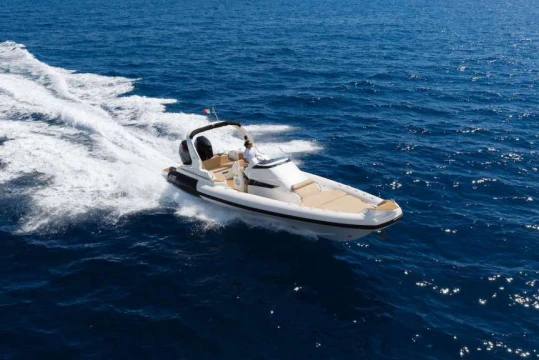
According to Nuova Jolly's own measurements, the result is an inflatable boat capable of 61-62 knots, a speed that calls for experience and care at the helm. Describing the Prince 33 CC only through the 800 hp of its two Mercury V10s would, however, miss the point. The project is built on a philosophy that puts ride comfort and the use of the outdoor spaces first, with a deep-V hull and a deck layout designed to make the most of the available dimensions. PressMare examined and tested this particular boat in the waters off Marina d'Arechi, in Salerno.
A centre console built for life outdoors
The Prince 33 CC is a RIB with a certified length of 9.80 metres, rising to 10.50 metres including the swim platforms. This keeps it in the Italian "natante" category, which covers craft under 10 metres that do not require registration, while its size and spaces allow for varied use, from day trips to long stays at anchor.
The centre console layout reflects a clear design choice: outdoor space takes priority over interior volume. In the Nuova Jolly range, the model sits alongside the Prince 33 Sport Cabin, which in the same size bracket follows a different approach, with more attention to the accommodation below deck and to cruising.
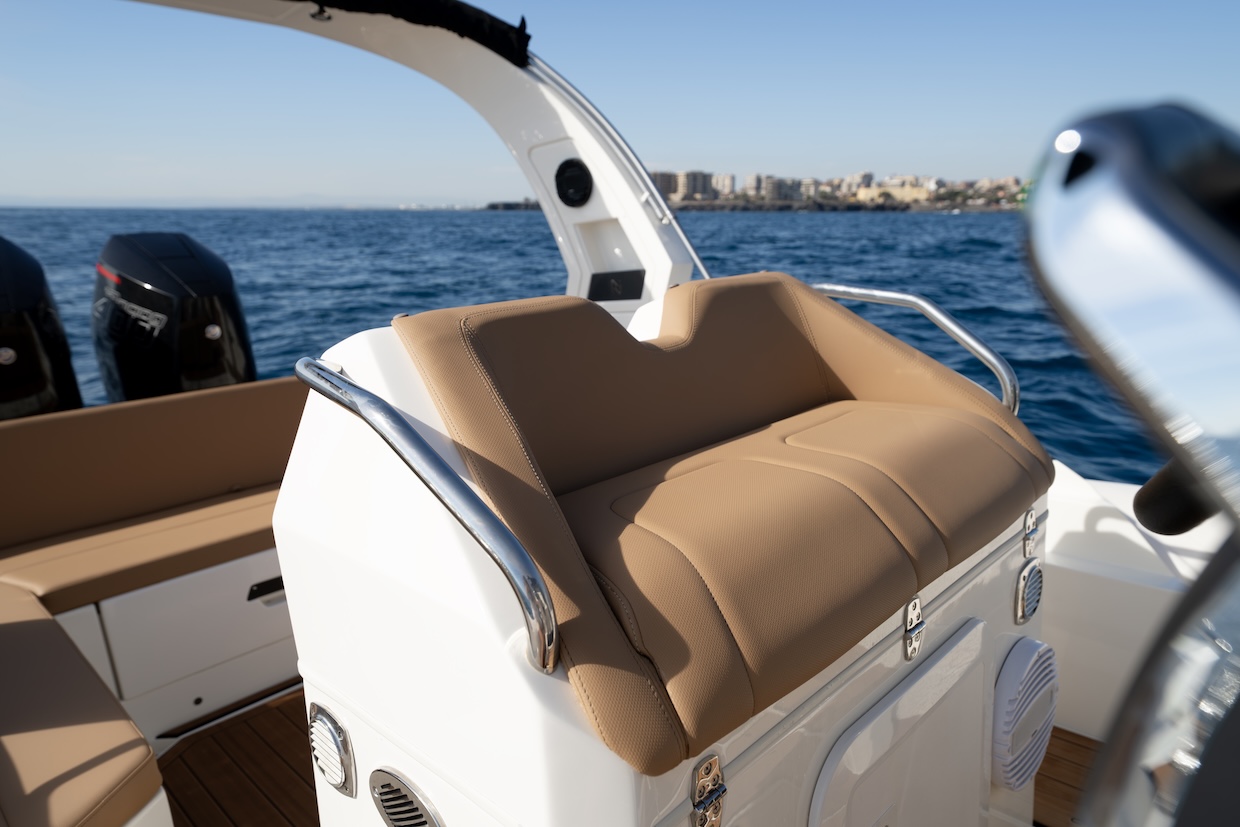
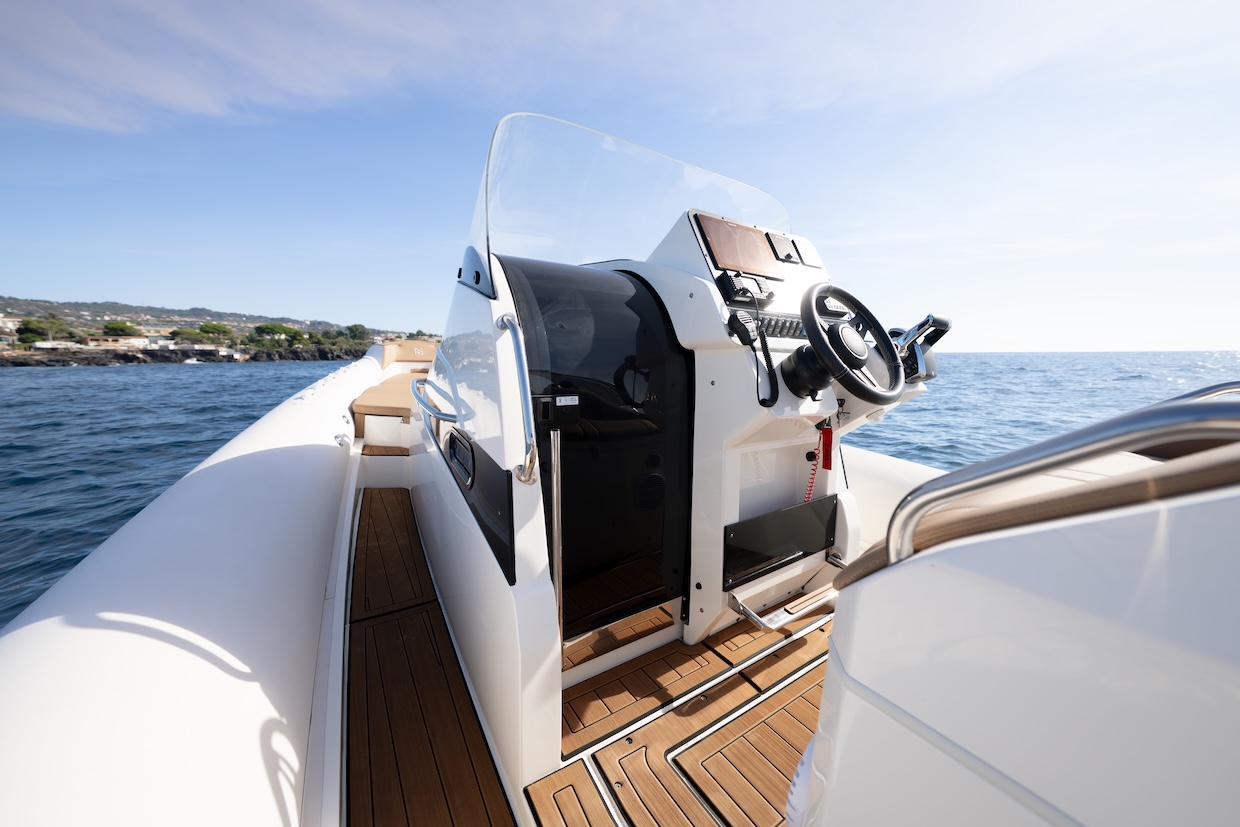
The Prince 33 CC is aimed instead at owners who spend most of the day outdoors and use the cabin as a complementary space for resting or for an occasional night on board.
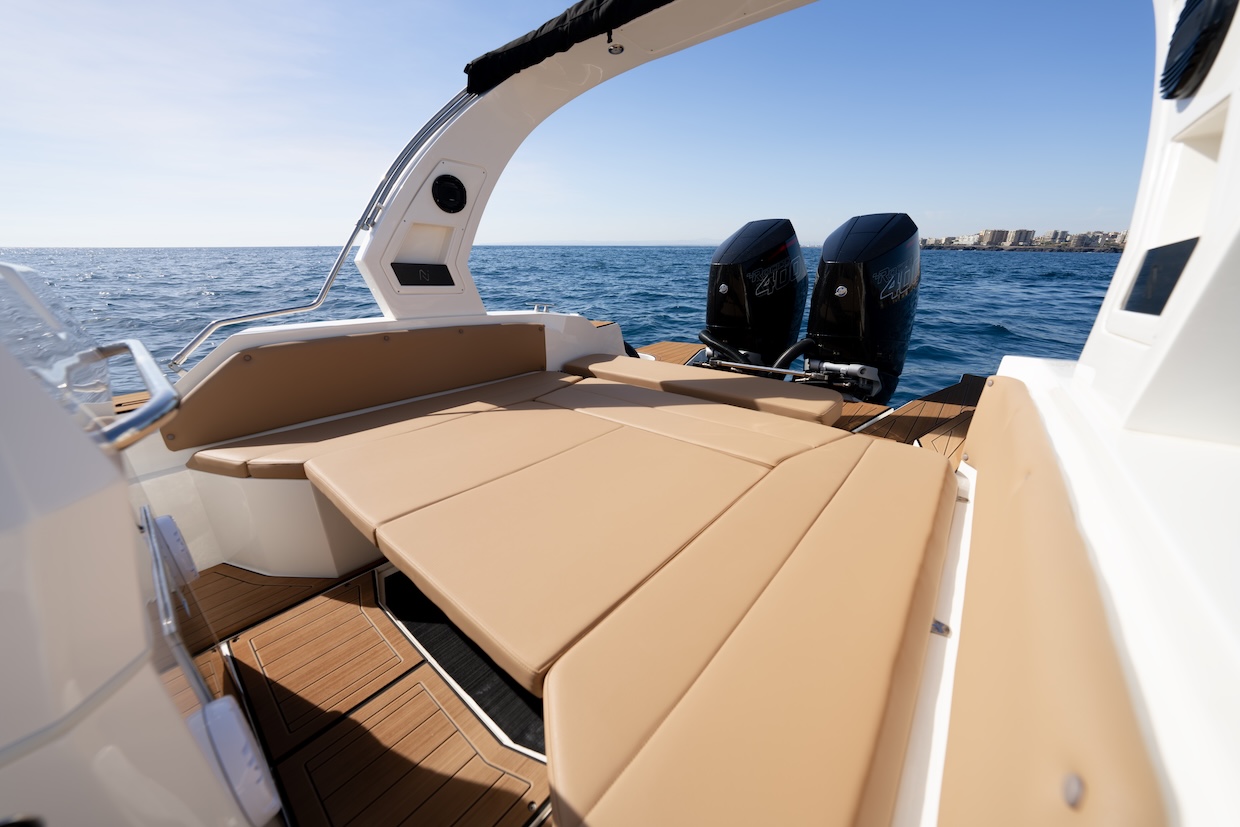
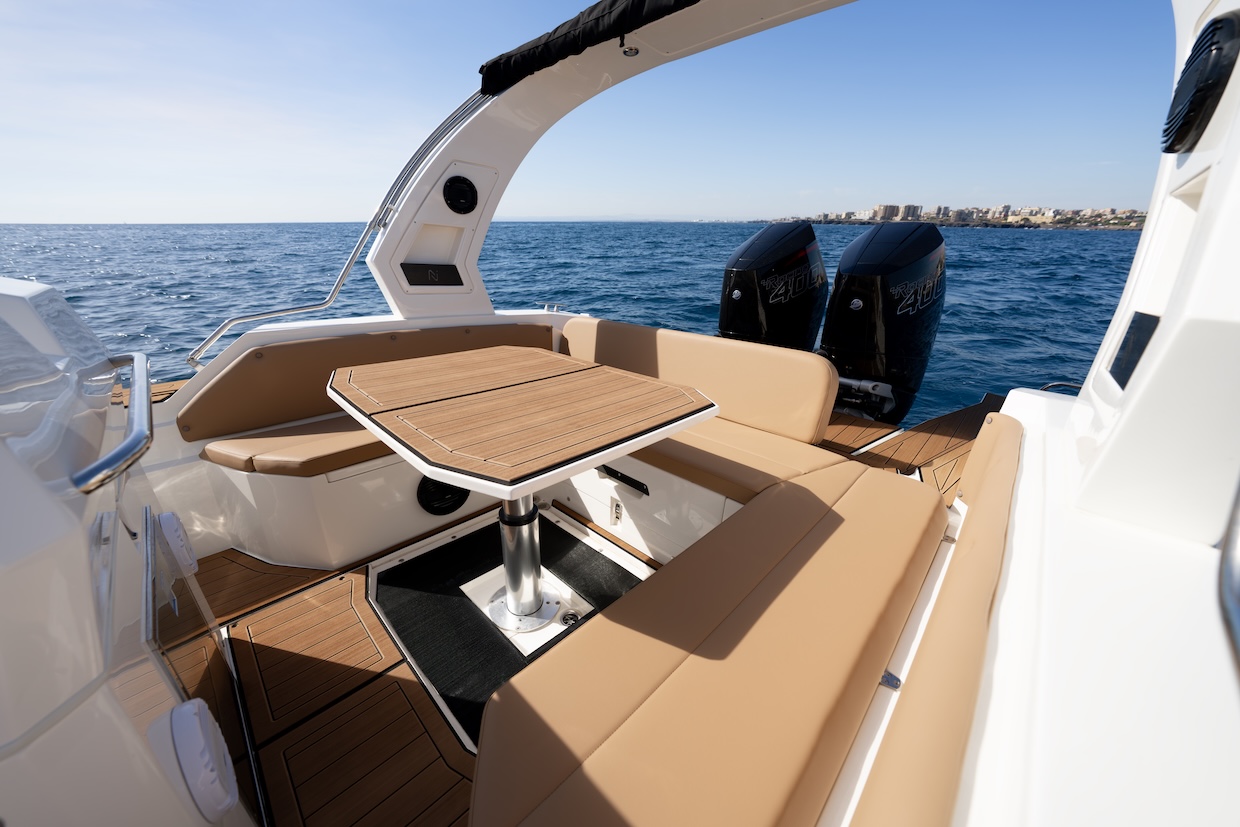
The aft area is organised around a dinette that seats six comfortably, and up to eight depending on the make-up of the crew. In the centre is an electrically operated table that can be lowered to seat level. In this position, with the addition of cushions, the whole area becomes a sunpad.
The lounging area can be extended further by folding the backrest of the aft sofa towards the engines, which brings an additional portion of the cockpit into use. It is a simple system that allows the layout to be changed quickly, depending on whether the space is used for socialising or for sunbathing.
A second sunpad is located forward of the console, following the sloping shape of the front of the cabin. The form of this area also accommodates a chaise longue, creating a relaxation zone separate from the aft dinette.
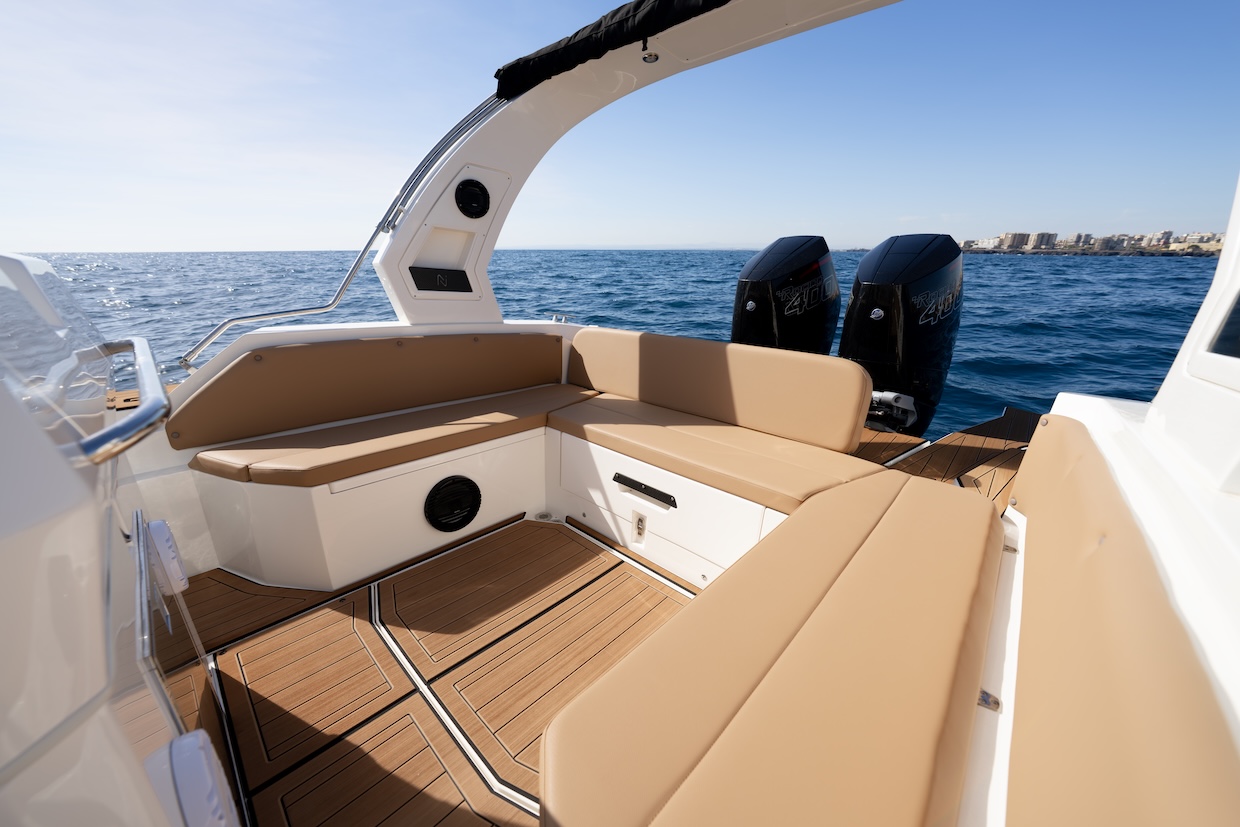
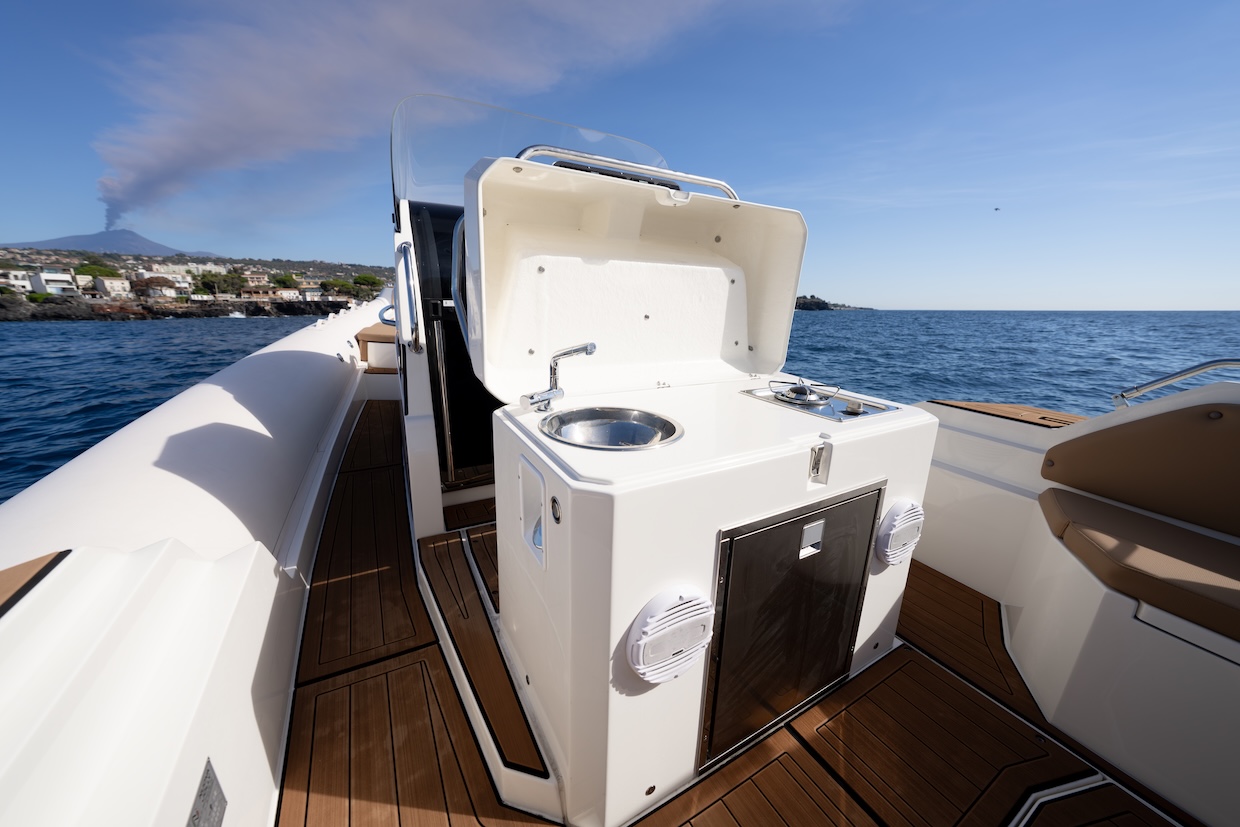
The outdoor equipment also includes a unit with a fridge, sink and cooker, which makes time on board more comfortable during stops at anchor and allows simple meals to be prepared without going ashore.
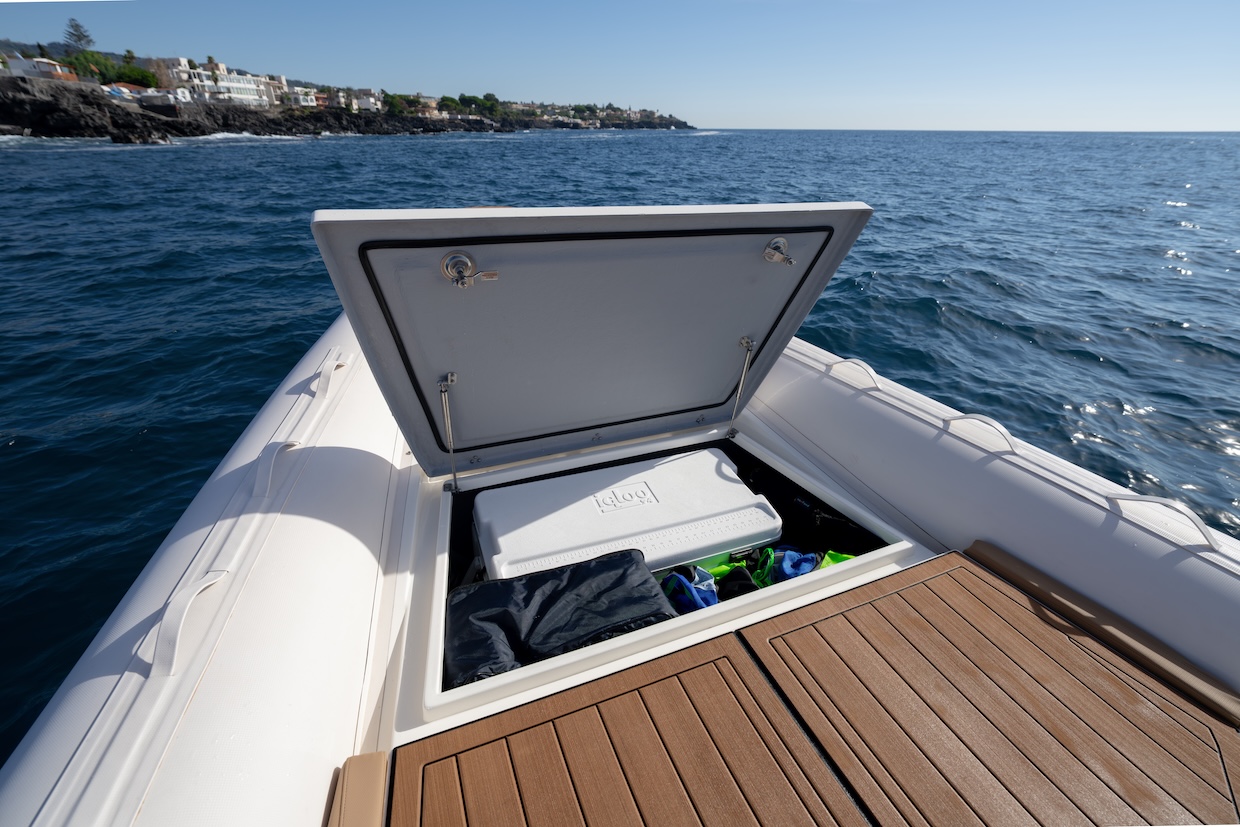
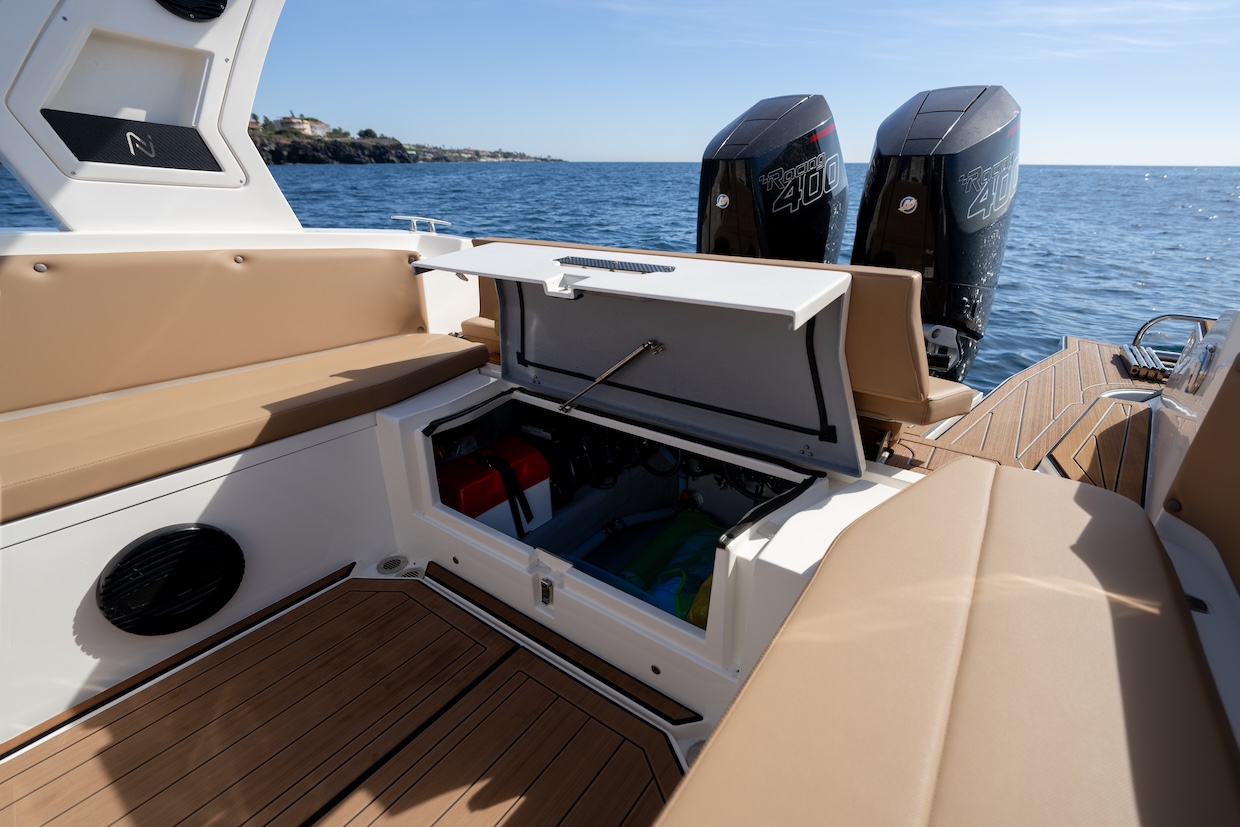
Nuova Jolly paid particular attention to storage. The yard chose to limit the number of lockers in favour of larger compartments that are easy to reach and to use. Rather than multiplying hatches and small compartments, it opted for generous volumes to hold equipment and onboard gear.
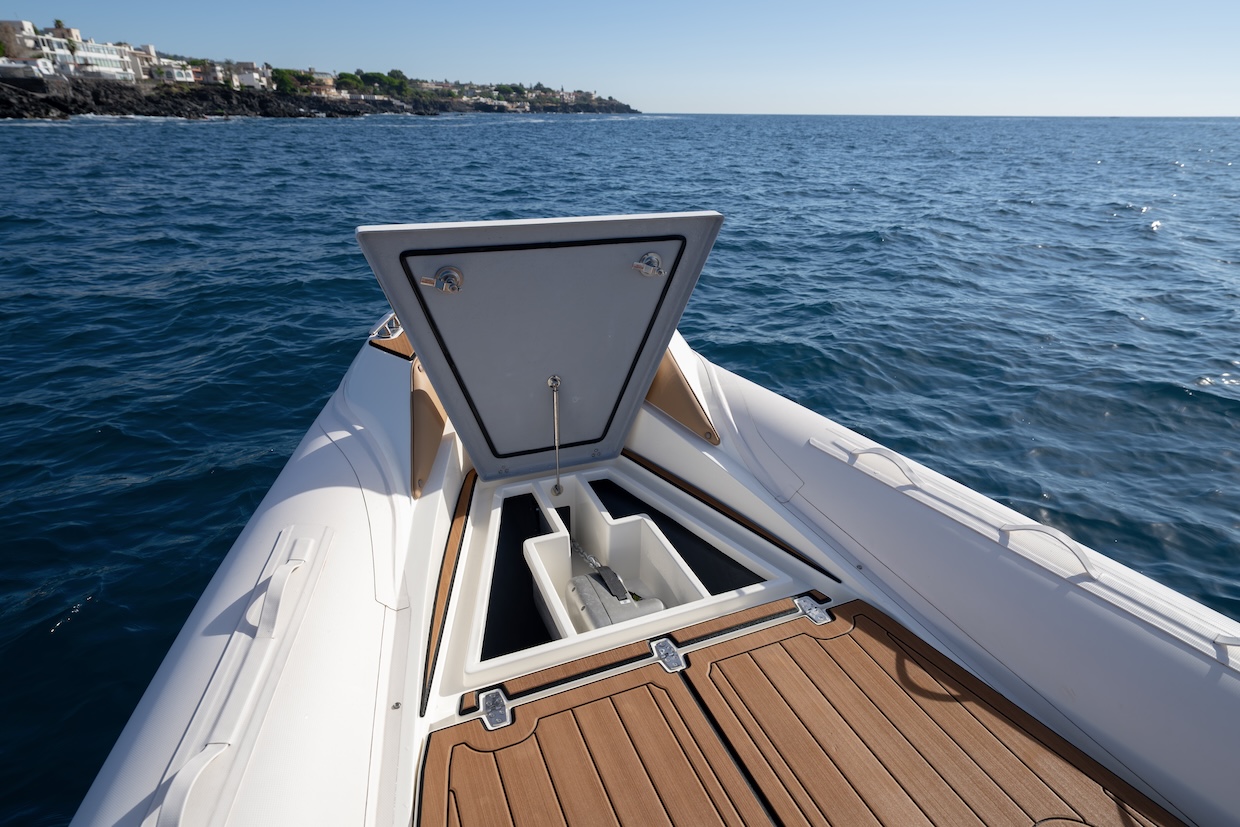
Under the forward sunpad there are two lockers, one of them dedicated to the anchoring system. The anchor is housed in a hawse pipe, with the chain fed inside the hull. The same area provides space for fenders, lines and other equipment.
The swim platforms, which ease access to the water as well as boarding and disembarking, are standard.
For sun protection, the Prince 33 CC can be fitted with different solutions. The boat tested has a fibreglass roll bar, but a T-top or a stainless steel roll bar are also available.
Below deck, two berths and a separate head
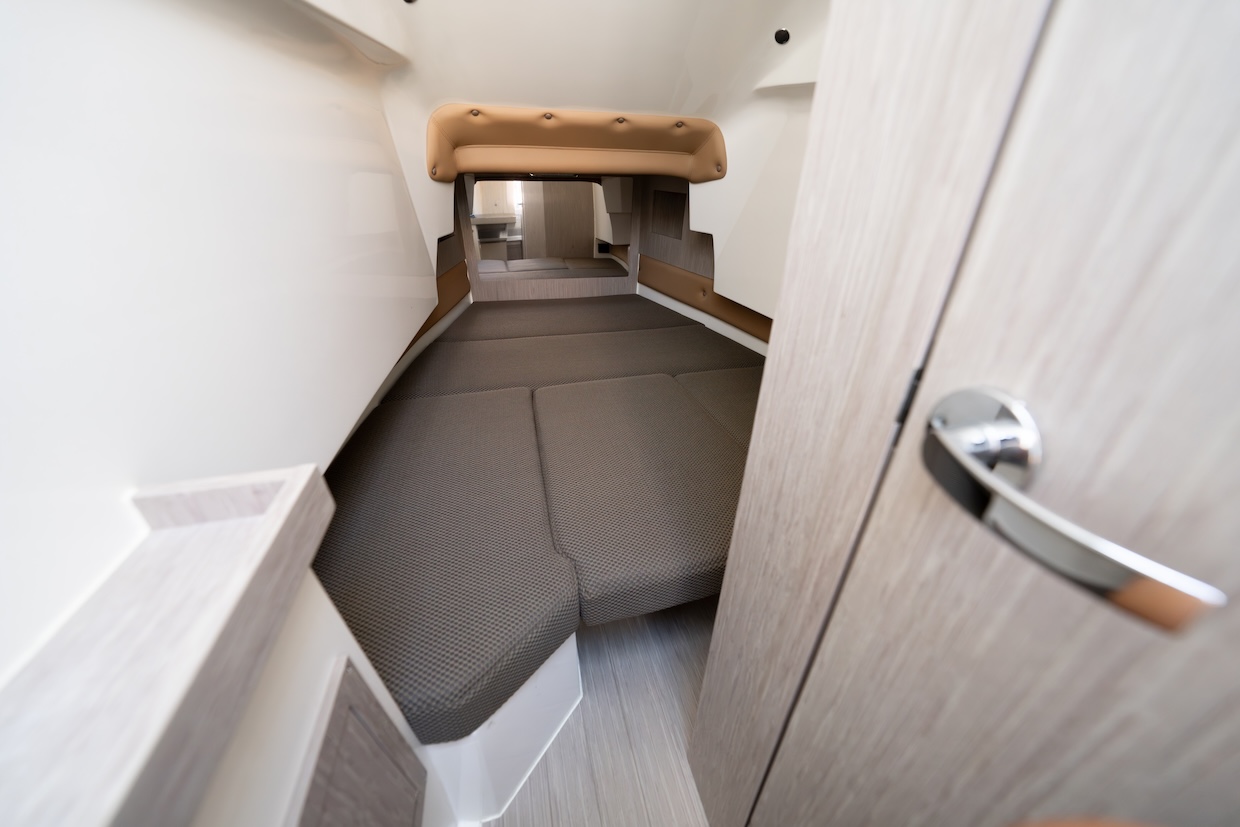
Although the design favours the outdoor spaces, the Prince 33 CC offers a cabin that broadens its range of use. It has two berths, allowing a couple to spend the occasional night on board, for example during a stop at anchor. It can of course also be used for an afternoon rest or as a sheltered space when needed.
The boat was not conceived as a true cruiser. The cabin adds versatility to a RIB designed for owners who use it mainly during the day, with a comfortable bed suited to a weekend at most.
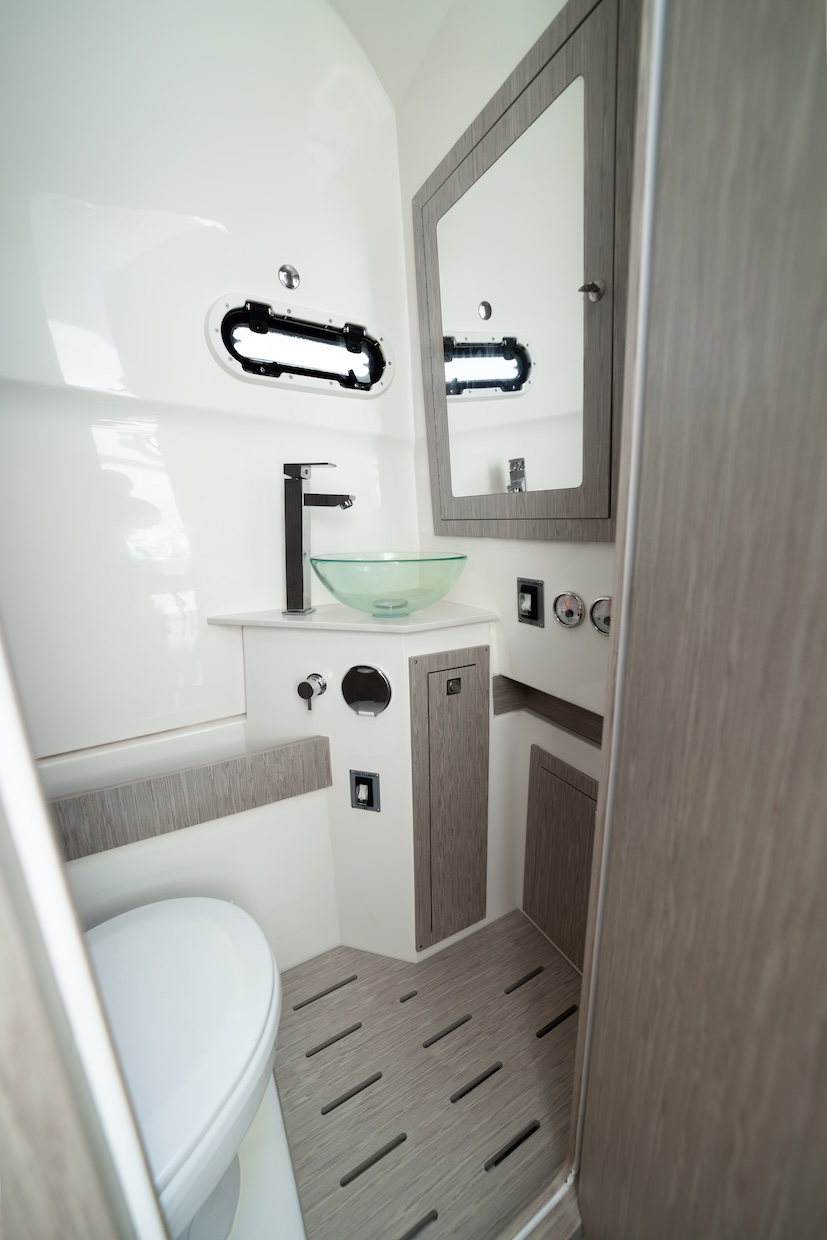
Particular care went into the head, which is separate from the sleeping area and fitted with a shower. A boiler for hot water can also be installed.
According to Nuova Jolly, a separate head is one of the features owners ask for most when they move up to inflatable boats of this size. It makes day-to-day use with family and guests more practical, especially during long stays away from port.
Construction and materials: multiaxial glass fibre and differentiated resins
The hull of the Prince 33 CC is built in composite using multiaxial glass-fibre fabrics. Vinylester resins are used in the first layers of the hull lamination, while the deck uses isophthalic resins. The aim is to combine structural strength with weight control, both important for a boat that must withstand significant loads at speed and when crossing waves.
The hull is a deep V, with a deadrise of 25° at the transom and a stated 60° in the bow section. These figures show close attention to the boat's dynamic behaviour, especially in a seaway. Nuova Jolly regards ride comfort as one of the priorities in designing the hulls of the Prince range. The goal is a soft ride even in rough water, limiting the impacts felt by those on board and the spray that can reach the cockpit.
Speed is therefore one of the possibilities offered by the hull shape and the engines, but it is not the only parameter driving the project. The builder's stated philosophy is to produce boats that keep a good level of comfort even when sea conditions become demanding.
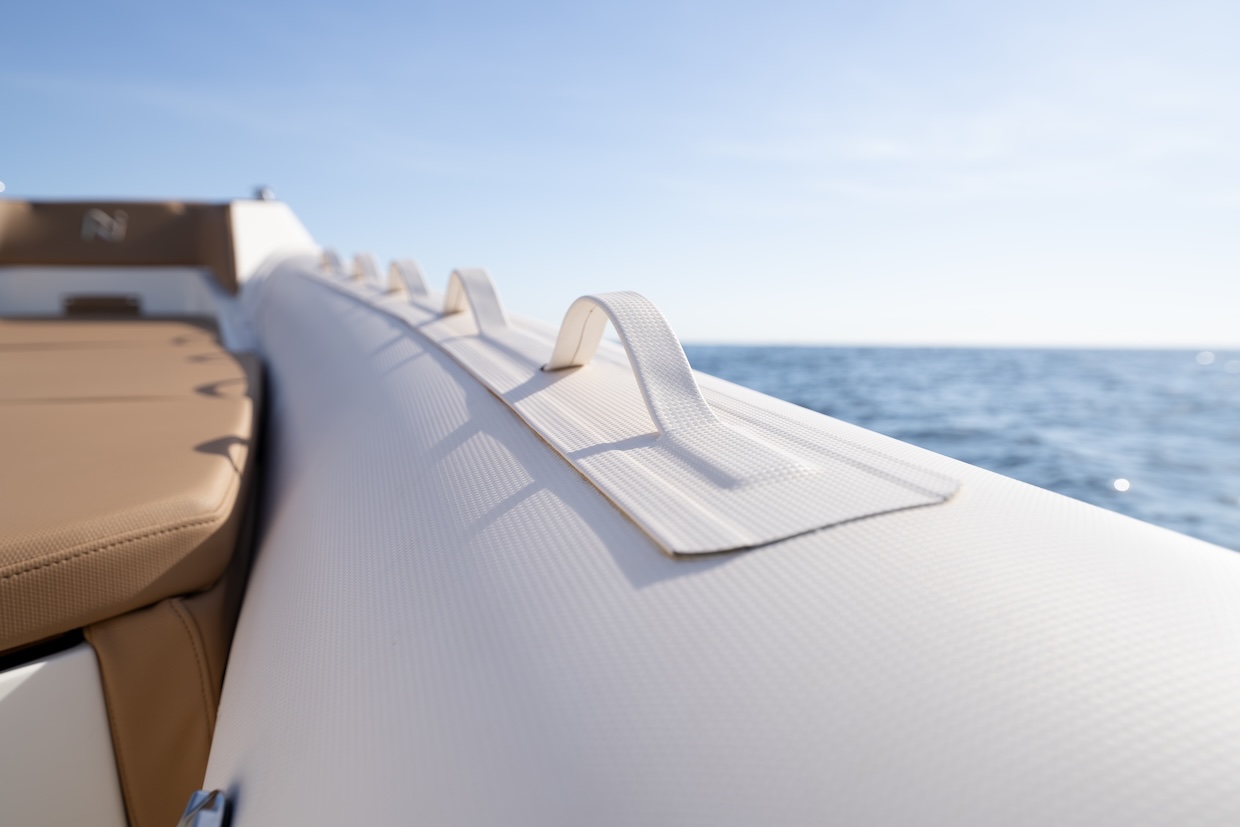
The tubes on the boat tested are made of ORCA 1670 fabric in Cream White, with a Black Carbon finish at the stern. The diameters given by the yard are about 62 cm aft and between 52 and 55 cm towards the bow.
Twin Mercury Racing 400s: a configuration requested by the owner
The most unusual feature of the Prince 33 CC tested by PressMare is without doubt its power package, a pair of Mercury Racing 400 outboards. They have a 5.7-litre aluminium block with banks set at 64 degrees, natural aspiration, indirect electronic fuel injection and double overhead camshafts with four valves per cylinder, driven by maintenance-free chains. The modular architecture follows that of the Mercury V6 and V8, sharing their bore and stroke of 92 and 86 mm respectively. Engine management relies on Adaptive Speed Control, which holds engine speed as the load changes, and Transient Spark, which optimises delivery at low revs.
To install the two Verado Racing 400s, Nuova Jolly reinforced the hull structure compared with the standard configuration. An additional row of stringers was added in the aft section, without extending it to the bow, and the amount of structural material in the transom was increased.
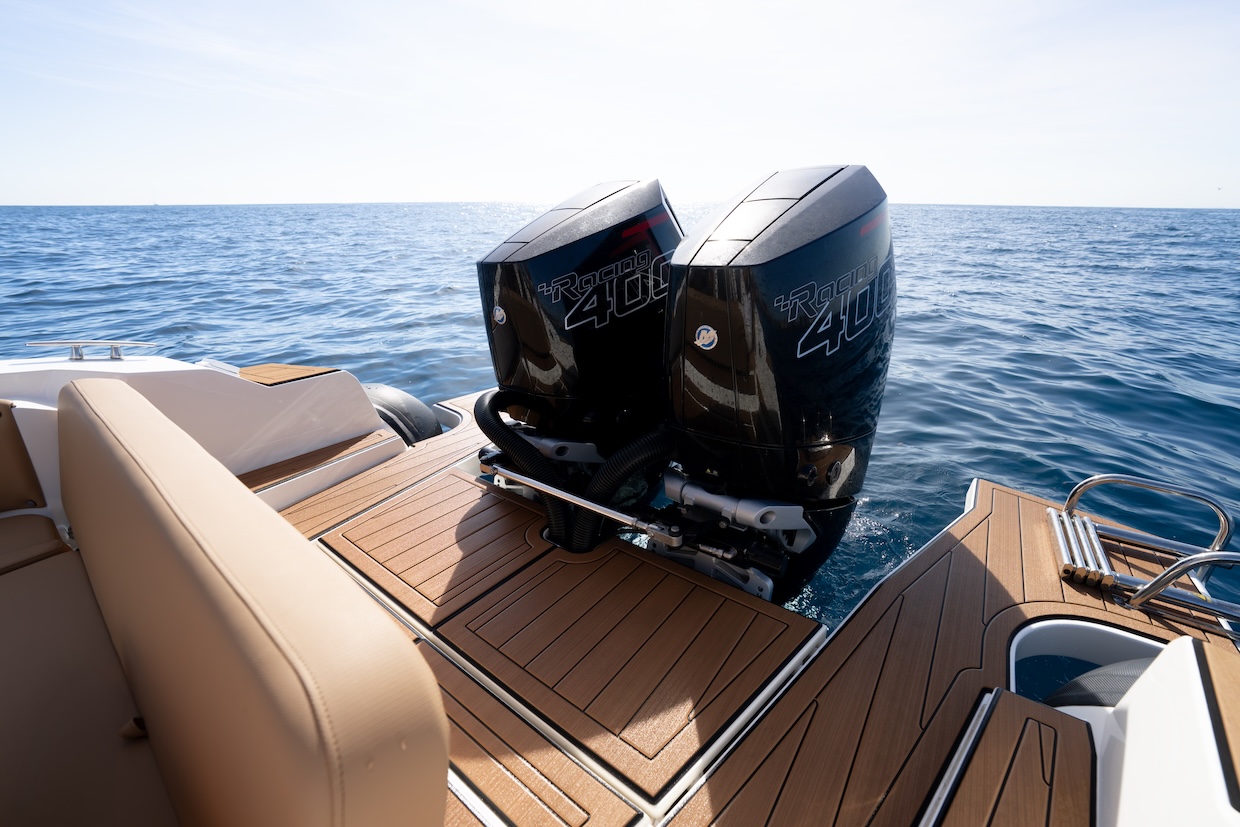
The work was needed to adapt the structure to the loads transmitted by the pair of outboards, both in terms of weight and of stresses under way.
The builder confirms that the boat is type-approved and certified for this 800 hp configuration as well, while stressing that it is intended for experienced skippers able to handle the available power with care.
The yard itself describes this engine choice as particularly aggressive, noting that the attainable performance requires experience and concentration at the helm.
Performance: over 60 knots and automatic trim tabs
With the twin Mercury Racing 400s, the Prince 33 CC reached a top speed of between 61 and 62 knots in the builder's own tests.
This was achieved without extensive optimisation work, such as repeated changes to engine mounting height or comparative tests with numerous propeller models. Nuova Jolly preferred to keep a configuration it considers satisfactory for the boat's characteristics and for the owner's intended use.
One distinctive element of the set-up is a pair of automatic trim tabs, used to help control fore-and-aft trim at higher speeds.
According to the yard, tests carried out without these devices showed that up to about 55 knots the hull does not necessarily need them. Above that threshold, the tabs help keep the boat's attitude under control, especially in the last 5-7 knots between that speed and the maximum.
The system therefore makes the boat easier to handle when the upper part of its performance range is used.
As for propellers, the options mentioned by the yard include Mercury Revolution X and Mirage. Four-blade Revolution X propellers, developed for the Mercury V10 engines, were referred to, but it also emerged that the engines had initially been delivered by the dealer with Mirage propellers.
Weights and load configuration
The stated weight of the Prince 33 CC, before the engines and accessories are fitted, is about 2,600 kg.
The pair of outboards adds about 600 kg, bringing the total to about 3,200 kg. To this must be added the roll bar, canopies and other equipment on board, which the yard estimates at around 250-300 kg.
In the configuration of the boat examined, the total weight without liquids is therefore between about 3,400 and 3,500 kg.
With full tanks, Nuova Jolly gives a figure of over 4,200 kg.
The difference between dry and fully loaded weight must be taken into account when assessing performance, especially with an engine package of this power. The actual load affects trim, acceleration and top speed, as well as the boat's behaviour in waves.
The certified length is 9.80 metres, which allows the Prince 33 CC to remain in the "natante" category. Overall length reaches 10.50 metres including the swim platforms.
A boat focused on comfort as well as performance
The unusual engine package of the boat tested by PressMare should not obscure the overall philosophy of the Prince 33 CC.
Nuova Jolly designed this model around three priorities: ride comfort, outdoor space and ease of use.
The deep-V hull is the main technical element through which the builder aims to deliver a soft ride in waves, while the deck layout was designed for flexible use of the different areas.
The convertible dinette, the two sunpads, the galley unit for food and drinks, the two-berth cabin and the separate head allow the boat to be used for long day trips, with the option of an occasional night on board.
The decision to build a few large, easily accessible lockers follows the same logic of functional simplicity.
In this context, the 800 hp fitted to the test boat is a customisation that pushes performance to particularly high values without changing the model's general purpose.
For those who prefer a balance between speed, comfort and ease of handling, Nuova Jolly recommends a pair of 300 or 350 hp outboards.
Price: from €133,000 without engines
The base price given by the yard for the Prince 33 CC is €133,000 excluding VAT.
This includes standard equipment and accessories but not the outboard engines. The final price therefore depends on the engines chosen and any customisation requested by the owner.
The twin Mercury Racing 400 set-up is a specific configuration, which also involves the structural work described above and dedicated components such as the automatic trim tabs.
The Prince 33 CC is aimed at buyers looking for a RIB of around ten metres with a strong focus on outdoor living, the option of an occasional night on board and a hull designed for ride comfort. The 800 hp configuration adds performance aimed at customers with a particular interest in speed and sporty engines.
The sea trial
The short, steep chop made testing the Prince 33 CC in this configuration demanding, at least when chasing top speed. Up to 45-50 knots, already a brisk pace, the boat runs comfortably and without any problems. Above that threshold it needs an experienced driver able to manage a certain nervousness in the hull, accentuated in this case by the sea state.
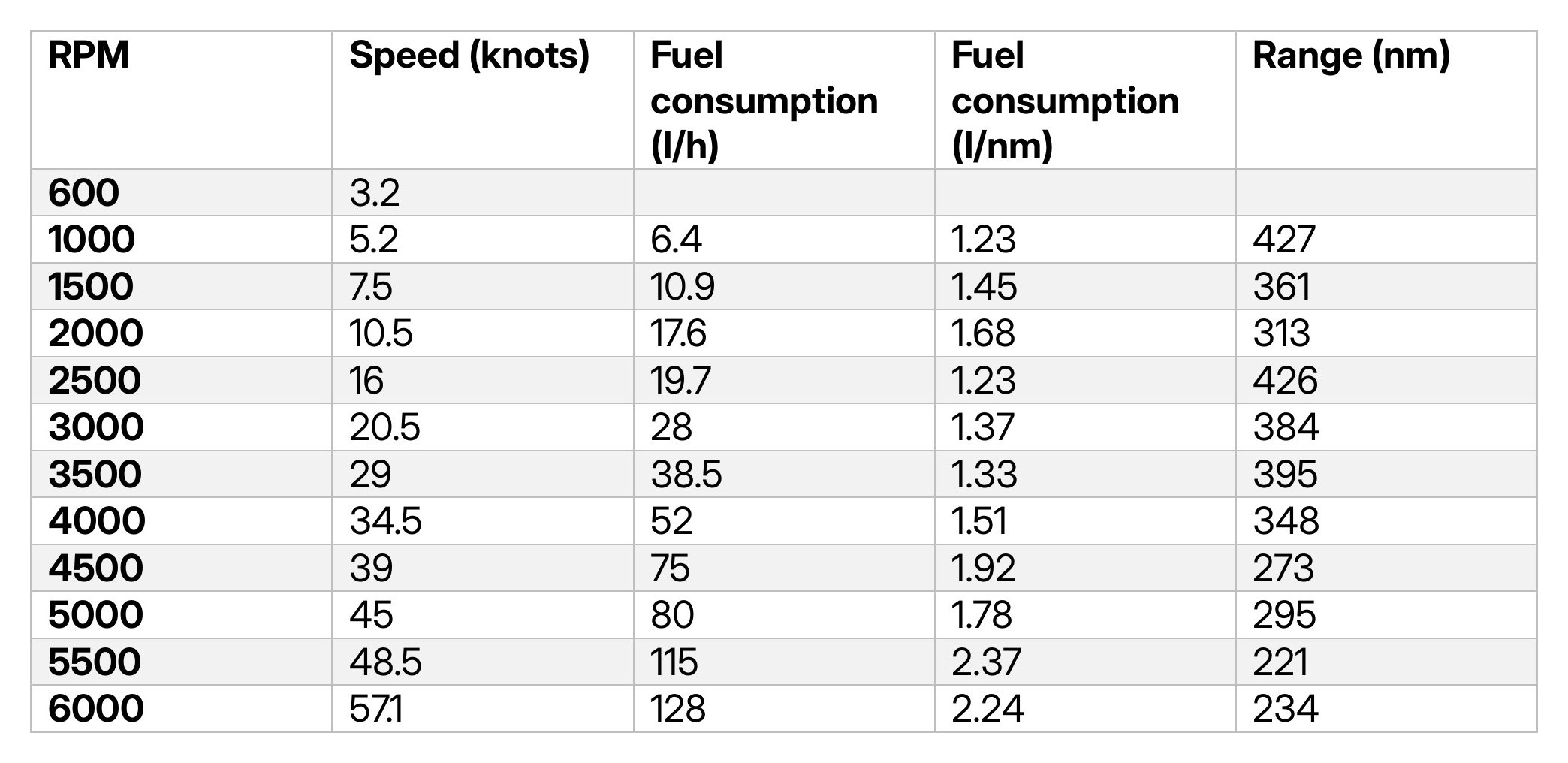
The yard states a top speed of over 60 knots, consistent with the 57.1 knots recorded during the test, given that the test boat had a very dirty bottom. Top speed is reached quickly, even from a standing start.
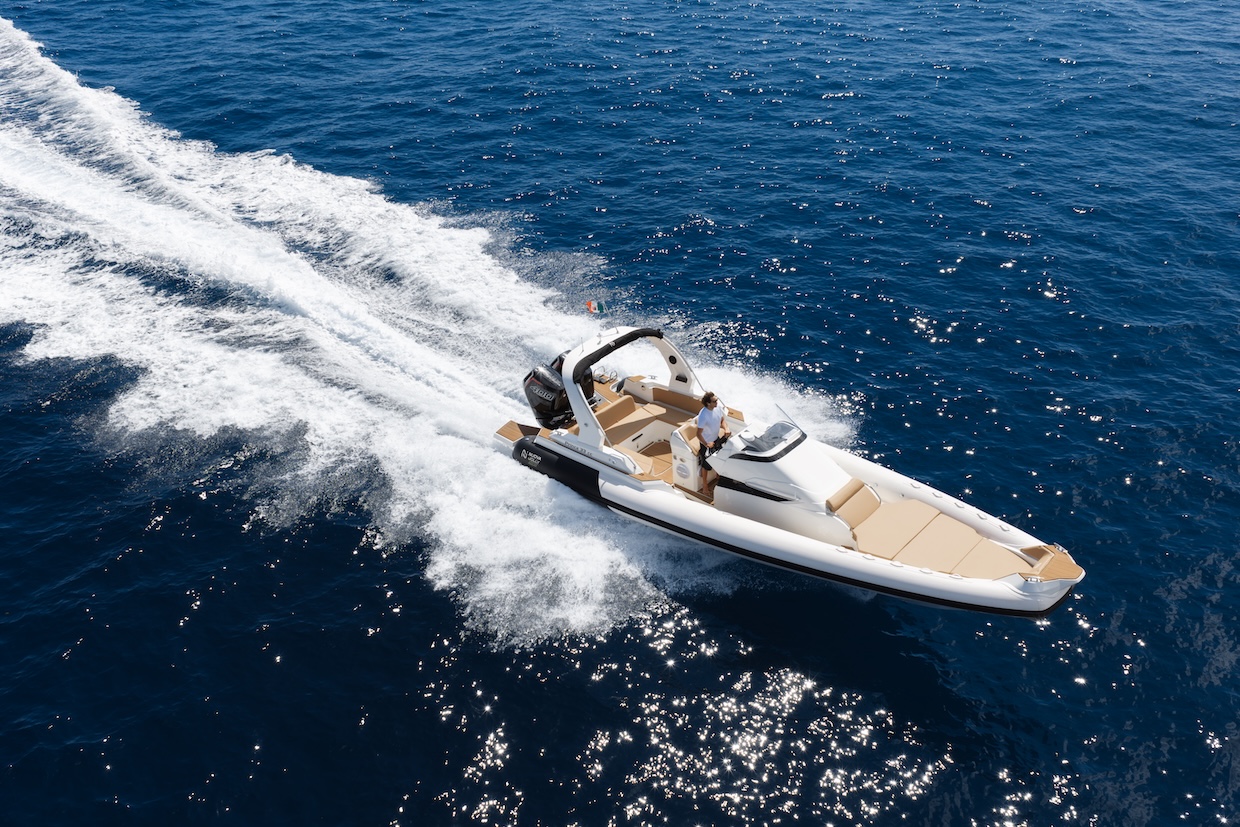
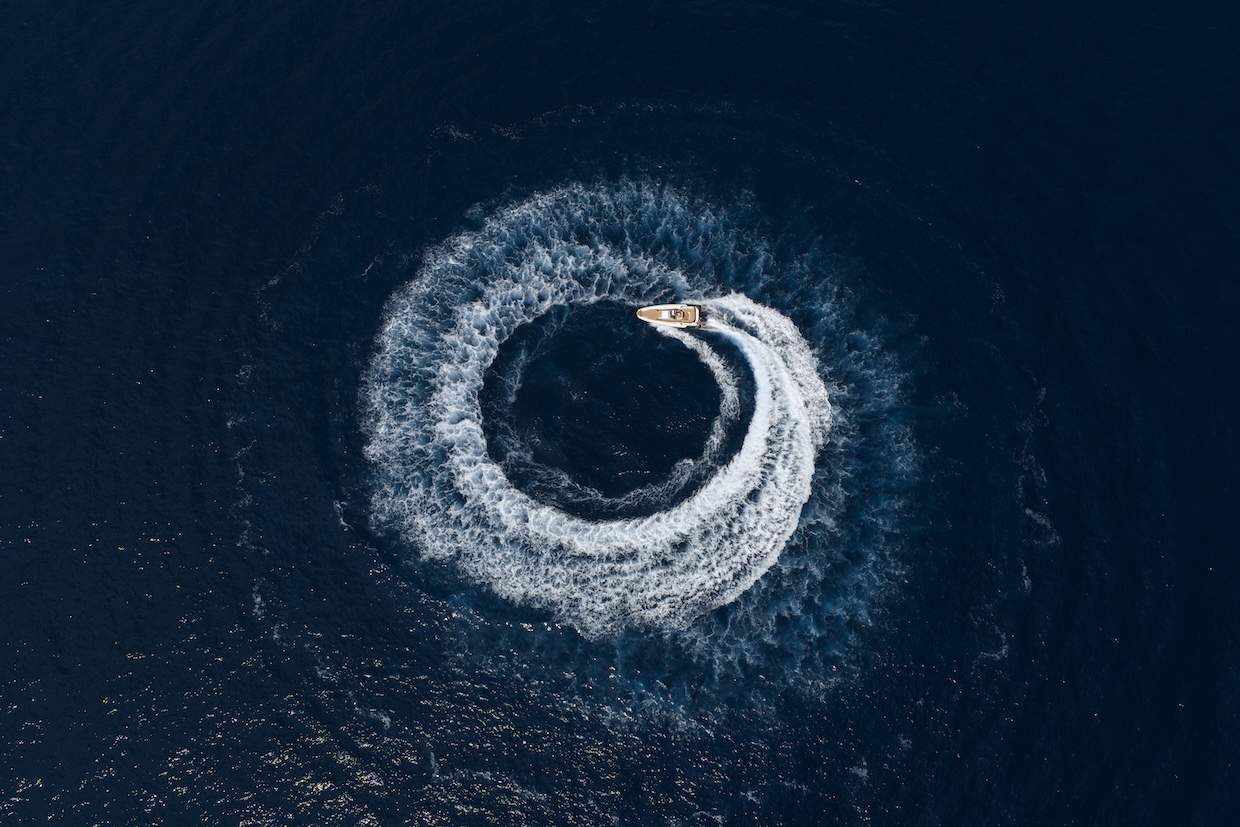
To assess how the hull responds in turns, we looked for a stretch of water close to the breakwater. Here, even at full throttle, the Prince showed stability worthy of a racing hull, giving a sense of security even to those seated on the aft sofa.
One point deserves mention: despite the difficult conditions, and although we took the waves from every direction, including those least suited to performance, everyone on board returned ashore without being hit by a single splash, apart from a few drops carried by the wind.
People on board: 3
Liquids: fuel 280 litres – water 50 litres
Engines: 2 x 400 hp Mercury 400R with 19" Revolution4 propellers
Wind: 3 knots NW, gusting 13 knots – Sea: 0.2 m waves from SE, period 2.4 seconds (Windy data)
Specifications
LOA: 10.40 m – Certified length: 9.64 m – Beam: 3.42 m – Internal length: 8.70 m – Internal beam: 2.10 m – Tube diameter: 60/44 cm – Dry weight: 2,300 kg – CE category: B – Number of compartments: 6 – Cabins: 1 – Maximum persons: 12 – Maximum power: 800 hp – Transom height: 2 XXL – Fresh water: 90 litres – Black water: 30 litres – Fuel: 525 litres
©PressMare - All rights reserved