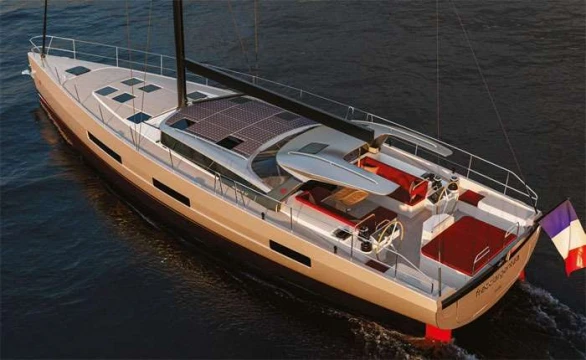
Pegasus 67 – next level ocean voyager from the Slovenian boatbuilder


Building on the success of their 50ft debut model, Pegasus Yachts is now developing a larger version of the concept with yet more innovative thinking
For the Slovenian boutique boatbuilder Pegasus Yachts, comfort is a founding philosophy. Comfort in this context is emotional as well as physical: ease, simplicity, an absence of stress. And for a brand with the strapline “blue water brilliance”, whose key principle is “less is more” and whose core values are performance, quality, easy to sail shorthanded and easy to maintain, that’s a lot of boxes to tick. Perhaps having Guillaume Verdier and Juan Kouyoumdjian on speed dial, for Pegasus 50 and the new Pegasus 67-footer respectively, makes those goals easier to achieve.
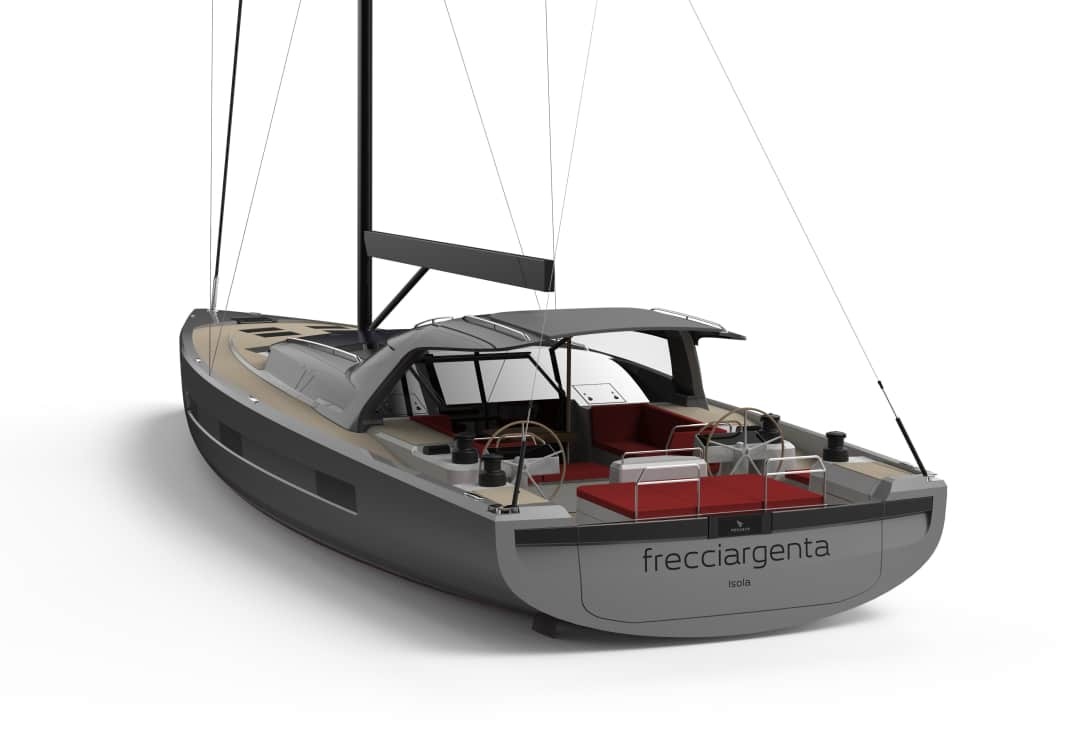
The Pegasus 50 aimed to reconfigure the traditional cruiser. ‘Put simply, we’ve created catamaran living on a monohull,’ says Marko Paš, former Tornado-class Olympic contender, co-founder Pegasus Yachts and designer of the Pegasus 67. ‘If you stand in the saloon, you’re at precisely the same eye level as someone sitting in the cockpit. To do this we raised the saloon and lowered the cockpit. That meant no aft cabins, but 95 per cent of your waking time on board is spent in the cockpit or the saloon.’
That connection is helped by the glazed aft bulkhead of a quasi-deck saloon, including a wide companionway hatch of sliding glass, creating a single insideoutside space. ‘Back then we didn’t know if people would appreciate this,’ Paš recollects, ‘but we’ve been proved right. We’re selling the 21st Pegasus 50.’ The previous 20 are sailing worldwide, in the Med, United States, Baltic and elsewhere.
Pegasus Yachts’ points of difference include a “less is more” approach to sail handling. The hull is hybrid carbon and glass fibre, expertly vacuum infused to keep weight down and the hull slippery. On the Pegasus 50, that allows them to step a rig two metres shorter than normal, with enough sail area to deliver entertaining performance (the third hull won the 2022 OSTAR across the North Atlantic in early season) while being easy to shorthand with the yacht’s standard Harken electric winches.
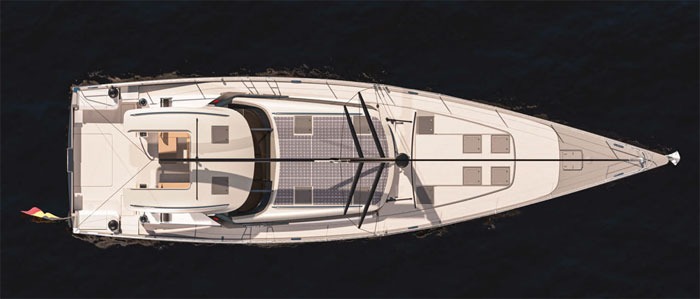
Another hallmark is the cockpit canopy, a fixed targa top mainsheet arch with a central canvas section that can be rolled away. ‘Originally it was for spray and rain, but it’s also for shade,’ says Paš. He relates a story about a yacht he saw entering a Greek anchorage in 20 knots of breeze. The crew was wearing oilies because of spray, then they anchored and spent half an hour trying to tame a 20 square-metre bimini in a stiff breeze before they could swim. ‘Our boats have a protected cockpit with fresh airflow,’ he says. ‘We sail in shorts, without shirts. We arrive, we drop the anchor, we jump in the water. That’s it.’
Maintenance is also key for blue water cruising. On the 50 that happens in two technical rooms below the cockpit: fluids and pumps are on one side, electrics on the other. Redundancy is critical too, so that system failure doesn’t interrupt your cruise. For example the Pegasus 50 is commissioned with spare fresh water, sea water and shower drain pumps. The yacht’s twin rudders have two independent B&G autopilots: if one fails, use the other. Despite being less efficient as one with bigger capacity, the Pegasus 67 will have two smaller Schenker water makers instead of one larger one for the same reason.
Another aspect of the comfort philosophy is clarity. For the 50, the base boat price is €1.25 million but the base boat spec is sail-away, from fridges and freezers right down to crockery and bedding. ‘That’s what you need to be autonomous,’ says Paš. It also includes a fully commissioned boat with a tuned Axxon carbon rig and an owner’s handover period.
Alongside the electric-gimballed saloon settee, which helps prevent fatigue, another Pegasus hallmark, on the 50 at least, is a tandem keel: two fins attached to a bulb. It’s another example of Pegasus Yachts’ relentless search for the right solution, not the obvious one.
Comfort in this instance means confident close-quarters boat handling. Pegasus makes lightweight yachts with two metres of saloon headroom, so there’s a fair bit of windage. Thus in a crosswind, life could get tricky.
‘For the boat to sail well, there is an optimal keel fin shape and surface related to sail area,’ Paš explains. ‘But for controlled handling in confined spaces, we need more lateral area in the keel fin and the rudders to resist side movement. We have a bow thruster, sometimes a stern thruster, but a comfortable boat needs to be able to get into a berth without any thrusters. It needs to be manoeuvrable at low speed in port.
‘Another America’s Cup veteran, Giorgio Provinciali (vice-president, performance and R&D at OceanWings), was doing CFD and VPP for us. I said that we needed to increase the surface area of the keel fin for manoeuvrability at low speed. But when we drew this keel it looked terrible, a real handbrake. Then Giorgio sent me a picture of the 1994 Farr-designed America’s Cup boat with the bulb and two fins. I was interested.’
‘After much CFD analysis, looking at chord lengths and fin spacing, Giorgio found the solution. That’s when we decided. We have increased keel lateral area, we’re not losing speed and we have very little leeway upwind, better than a single keel.’ The tandem keel also has a very long top plate. If you run aground, the moment transferred into the hull structure is substantially reduced.
For the Pegasus 67, various keel configurations including a further development of the tandem keel concept from the Pegasus 50 are now being tested and shape-optimised with Juan Yacht Design’s in-house CFD cluster.
The story of how the new larger model became 67ft long says much about Pegasus Yachts’ approach to problem solving. First, they knew there was a market. ‘When we brought out the 50 in 2021, many customers asked: “Do you have something bigger, maybe 55 or 60?”. We had invested a substantial amount of money in developing the Pegasus 50. At a meeting with our business partners, we said: “First we sell 20 boats, then we can start investing in a bigger boat.” So in the last 10 months, alongside our regular jobs we’ve been developing the “6X”.’
Paš knew exactly who he needed as a design partner: Juan Kouyoumdjian. ‘He thinks out of the box. To design a big boat that can sail shorthanded, you need that. He has the latest CFD software, huge computing power to run different hulls.’
The design process began with a displacement figure, considering blue water tankage, watermakers, a decent engine, generator, solar panels, serious battery bank, galley equipment, dive compressor, fast dinghy – everything a couple with friends might need for premium cruising. ‘I went to Juan with proven, realistic numbers and we agreed that 23 tonnes is a well-equipped boat with four crew. I know what our customers are expecting from the interior space so I gave him an envelope and said: “Optimise the hull for this displacement and optimise the sailplan to a minimum size needed so that the boat will still sail properly and the customers will have fun”. We did not compromise a lot. That’s why I partner with these guys. They have experience and they’re super intelligent, super creative.’
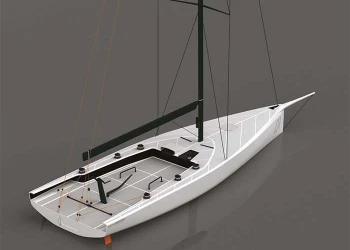
The Pegasus 67 has an inside forward-facing steering and watch position, with an all-round view of the horizon to reduce seasickness and also a full view of the sails. One of many novel features is a gimballed settee.
Her hull form is designed to surf the waves easily, her downwind numbers are impressive and she will be easy to handle shorthanded, with a furling code sail. At the same time she will point high when sailing upwind, with a soft, easy motion. Consistently good performance on all points of sail is the name of the game.
As a true ocean cruiser, performance under autopilot is key. Some Pegasus 50 owners compete with each other to set speed records during night watches. 20 knots is regularly logged on autopilot.
Paš reports that working with Juan K and his team was outstanding: “Clear, open and honest communication with the highest level of professionalism,’ he says. ‘They have so much real, on deck at 5AM boat-handling experience, which will be very valuable for Pegasus 67 owners.’
The new boat started as a 60ft concept and the first length increase came from a decision to remove the bowsprit. ‘On the 50 we have this beautiful carbon bowsprit,’ Paš explains. ‘But when I go sailing with (co-founder) Miha (Breskvar), I say “Are we going to hoist the gennaker or Code Zero?” He says “No, I’m not climbing out there.” Sometimes I do it, sometimes we don’t do it at all.
‘I started thinking “Let’s integrate the bowsprit into the hull.” First, you are protected by the pulpit when you work at the bow. Second, the loads are much more directly transferred from the Code Zero into the hull. Third, you get a finer bow, which is good for speed and for comfort as there’s no slamming. So, we said “Let’s do it.” We were at 65ft at that point but, by interior volume, we were – and still are – at 60ft.
‘Because of the longitudinal tender garage, the cockpit must be higher so we have room for two aft cabins. Then we realised that with the cockpit layout we wanted, we needed a good half metre for a longitudinally placed telescopic passerelle. We could have fitted a rotating passerelle but it’s complicated and adds 70kg, so we extended the stern by half a metre while keeping the interior of a typical 60-footer.’
The addition of aft cabins precludes the technical rooms that make maintenance so easy on the 50. What are the plans to square that circle? ‘Behind a removable panel, the starboard aft cabin will have a four square-metre space next to the engine room for equipment that needs to be easily accessible,’ Paš explains. ‘We’re deciding what needs daily access, like the watermaker, what needs weekly access and what needs access when it’s not working, electric winch switches for example. What is less important will be lower, what is super important will be at face height.’
Forward of the saloon, the berths are placed as close as possible to the boat’s centre of gravity, which makes it easier to sleep in a seaway. ‘ Understanding your own product and the conditions the boats are exposed to is invaluable,’ Paš says. ‘We sail our own boats as many miles as work allows and we race, also with other boats, worldwide.’
Pegasus Yachts invites a certain amount of customisation. Should an experienced blue water client decide that, instead of a second aft cabin, they would prefer a proper technical room with plenty of storage for cockpit cushions, bikes and other cruising paraphernalia, ‘this would be ideal,’ says Paš. If a less seasoned client wants bunks for a captain and crew, that’s another option.
The intention is to have the first 67, price tagged fully spec’d at €3.5 million, in the water by the end of next year. Then a programme of testing begins ahead of a debut at the Cannes Yachting Festival in 2027. After selling 20 Pegasus 50 yachts in six years, what does sales success look like for the 67? ‘If we sell 10 in 10 years, I will be super happy,’ Paš concludes. ‘Then I can go sailing far.’