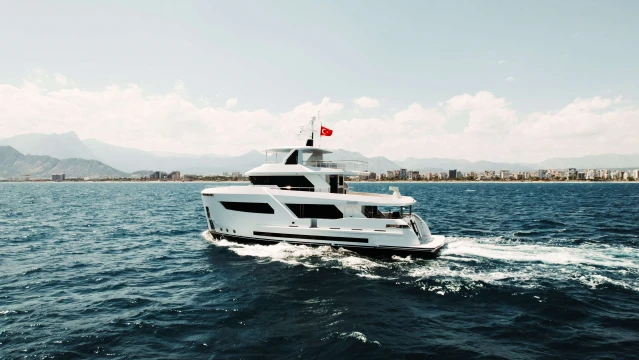
Bering Yachts Completes First Sea Trials of Third Bering 88 Hull


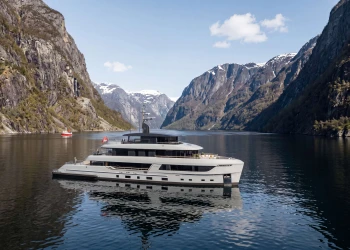
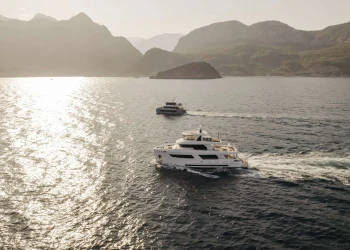
Bering Yachts has completed the first sea trials of the third hull of the Bering 88, the company’s bestselling model in the under-24-metre explorer segment.
Originally developed as the Bering 80, the design has evolved into the Bering 88 while retaining the same proven platform, general architecture and core capabilities. The main changes focus on refreshed exterior styling and an updated equipment list. The first hull, named Beyond Capricorn, and the second hull of the modified B88 are already operating successfully.
Alexei Mikhailov, Founder and CEO of Bering Yachts, commented:
“There are some questions like you had a Bering 80, now it’s Bering 88. It’s actually the same concept, the same platform. If it’s a successful platform and a good boat, you just can update and perfect it, change the exterior styling to be in line with current trends. Every luxury car gets updated every couple of years. I think boats should do the same. We can have a model of 2025 or 2028, but the platform, the general architecture and layout remain the same, and of course the capability and functionality of the boat.”
The trials concentrated on open-sea performance — fuel consumption at different speeds, range potential, noise and vibration levels, handling and overall comfort underway. The results confirmed that the B88 is a serious long-range, practical and comfortable explorer in a compact package.
Key Sea Trial Highlights
At a comfortable cruising speed of 8 knots, fuel consumption with both engines running was approximately 60 litres per hour, giving a theoretical range of around 5,000 nautical miles. Performance remained strong even at higher speeds for a full-displacement steel hull of this size.
On the subject of single-engine operation, Mr. Mikhailov noted:
“Of course, when manoeuvring, it makes sense to engage both engines. But on long-range passages, you may prefer to use one engine at a time, especially if you’re not in a hurry. This way we save on maintenance and engine hours while loading the engine properly. The fuel consumption is pretty much the same. Yes, one engine consumes a little bit more, but the engine is in much better condition. It’s better lubricated at this load, and the turbo works effectively.”
This approach not only optimises fuel use over long distances but also reduces overall engine hours and maintenance costs.
The full-displacement hull performed confidently in less-than-perfect conditions, with 15–20 knot winds and residual swell from the previous day. The yacht tracked straight, confirming its strong seakeeping abilities.
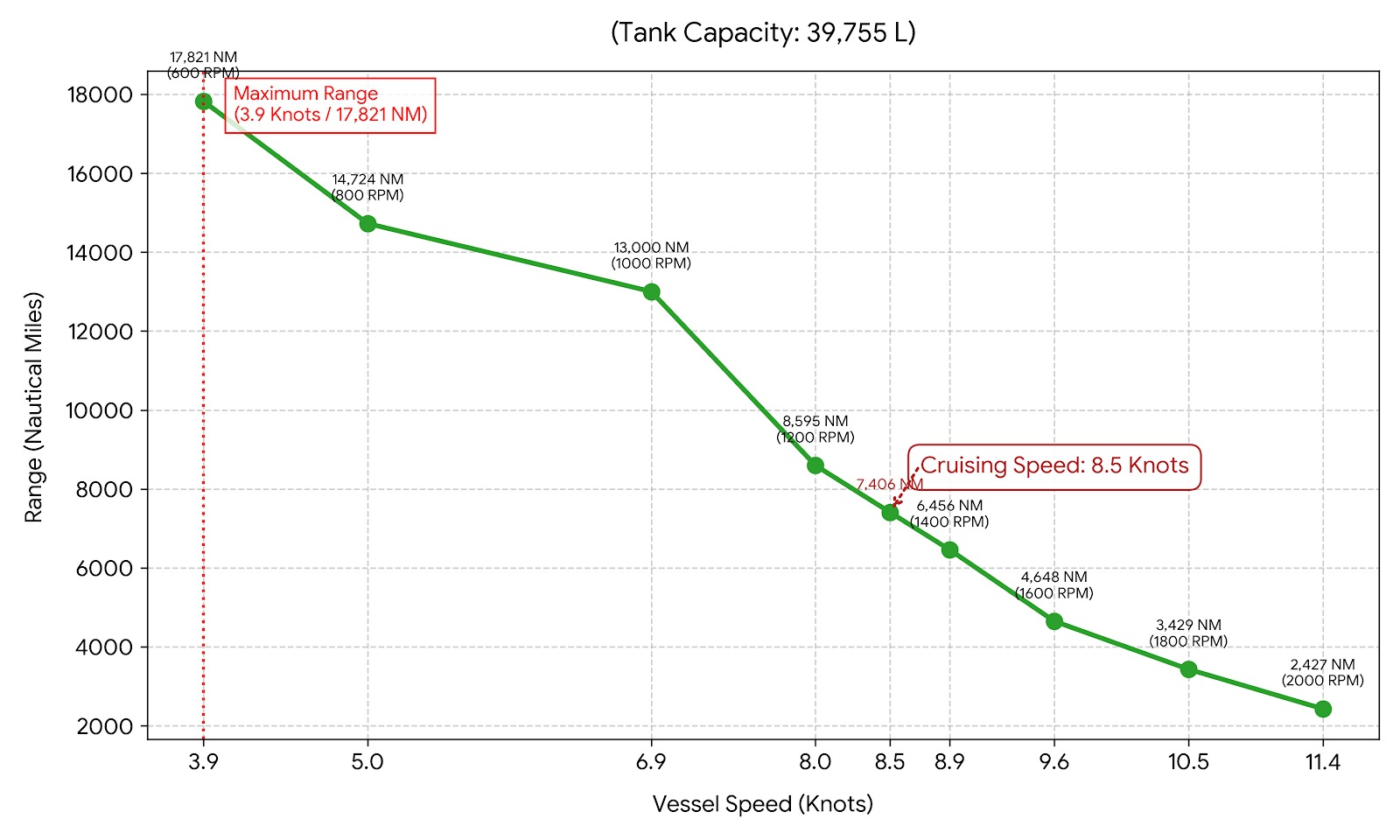
*Please note that the range mentioned here is a mathematical figure, calculated simply by dividing the total fuel capacity by consumption at a given RPM, without accounting for generator usage, safety reserves (typically 10–20%), or other real-world variables.
Why the Bering 88 Stands Out
The B88 combines the operational advantages of a smaller yacht with the volume, storage capacity and ocean-crossing capability usually associated with much larger vessels. With approximately 40,000 litres of fuel capacity and robust construction, the yacht is designed for owners who want to travel far without compromise.
The third hull of the Bering 88 will be presented at the Cannes Yachting Festival in September 2026. Interested parties are invited to contact Bering Yachts at [email protected] to arrange an overview and sea trial in Cannes.