The French AC75, the La Roche-Posay Racing Team, unveils its new livery and sails again from Lorient


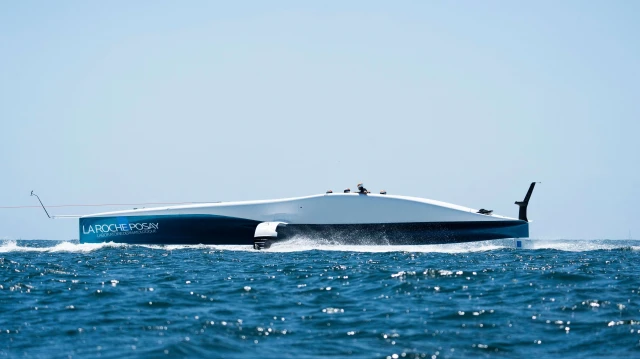
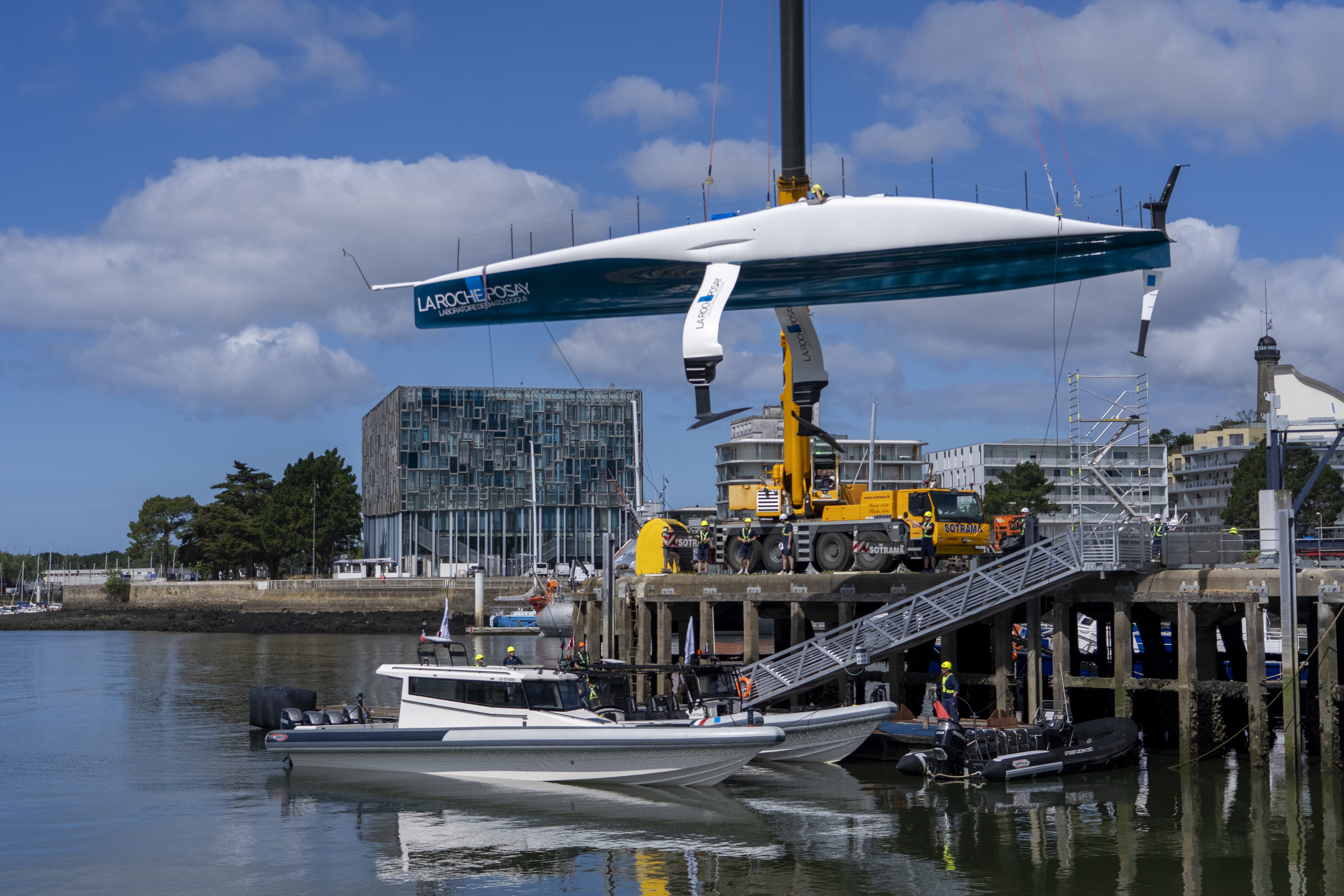
The third AC75 to be relaunched by a team competing in the 38th America’s Cup, the La Roche-Posay Racing Team’s boat – now resplendent in the azure blue and white colours of its title sponsor – returned to the water on Monday in Lorient for its first sail since leaving Barcelona.
In what is still a major first for France, where no AC75 had previously been launched or sailed, the relaunch also sends a strong message – for the first time in the history of the America’s Cup a single French challenger is competing in two consecutive campaigns, competing with the very best teams.
Unveiled three months after La Roche-Posay’s arrival as sponsor, this new livery reflects a partnership built on science, innovation and the pursuit of performance. Looking ahead, the campaign for the 38th America’s Cup will provide the brand with a veritable open-air laboratory, where its sun protection and skin repair products will be tested by UV rays, salt, wind and the extreme conditions of high-performance sailing.
The new livery also reflects a major technical evolution of the foiling monohull since 2024: beneath its familiar silhouette several months of work on the AC75 were required to adapt it to the new competition rules, a crew reduced from eight to five sailors, and a completely redesigned energy system.
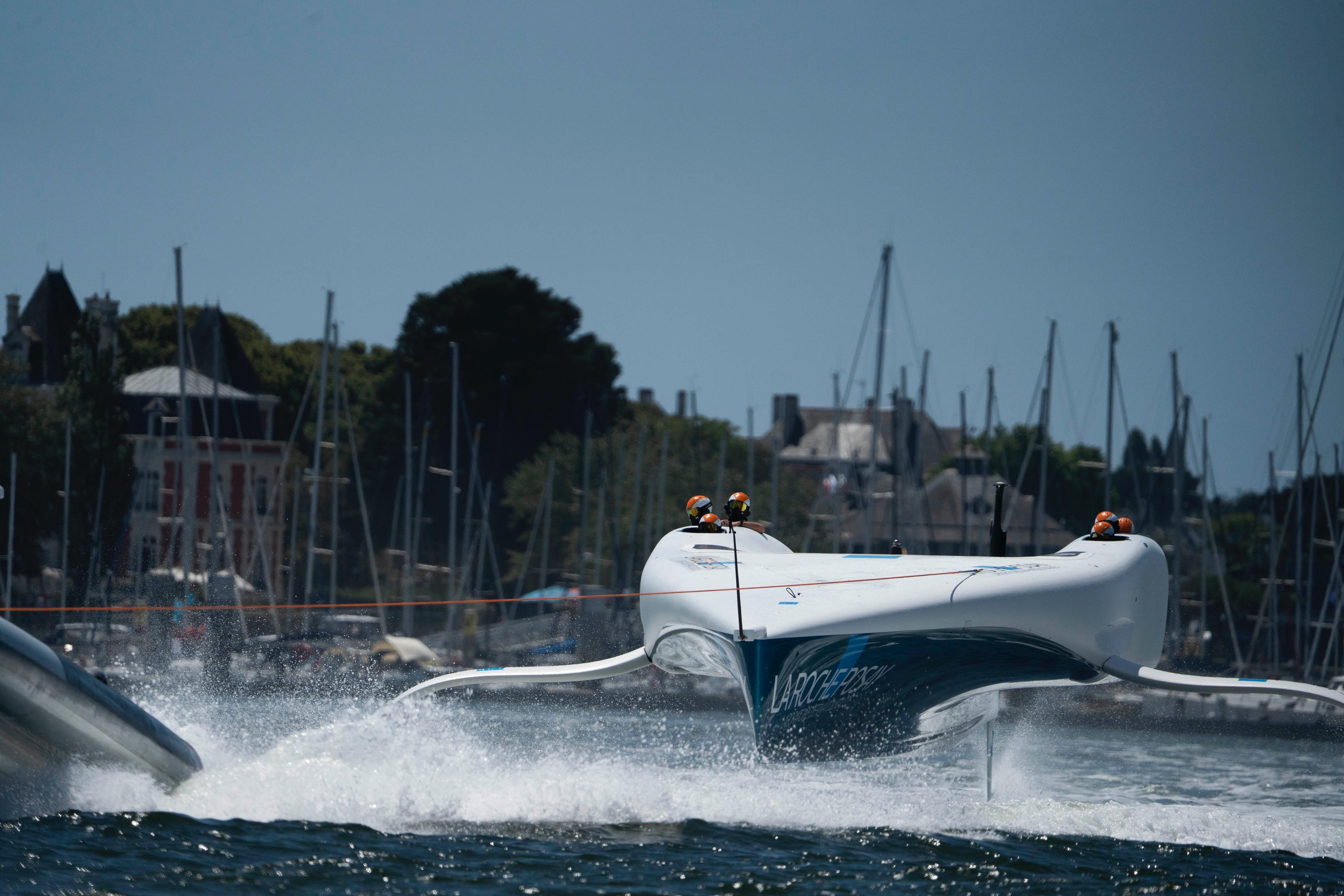
Measuring 75 feet in length – nearly 23 metres – the AC75 is one of the fastest and most complex racing yachts ever designed. Thanks to its foils, it can lift its hull completely out of the water and reach speeds in excess of 50 knots. But behind the striking image of a flying monohull lies a genuine technological laboratory, where aerodynamics, hydrodynamics, electronics, hydraulics and materials science must all function as a single integrated system.
For the La Roche-Posay Racing Team, this relaunch marks the transition from extensive work on land to a new phase: testing the boat in real-world conditions.
Antoine Carraz, Technical Director of the La Roche-Posay Racing Team: "A launch is always a special moment. For months we’ve been working on plans, simulations, parts and systems. On the day the boat returns to the water, all these elements must work together. It is both the culmination of an initial phase and the start of the real validation work."
A familiar boat that has been radically transformed
The rules of the 38th America’s Cup require teams that competed in the previous edition to build on an existing hull. So, the challenge was not to build a new AC75, but to adapt the 2024 model within a radically revised technical framework.
The main hull remains, but much of what enables the foiler to sail, fly and be controlled has had to be redesigned. The deck plan, cockpits, weight distribution, control systems, electrical and hydraulic circuits, as well as crew ergonomics, have all been revised to comply with the new rules.
Antoine Carraz: “Externally, the public will recognise the 2024 boat. But technically, this is not simply a refurbishment. We’ve had to rethink its internal architecture and the way the crew interacts with the vessel. The challenge was to radically transform the boat whilst retaining its original platform.”
This philosophy changes the very nature of development. In the previous edition, a significant part of the performance hinged on the design of a new boat. For the 38th America’s Cup, the focus is more on systems integration, reliability, energy efficiency, flight control and, ultimately, the development of the appendages.
From eight to five crew: a new on-board organisation
The most visible change is with the crew. In Barcelona, eight crew members were on board the AC75. In Naples, there will be just five, with a requirement to include at least one woman in the crew.
The reduction is not simply a matter of cutting three posts. It requires a redistribution of roles, a rethink of the crew’s positioning, and making each function more accessible, quicker and more intuitive.
The bridge and cockpits have therefore been extensively redesigned. Each crew member must have instant access to the information needed for steering, sail trim, and flight control.
Antoine Carraz: “Going from eight to five crew members changes everything: ergonomics, communications, the division of tasks and the control systems. With fewer people on board, every action must be simpler, more direct and perfectly coordinated. We have worked to ensure the boat remains extremely high-performance without becoming more complicated for the crew to operate.”
A sixth cockpit is also planned to accommodate a guest during training and races, although the guest will not be able to intervene in the boat’s handling. This innovation is unique in the sport, as a guest will be able to experience the thrills of the race, at the heart of the team, and in real time.
Legs replaced by batteries
During the 37th America’s Cup four sailors pedalled on board, these ‘cyclors’ generating the hydraulic power needed, in particular, to trim the sails. They will no longer be used in the next edition. Power will now be supplied mainly by batteries, requiring a complete overhaul of the electrical and hydraulic systems.
Antoine Carraz: “The disappearance of the cyclors is a major development. Previously, part of the performance depended directly on the sailors’ ability to generate power. Now, we have to manage a certain amount of on-board energy. We need to store it, distribute it and use it at the right moment, with the best possible efficiency.”
Just like in a racing electric vehicle, every expenditure of energy must be carefully managed. Engineers are therefore working on battery consumption, cooling and the overall reliability of the system.
Antoine Carraz: “We’re not just looking to have a lot of power available. Above all, we’re looking to avoid wasting it. A few seconds of operation, a manoeuvre or an adjustment repeated dozens of times can have a significant impact on a race’s energy balance.”
A flying computer, but still steered by sailors
The AC75 receives thousands of data points in real time: speed, height above the water, forces on the appendages, sail positions, hydraulic pressure and power consumption.
This data enables the sailors to understand what the boat is doing and to act with extreme precision. However, it cannot be used to create an autopilot. The rules say that decisions must remain in human hands. As a result, the technical team’s work focuses largely on the interfaces between the sailors and the boat: screens, buttons, steering wheels, controls and manoeuvring sequences.
Antoine Carraz: “The aim is not to replace the sailor with a computer. It is to provide the sailor with the right information at the right time and to ensure that their command is carried out immediately. At these speeds, a control that is difficult to locate or information that is poorly presented can cost a great deal of ground.”
The boat must therefore manage a paradox: becoming technically more sophisticated whilst remaining simple to use at speeds of over 80 or 90 km/h, all amidst noise, vibrations and under intense sporting pressure.
Performance lies in the details
As the hull is largely unchanged, the technical competition shifts to areas that are sometimes less visible to the public: the foils, the rudder, the sails, the control systems and the aerodynamics of the deck and cockpits.
The foils, in particular, will play a central role. It is they that enable the AC75 to rise above the water. Their shape, rigidity and ability to maintain the boat at a stable height directly influences its speed.
The configuration revealed during this first sea trial does not necessarily foreshadow the one that will be used in Naples, as development will continue throughout the campaign.
Antoine Carraz: “The first launch does not represent a final configuration. It gives us a working basis. We will measure, compare, understand and gradually refine the boat. In the America’s Cup, performance rarely stems from a single great idea. It arises from hundreds of details that ultimately work together.”
From simulation to the reality on the water
Before the launch, much of the work was carried out using digital tools: 3D modelling, structural calculations, air and water flow simulations, systems analysis and bench testing. But no model can perfectly replicate the complexity of an AC75 under sail. The first few runs therefore provide an opportunity to test the engineers’ assumptions against reality.
The priorities will initially be safety and reliability. The team will check the behaviour of the systems, power consumption, temperatures, communications between the equipment, and the crew’s ability to operate their new stations.
Antoine Carraz: “During the first few sorties, we won’t be aiming for top speed straight away. We’re taking it step by step. We need to check that all systems are performing as expected, then gradually increase the load and intensity. Performance can only be achieved once the boat is reliable and fully understood by those who sail it.”
Each test run will generate a considerable amount of data, which will be analysed ashore by engineers and compared with the crew’s feedback. This continuous cycle of sailing, analysis and refinement will form the core of the technical programme in the coming months.
A symbol of French expertise with major economic and scientific benefits
Designed in Vannes in 2023, and now prepared and operated from Lorient, the AC75 brings together expertise from the world of elite sailing, as well as from industry, digital technology, electronics and research.
Its relaunch marks a new stage in the French campaign for the 38th America’s Cup. It also reflects the ambition of the La Roche-Posay Racing Team: to build a team around this boat capable of mastering one of the most demanding racing machines in the world. Such a project also creates skilled jobs and generates significant economic and scientific benefits for the region and at national level, extending far beyond competitive sailing.
Antoine Carraz: “The La Roche-Posay Racing Team’s AC75 is the result of a collective effort. Behind the five sailors we’ll see on board, are engineers, technicians, builders, electronics specialists, hydraulics engineers and numerous partners. The launch gives a visible form to all this work. From today, our aim is to translate this technical expertise into performance on the water.”
With the third AC75 among the 38th America’s Cup contenders now back in the water, a new phase of the French campaign begins: a return to sailing a boat that is familiar in design yet radically changed in its operation, and now with its sights set on Naples 2027.
Stephan Kandler, CEO of K-Challenge: “Following our excellent start at the first official regatta in Cagliari last May, seeing our AC75 sail for the first time in France is a highlight for the whole team. This launch marks the culmination of months of work carried out in Lorient by our sailors, engineers, technicians and all our partners.
Being the third team to relaunch its AC75 demonstrates the momentum we have built up and the progress made since Barcelona without ever stopping. In its new livery, the boat fully embodies the project we are building with La Roche-Posay: a long-term French campaign based on science, innovation and the pursuit of performance. These first runs mark an important milestone and kick-off a new phase of on the water operations, with a clear objective: to help the team make progress every day in the run-up to Naples 2027.”
La Roche-Posay Racing Team’s 2026 Programme
29 June to 17 July: Training in Lorient
1–14 August: Training in Lorient
Mid-August to end of September: Move to Naples
24–27 September: Naples Preliminary Regatta in the AC40 class
October: Start of sailing in Naples, host city of the 38th America’s Cup
Thursday: Announcement of the final member of the La Roche-Posay Racing Team crew