HP Watermakers at Metstrade: rethinking the complete onboard water cycle
HP Watermakers at Metstrade: rethinking the complete onboard water cycle


From 17 to 19 November, HP Watermakers will be exhibiting at Metstrade in Amsterdam, at stand 01.431, showcasing a selection of its solutions for on-board water production, treatment and distribution.
In recent years, water has become an increasingly important consideration in the design and operation of boats and yachts. It is against this backdrop that Water Package comes into its own, as Gianni Zucco explains: water is no longer simply something to be produced, but a true asset on board, to be managed throughout its entire cycle.
Gianni, you often say that “water on board is no longer an optional extra, but an asset”. Why is it so important to change the way we look at it?
Because consumption is much higher than people might think. Today, water on board is a strategic resource, just like energy. On boats of 50 feet and above, daily consumption can be estimated at around 200 litres per person, covering showers, cooking, bathrooms, laundry and drinking water. These are significant volumes that have a direct impact on autonomy and everyday life on board. That is why water needs to be planned for, treated and distributed. An asset, in other words.
Has the way people use water on board also changed compared to the past?
Completely. The difference is comparable to the transition from analogue to digital, from the mobile phones of the past to today's connected world. Water used to be something you had to ration carefully. Today, with a watermaker and the systems that support it, water availability is much closer to what you would expect at home.
This belief led to the development of the integrated HP Water Package system. What is the idea behind it?
I strongly believe in this system because it allows us to address the entire water cycle. Producing water is not enough: we also need to consider how it is taken on board, treated, stored, distributed and monitored. With HP Water Package, we bring these different stages together, treating the installation as a single system rather than a collection of independent machines. The aim is to ensure high-quality water under all operating conditions, from staying in port to anchoring and cruising, right through to the moment it is actually consumed. This also gives owners greater freedom when planning their cruises.
Is this approach also gaining traction among boatbuilders?
Yes, there is growing interest in a more comprehensive approach to water management. Many international boatbuilders have already chosen to integrate our Water Package into their offerings, some as standard equipment and others as an optional extra. This shows that water management is becoming part of the yacht design process, rather than simply a requirement raised by the owner at a later stage.
Throughout this process, you often emphasise the importance of the “last ten metres”. What exactly do you mean by this?
I am referring to the final stretch of the water's journey: the distance from the tank to the glass. In other words, the point at which the whole cycle is completed. On boats, considerable investment goes into producing fresh water, with increasingly efficient watermakers, as well as into water treatment and storage management. But quite often, that is where the process stops. When it comes to drinking water, people still rely on bottled water. It is a contradiction. To me, a plastic bottle on a yacht worth millions is a sign of unfinished design. There are still those “ten metres” between the tank and the tap, and today we have the technology to cover them.
There is also an immediate practical benefit: ten people spending a week on board will drink almost 300 bottles of water, meaning more than 200 kilos to bring on board, store, refrigerate and eventually take ashore. That means space and crew hours that can be freed up straight away. If we already have all the water we need on board, why not bring it all the way to the glass?
How is this process completed?
Water Package brings together all the technologies required, from water production and intake to treatment and distribution. HP Genius is the component dedicated to drinking water: it treats water from the on-board supply network through a process that includes filtration, sterilisation and remineralisation, before dispensing it at room temperature, chilled or sparkling. It is the component that closes the loop and brings water right to the point of use.
It is not a complicated installation: the on-board water line is already there; all that is needed is to divert it to a dedicated tap, with relatively little effort compared to the overall investment in the system.
Water Package is useful both when a yacht is in port and when it is at anchor or underway. How does it work in these different situations?
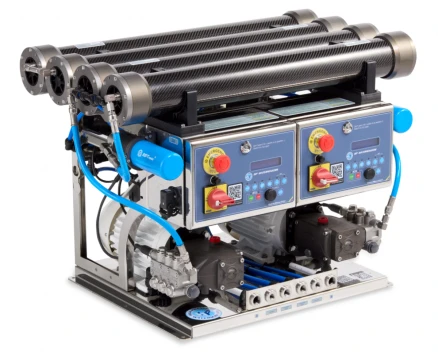
In port, we use water supplied by the marina, but its quality can vary considerably from one location to another. This is precisely where HP Sea Zero Spot comes in: it uses reverse osmosis to treat water from the marina supply, reducing dissolved salts and eliminating hardness.
When the yacht is at anchor or underway, our watermakers come into play, producing fresh water directly from seawater.
But treatment does not stop there. Once produced or taken on board, water must maintain its quality while stored in the tanks and throughout the distribution network. This is why the system can also incorporate UV sterilisation, which helps control the presence of microorganisms.
Producing water on board requires energy...
Yes, of course. Producing one cubic metre of water requires approximately 10 kWh. But the comparison needs to take the entire process into account: supplying that same cubic metre of water in sparkling PET bottles requires more than fifty times as much energy, because almost all that energy is not used to produce the water itself, but to manufacture its packaging. The bottle alone requires around 80 times as much energy to manufacture as it takes to produce the water it contains. On board, by contrast, the entire supply chain takes just a few hours and involves only a few metres of pipework.
Ultimately, what does all this mean for someone enjoying a holiday on board?
Someone who has two or three weeks of holiday cannot afford to have things go wrong. They want to be in control of their own time. If you are at anchor in the perfect spot and have all the water you need, independence makes the difference between a holiday that goes smoothly and one that runs into problems. That is why, if water is an asset, the design must be completed all the way to the tap.