Volvo Penta unveils IPS Hybrid: new propulsion system for the marine commercial sector
Volvo Penta unveils IPS Hybrid: new propulsion system for the marine commercial sector


Volvo Penta has announced the debut of its new IPS Hybrid propulsion system for the professional marine sector. The platform will be officially presented during Seawork 2026, the exhibition dedicated to workboats and marine commercial operations taking place from June 9 to 11 in Southampton, United Kingdom.
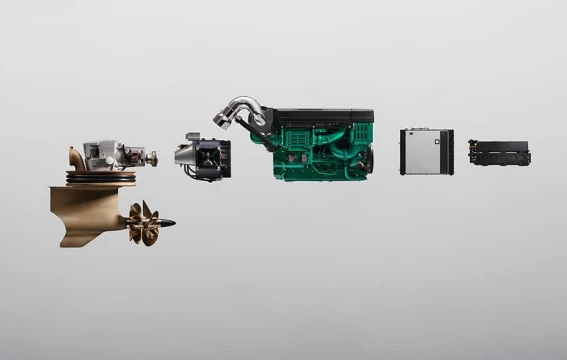
The new Volvo Penta IPS Hybrid has been developed for applications characterized by intensive and continuous duty cycles, including passenger ferries, coast guard vessels, offshore crew transfer vessels, river and coastal transport, and workboats. The system integrates propulsion, electric motors, batteries, energy management and control systems into a single architecture, with the aim of reducing installation complexity and simplifying operation and maintenance. The new platform builds on Volvo Penta’s experience with the IPS system, which has been adopted in more than 45,000 operational driveline units over the past twenty years. With IPS Hybrid, the Swedish manufacturer brings the maneuverability and control features typical of the IPS platform into the field of hybrid-electric propulsion as well. According to the company, one of the project’s core objectives is optimizing uptime. By assigning a single supplier responsibility for the entire “helm-to-propeller” package, Volvo Penta aims to reduce interface points between different subsystems, offering operators a single point of responsibility for propulsion, batteries, controls and energy management.
Hanna Ljungqvist, President of Volvo Penta Marine Business, explained that the system was developed to meet the needs of professional operators seeking daily operational reliability, efficiency and ease of management, combining the characteristics of the IPS platform with hybrid-electric technology.
At the center of the platform is the Electronic Vessel Control (EVC) system, which integrates propulsion and energy management into a single operator interface. Captains can monitor energy consumption, battery status, power flow and charging in real time while maintaining access to Volvo Penta features such as Joystick Driving and Assisted Docking. The system also introduces a new 24-inch Type Approved Display (TAD). The control architecture has been designed to reduce crew workload in demanding operational environments, such as congested harbors, dock-and-go operations or activities close to infrastructure. Low-speed propulsion management and power transitions between operating modes are handled in an integrated manner.
The IPS Hybrid system includes several selectable operating modes based on the vessel’s operational profile: Pure Electric, Hybrid Electric, Hybrid Fuel and Cross-over. These different configurations allow operators to adapt energy usage to the various phases of operation, from low-speed maneuvering to full-load transit, with the goal of optimizing fuel consumption and efficiency. The electric motor can also support both acceleration and maneuvering, while generating power to recharge the batteries during navigation or at anchor. From an installation standpoint, Volvo Penta emphasizes that the platform has been designed to simplify onboard integration thanks to a compact and standardized architecture. The manufacturer also foresees co-engineering activities during the early design stages, helping align hull and propulsion system integration from the very beginning of vessel development.
On the environmental side, IPS Hybrid is compatible with HVO100 fuel and compliant with IMO III and EPA Tier 3 standards. According to Volvo Penta, the platform represents a readily available solution to support decarbonization pathways and help operators prepare for evolving environmental regulations in professional maritime markets.
The new Volvo Penta IPS Hybrid will be showcased at Seawork 2026, where operators, shipyards and marine industry professionals will be able to explore the system’s features and potential applications within the professional marine sector.
©PressMare - All rights reserved