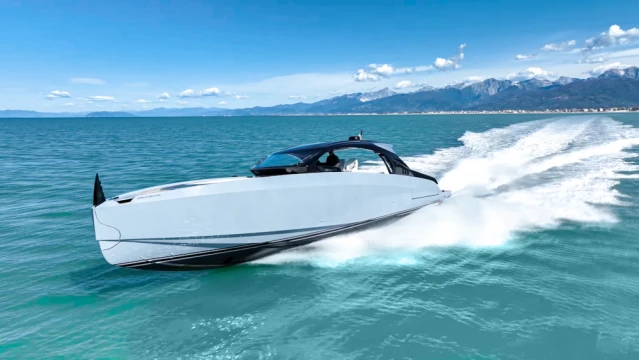
Centounonavi Vespro 55
Fast is Green: How Centouno Navi Turned Speed into a Design Philosophy


There is a phrase that has accompanied Centouno Navi since its foundation, almost a technical manifesto before a commercial one:
“Man has always sought speed, a synonym for proximity and efficiency. Through speed, everything related to boredom, waiting and distance is drastically reduced, while everything associated with pleasure and exploration expands immensely.
Speed means having more time.
This is made possible by science, understood as research, study and ingenuity.
To transform a yacht into a work of art and to make speed comfortable, economical and safe.
Centouno Navi is all of this: art, speed and science.”

This is not a slogan crafted by a marketing department. It is the way engineer Marco Arnaboldi has always approached boats, and it explains better than any brochure why this shipyard exists and what it intends to achieve in the high-performance yacht market. Centouno Navi was founded in Viareggio in 2022—a city that needs no introduction for anyone involved in yachting—with a clear ambition: to build yachts in which speed and comfort are not opposing concepts but two sides of the same engineering solution. The shipyard’s name is no coincidence. One-zero-one: one step beyond, a declared intention to enter a new era of naval architecture without carrying forward the industry’s entrenched assumptions.
To understand Centouno Navi, one must understand the people behind it. Arnaboldi brings with him thirty years of experience in the sector and a family legacy that is far from secondary. In the 1990s, his family founded AB Yachts (AB standing for Arnaboldi–Ballarini, the surnames of Marco Arnaboldi’s parents), among the Italian pioneers of high-performance planing yachts powered by waterjets.
This is not merely an interesting historical detail. It is part of the company’s DNA and can be found in the design choices behind every hull.
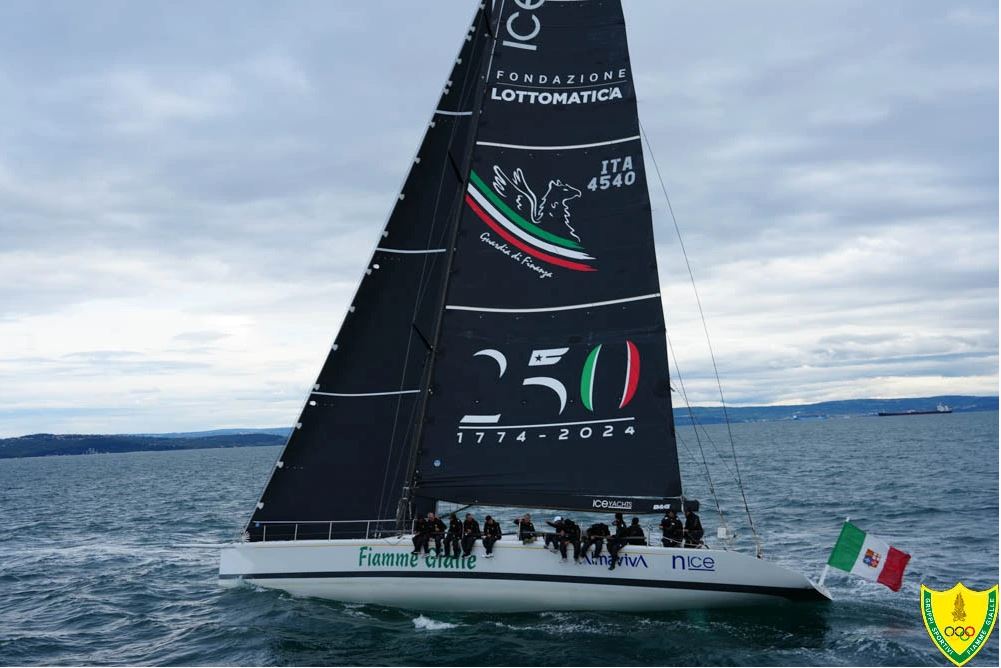
Yet there is another element that fundamentally distinguishes this shipyard. Centouno Navi is not a company born from production and later expanded into design. It is exactly the opposite: it is the manufacturing arm of Studio Arnaboldi, a naval engineering firm that for decades has designed hulls for some of the world’s most demanding shipyards—including Sanlorenzo, Mangusta and Pershing—and that also maintains a strong international presence in the defence sector, with clients such as Kongsberg Defence and the Italian Guardia di Finanza.
In practical terms, this means that every construction decision made by Centouno Navi is rooted in experience gained over years of working with the highest standards of international yachting. Arnaboldi originally developed as the designer and author of his family’s boats before placing his talent at the service of other shipyards and creating “scores” tailored to the needs of different owners and brands. Today, with Centouno Navi, he has returned to developing an entirely personal vision: like a composer who, after writing for the world’s greatest orchestras, decides to return to composing his own symphonies.
The audience Centouno Navi addresses is identified with unusual clarity for the sector. These are not traditional owners seeking a status symbol. They are individuals accustomed to high-performance automobiles—buyers who understand the difference between a car that merely claims 700 horsepower and one that actually delivers it—and who expect the same technical honesty when they step aboard a yacht.
They do not tolerate technical exaggerations or marketing promises that defy the laws of physics. Nor are they satisfied with leaving the harbour only to cruise at 20–25 knots through crowded waters while holding onto handrails and dealing with water on deck.
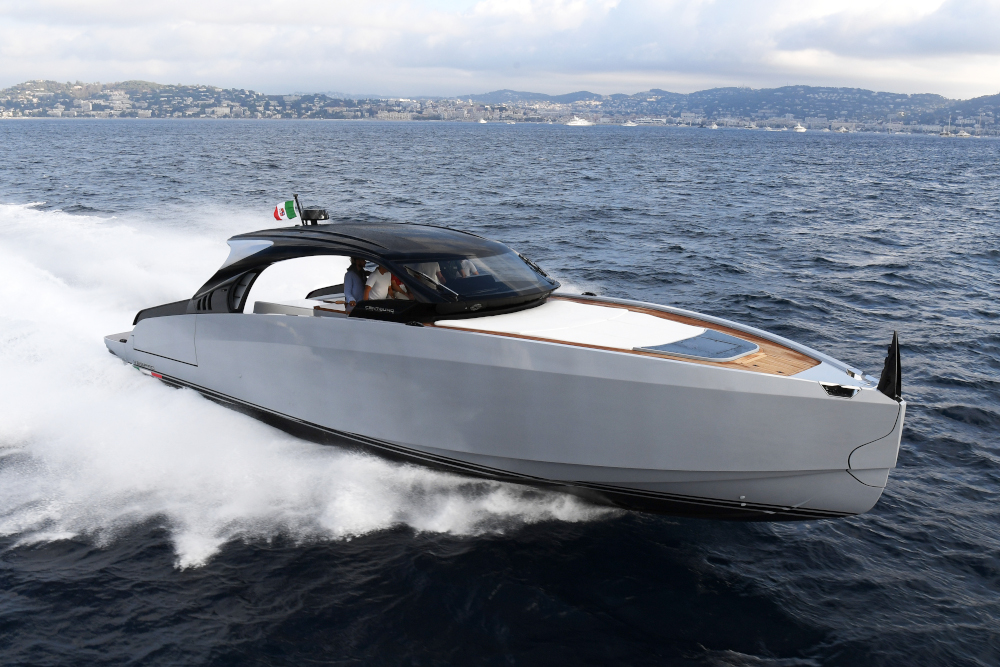
The example the shipyard uses to explain this philosophy is very tangible: a Vespro 55 that allows owners to have breakfast at Sénéquier in Saint-Tropez and lunch three hours later at La Ferme on Cavallo Island, consuming just 6.5–7 litres per nautical mile. Or to travel from Monaco to Portofino in two hours, completely relaxed and perfectly dry.
Centouno Navi calls this “freedom”. It is a powerful word, but in this context it has a very precise technical meaning. The shipyard has also deliberately chosen to maintain limited production volumes. Not because of an inability to scale, but because selectivity is an integral part of the brand.
In a market crowded with claims of leadership and innovation that often lack substance, building only a small number of yachts—each different from the next—and allowing the boats to speak for themselves is a matter of entrepreneurial philosophy before it is a commercial strategy.
How do you build a yacht capable of cruising at 56–60 knots while maintaining a level of comfort that is not a compromise? Centouno Navi’s answer is based on four distinct and interdependent elements.
Lightweight Construction. The hull is built using a hybrid composite sandwich structure combining carbon fibre, fibreglass, vinylester resin on an epoxy base and a high-density PVC core. The result is a hull approximately 30% lighter than those of direct competitors of comparable size, strength and rigidity.
One immediate consequence is the elimination of fixed structural bulkheads throughout most of the hull—an engineering advantage that also becomes a commercial advantage, as we shall see. Physics is not negotiable: less weight means less energy is required to achieve high speeds, resulting in lower vibration levels, reduced noise and lower fuel consumption.
Waterjet Propulsion. Paired with MAN V8 engines on the Vespro 55, the waterjet system eliminates many of the limitations associated with traditional propellers.
There are no shaft-driven vibrations transmitted through the hull and no low-frequency structural noise. The absence of underwater appendages also contributes to a cleaner hull profile, reducing drag, while vectored thrust provides more responsive and precise manoeuvrability than a conventional propeller-and-rudder arrangement.
Aerodynamics as Functional Design. Decades of CFD studies are translated into solutions that owners may not notice until they experience them.
The Vespro 55’s hard top, for example, is not simply a roof. It is a defining design feature whose integrated windscreen visually disappears into the yacht’s profile.
At the same time, its supporting structures channel airflow dynamically toward the engine room, improving natural ventilation and reducing heat build-up on deck during high-speed navigation. It is the exact opposite of a purely decorative design element.
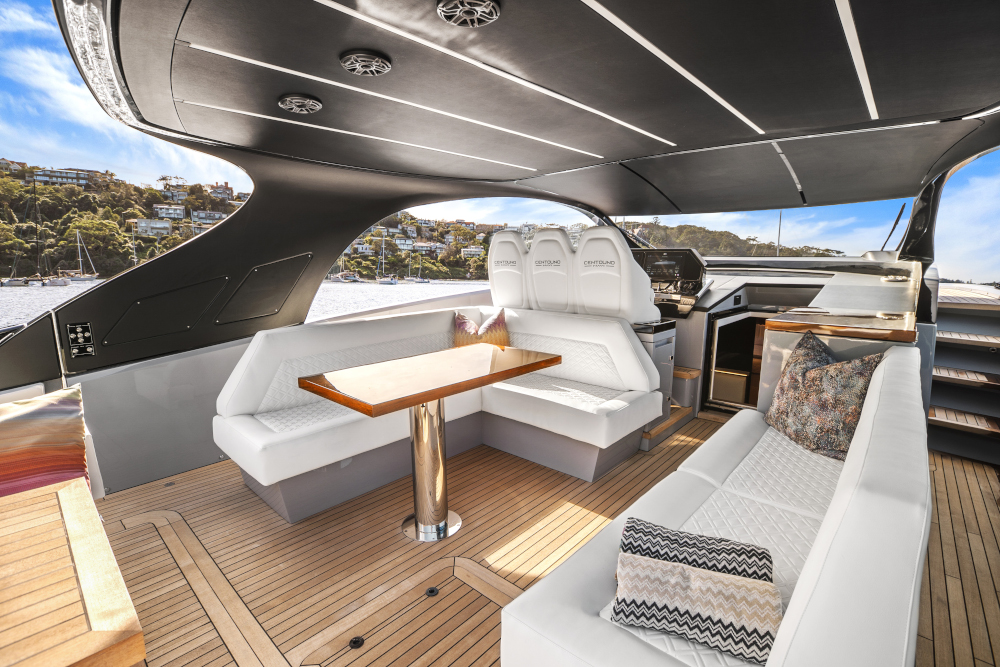
Customization without structural constraints. This is where sandwich construction reveals its second advantage. In the absence of fixed structural bulkheads, the interior layout can be modified 100%. Furniture is custom-built in-house using lightweight materials developed by Studio Arnaboldi. This is not about choosing between predefined configurations: it is a process of co-designing the interior. It is customization in the technical sense of the term, not in the commercial interpretation often abused to win over customers.
The most counterintuitive point - or, if you prefer, the paradoxical one - of Centouno Navi’s proposition concerns sustainability. The question that naturally arises - how can 60 knots be reconciled with respect for the sea? - has an answer that starts with physics, not with the communications department.
The lightness of the hull, combined with the efficiency of the hull lines, drastically reduces hydrodynamic resistance. The waves generated by a moving hull are the direct visualization of energy wasted moving water rather than the boat itself. Less resistance means less diesel burned, less CO2 produced, less energy dissipated in unnecessary turbulence. The shipyard claims CO2 emissions up to 50% lower than yachts in the same category: a figure which, in this context, is the direct consequence of lightness and hydrodynamic efficiency, not a marketing objective.
The waterjet contributes on another front: its impact on marine wildlife. Water enters through a flush-mounted intake and is accelerated before being expelled. No rotating propellers beneath the hull, no risk to cetaceans or turtles, no suction of larvae in breeding areas. This is not a secondary detail in an increasingly regulated Mediterranean.
The shipyard also uses predominantly recyclable materials - without turning them into advertising campaigns. In this sense, “Fast is Green” is not a slogan: it is simply what happens when things are built properly.
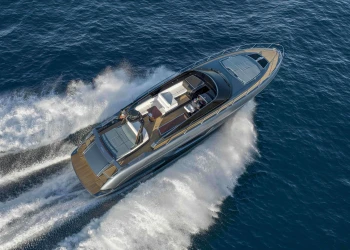
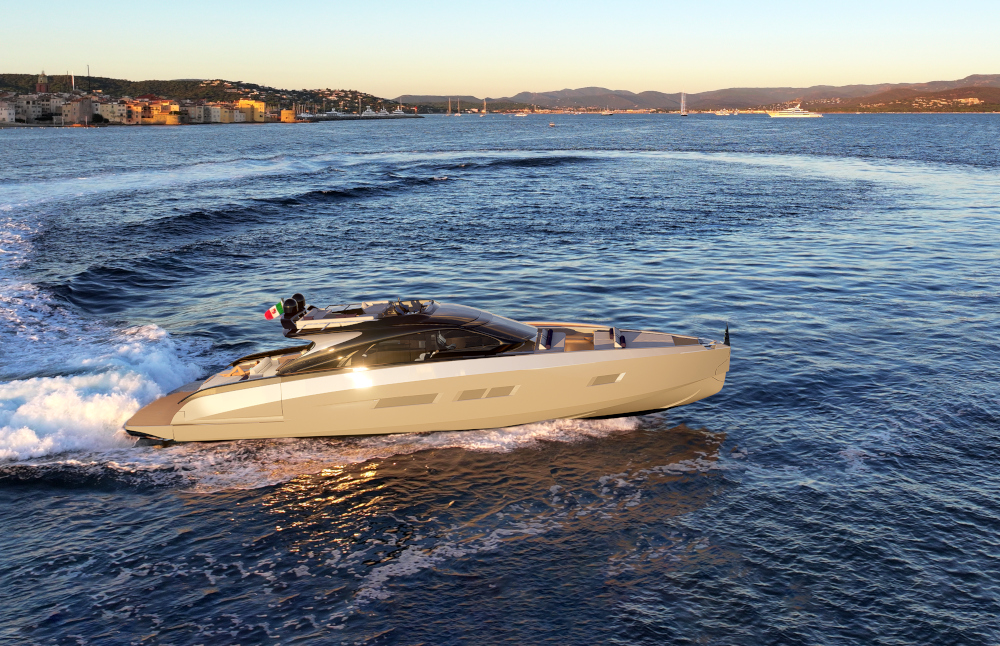
The launch model for Centouno Navi was the Vespro 55, a 17-metre yacht in a size category well known to the sport yacht market. The numbers: 56 knots top speed – more than 100 km/h – 350 nautical miles of range, average fuel consumption of 6.5 litres per mile. It is not a day cruiser that happens to be fast: it is a boat designed to cross the Mediterranean at sustained speeds. Three units have already been sold, two of them purchased directly from drawings, without the owner ever having seen the actual model. In a market where owners do not rely on trust alone, this fact speaks volumes about the reputation Studio Arnaboldi had established even before the first delivery.
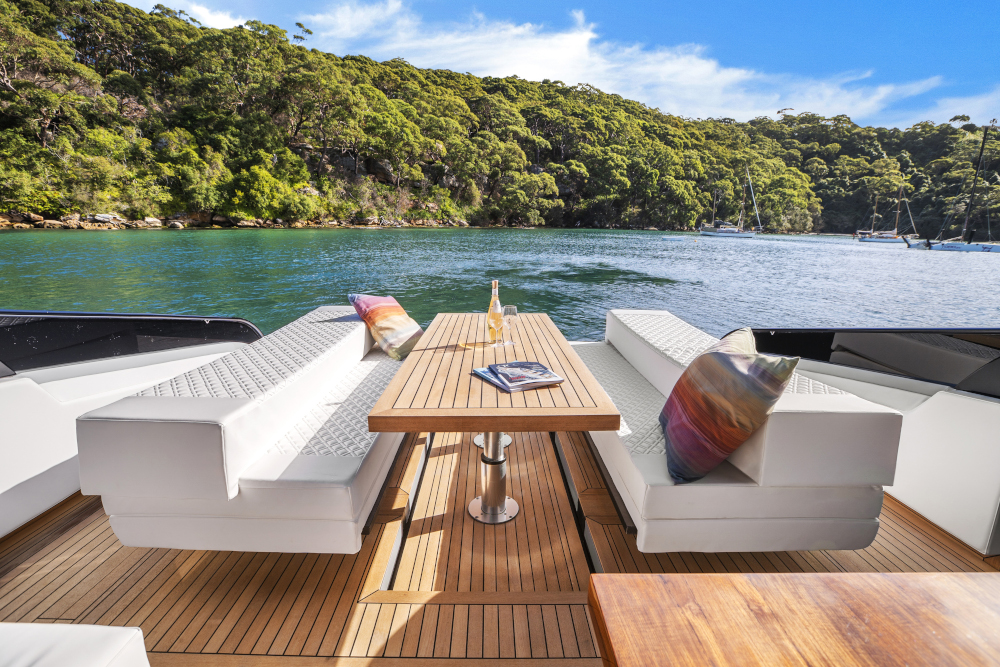
The Vespro is available in two versions. The original version expands the spaces below deck with a more Mediterranean approach: generous sofas, larger living volumes, atmosphere. The walkaround version shifts the emphasis towards bow usability and continuity between interior and exterior spaces. The same hull, two interpretations of use.
Other models are currently under development. The Aria - technically a 23.95-metre motoryacht - is an interesting design case: the decision to remain below the 24-metre threshold is not aesthetic but operational. The new European anchoring regulations, progressively introduced between 2019 and 2021 to protect Posidonia oceanica, impose severe restrictions on yachts over 24 metres in bays, mooring field areas and some of the most frequented destinations in the Western Mediterranean - particularly the French Riviera and Corsica. Remaining below that threshold means guaranteeing the owner genuine freedom of use in the waters that really matter.
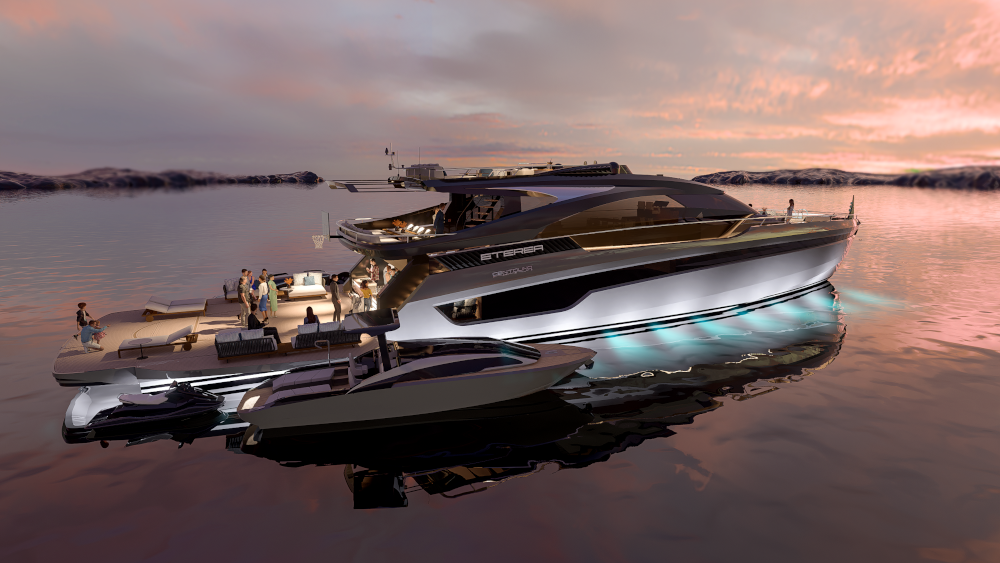
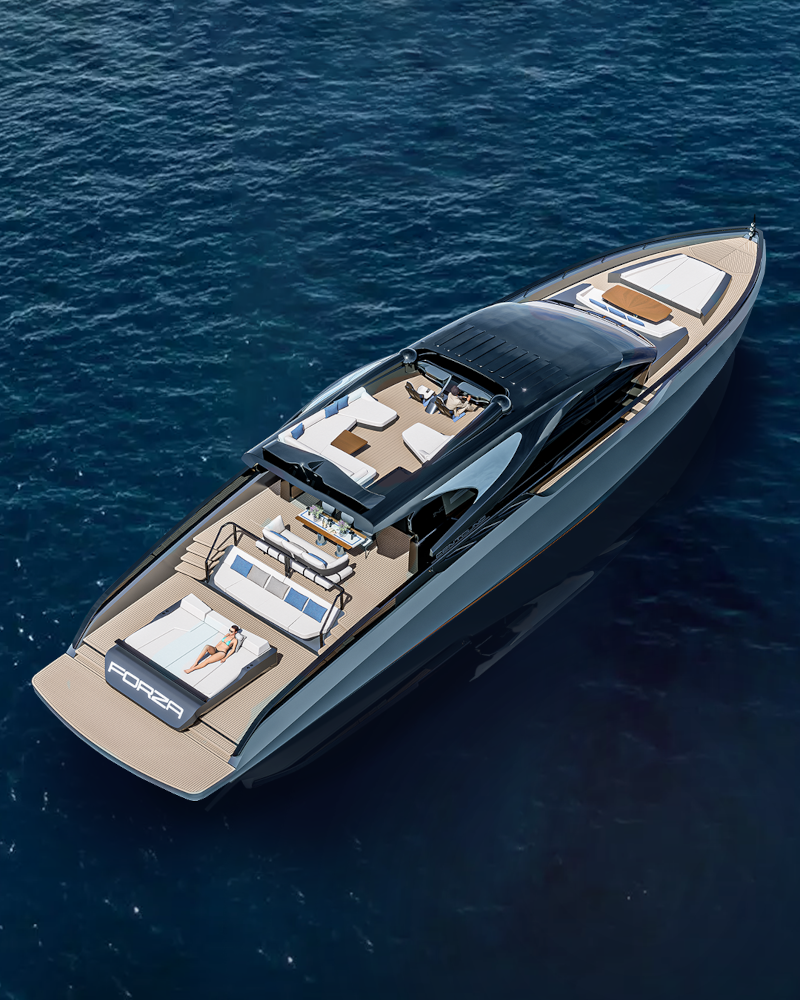
The Forza 100 represents the most extreme expression of the shipyard’s philosophy: a sport yacht designed to exceed 60 knots, with declared inspiration drawn from the world of motorsport. The Eterea 140, on the other hand, is the visionary superyacht that defines where Centouno Navi intends to go in the long term.
Centouno Navi therefore presents itself as a technical partner for the modern owner seeking a boat with different requirements, in many respects unique. It has the know-how - built over thirty years of naval engineering at the highest level - to translate aesthetic requests into measurable performance, and measurable performance into experiences that can be felt physically when at sea. Pure emotion.
The Vespro 55 is the starting point. But the intellectual project is broader, and it rests on a design consistency that does not depend on industry trends. Genuine customization, high-tech materials, respect for the sea: not because it is politically correct to say so in 2026, but because it is the only way to build high-performance boats that make sense today and are built to last.
©PressMare - All rights reserved