CMC Marine: When Efficiency Starts with Listening to the Problem


At the Cannes Yachting Festival 2026, CMC Marine is presenting several new products, but behind some of them lies a story that goes beyond the simple evolution of a product range. It is the story of how the energy architecture of yachts is changing and, consequently, how even apparently established components need to be rethought.
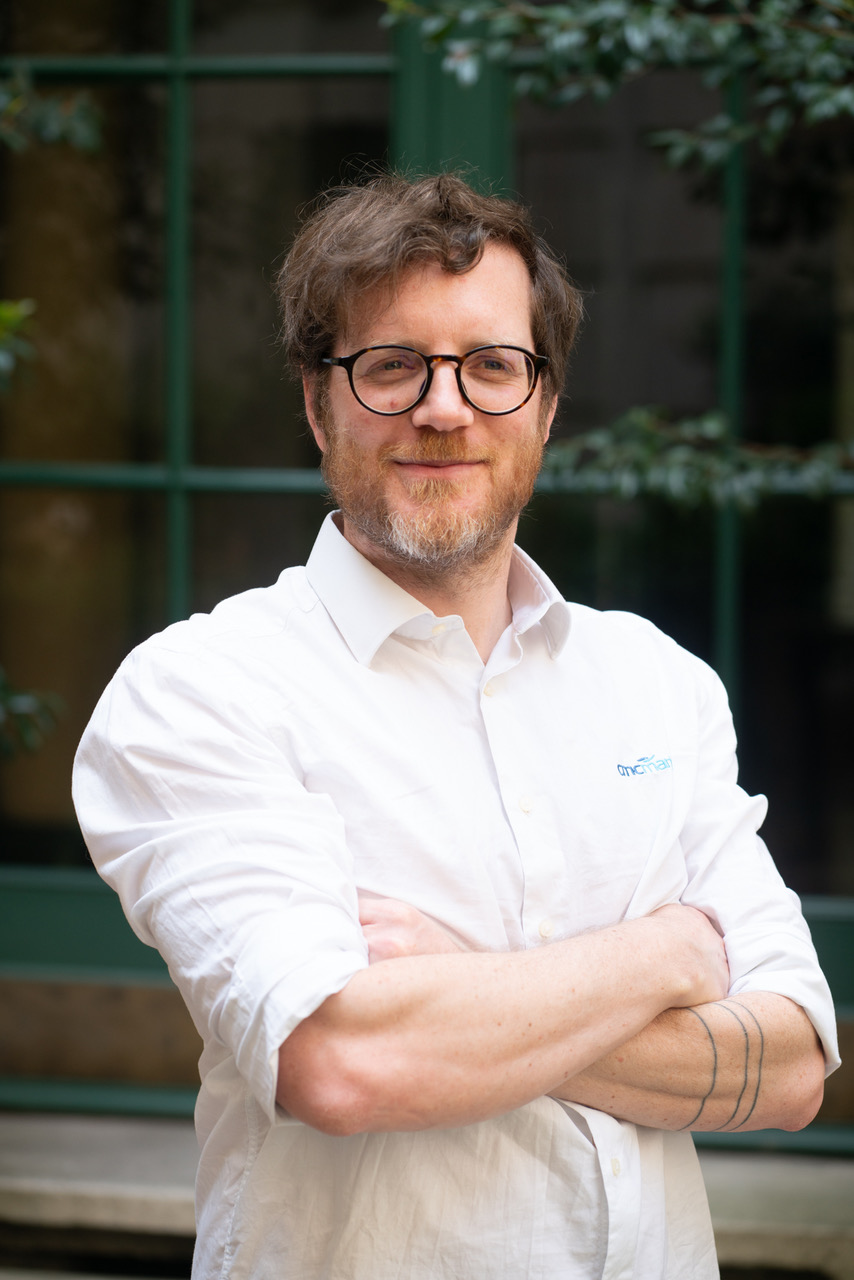
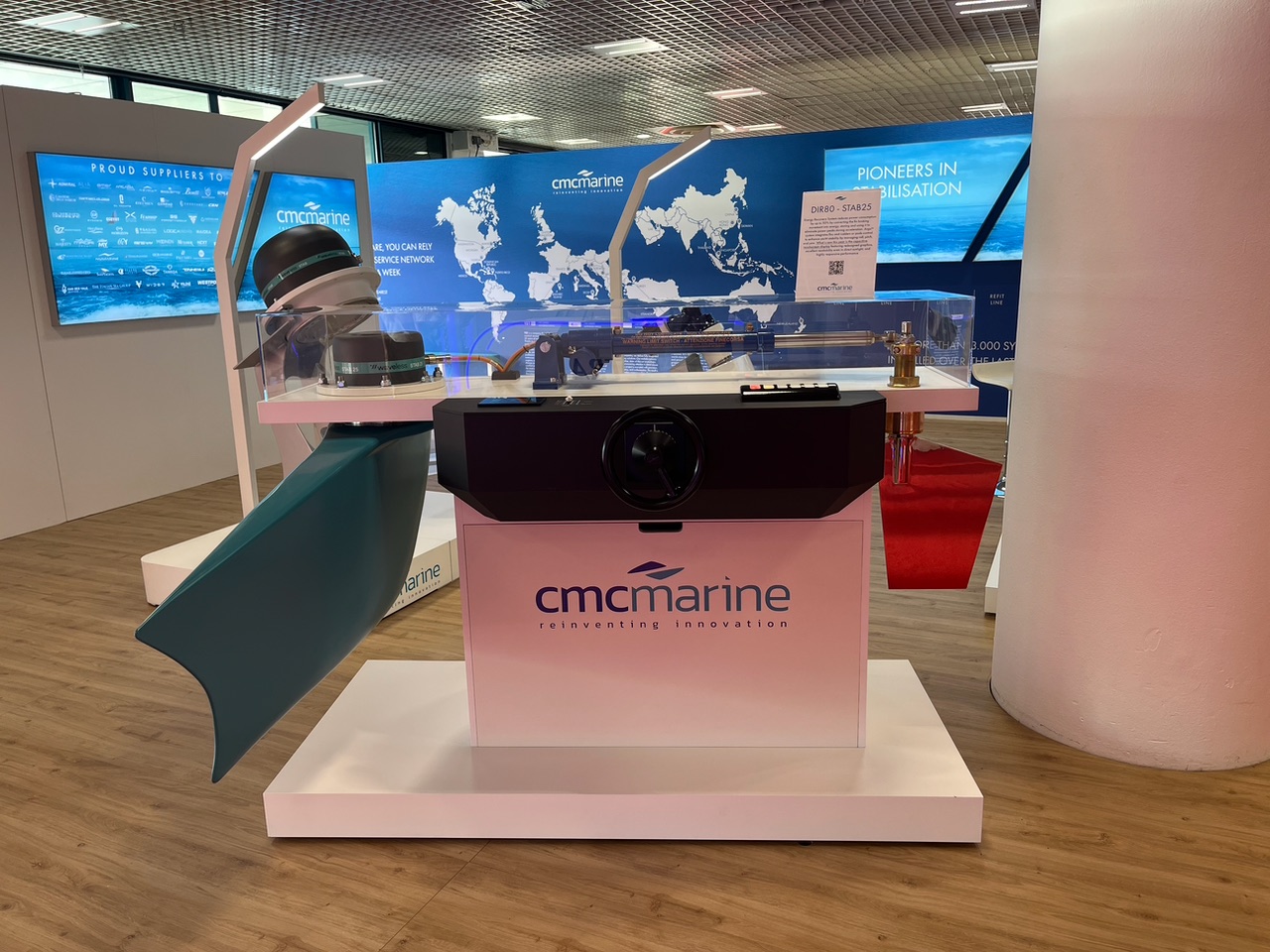
We discussed this with Pietro Cappiello, Vice President of CMC Marine, starting with a technology that is a good example of this approach: the Energy Recovery System, developed to recover energy that would normally be dissipated during the operation of stabiliser fins.
The starting point is a change taking place upstream. Sustainability requirements and the search for greater efficiency are pushing shipyards towards smaller generators and onboard systems designed to consume less. But reducing installed power also means that power demand peaks have to be managed more carefully.
“We started receiving signals from the market,” explains Cappiello. “When the fins moved, we could see the generator ‘sitting down’ a little, and the lights might fluctuate slightly. We asked ourselves what we could do about it.”
The issue is particularly evident during the acceleration phase of the fins. An electric actuator can deliver high performance very quickly, but precisely this characteristic can result in a very intense power demand concentrated over a short period. A generator designed to operate with lower overall consumption may therefore find itself having to handle a particularly demanding load.
The solution developed by CMC Marine uses a capacitor-based energy storage system positioned between the generator and the stabilisation system. The principle is to limit the peak demand placed on the generator: when demand exceeds a defined threshold, part of the required energy is supplied by the storage system.
The key factor is the speed at which this process needs to take place. “A capacitor is not a battery,” Cappiello points out. “A battery has much longer charging and discharging times. Here we need to store and return energy very quickly.”
The system therefore acts on the dynamics of the load, rather than simply on the total amount of energy consumed. This is an important distinction because, in the electrical architecture of a modern yacht, managing power peaks can become just as important as reducing average consumption.
From Dissipation to Recovery
The same philosophy underpins the Energy Recovery System presented by CMC Marine.
In this case, the principle is even more intuitive. When a fin has to slow down, the kinetic energy associated with its movement does not simply disappear. In a conventional system, it can be dissipated through a braking resistor, essentially being converted into heat.
With an electric system, however, the motor can also operate in reverse: during braking, it becomes a generator.
“All electric motors, when you brake them, become generators,” explains Cappiello. “When the fin decelerates, we generate energy. Normally that energy is dissipated. Instead, we recover it, store it and use it when the next power demand peak arrives.”
By analogy, the principle is similar to the KERS systems used in motorsport: energy that would normally be lost is recovered and made available again.
On a yacht, however, the advantage is not simply the recovery of energy. The ERS primarily makes it possible to smooth the generator’s power demand curve, so that the generator does not have to constantly respond to very rapid changes in load.
The system therefore acts as a kind of energy buffer between production and consumption.
“When we know that we are asking too much from the generator, we use the energy we have stored. The generator only sees the demand up to a certain threshold; we take care of the rest.”
The solution is particularly relevant as the marine industry seeks to reduce generator capacity while increasing the overall efficiency of onboard systems. For CMC Marine, therefore, electrification is not simply a matter of replacing one component with another: it also means managing the energy available onboard in a different way.
The first systems have already been tested on several boats. According to Cappiello, the results have been positive, although a complete assessment of the economic return requires long-term analysis, taking into account the yacht’s configuration, operating profile and the behaviour of the other onboard systems.
It is an area that, as Cappiello suggests, could warrant further investigation: understanding how much optimising peak-load management can affect overall consumption and generator operation over time.
The Propeller Becomes an R&D Project
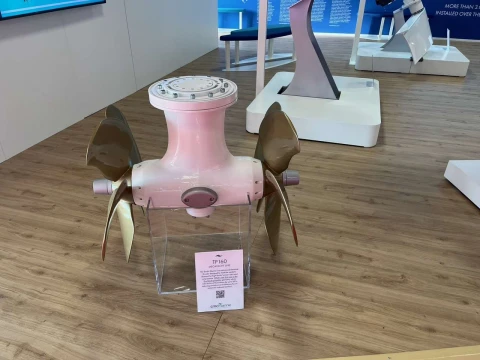
Another example of this approach can be found in the Dualis Electra thrusters, for which CMC Marine has completely rethought the geometry of the propellers.
The new five-blade design has a precise objective: to maintain performance while reducing noise and making thrust delivery smoother.
In this case, noise is not a problem separate from performance. It is closely linked to cavitation. Changing the propeller geometry therefore means working simultaneously on system efficiency and the acoustic quality experienced onboard.
This is work that CMC Marine can now carry out internally thanks to expertise spanning fluid dynamics and mechatronics, naval engineering and control systems.
“We have aerospace engineers working on aerodynamics and fluid dynamics, we run our own CFD, and we have control engineers and naval engineers,” says Cappiello.
The difference here is not simply having an engineering department capable of modifying an existing product. It is the ability to work on the product from the outset.
CMC Marine has developed the propeller design internally, including the definition of its geometry, and has also developed its own dimensional verification capabilities. The inspection of the component produced by the foundry is now supported by tools developed to capture and verify the actual geometry.
A significant example is the use of three-dimensional scanning. A scanner captures the points on the propeller surface and the software reconstructs the geometry, making it possible to verify parameters such as pitch.
“This is important to us because the product is ours,” Cappiello observes. “And if tomorrow I want a slightly different propeller, I need to have the ability to develop it.”
Customisation as a Capability, Not an Exception
Perhaps this is one of the most interesting aspects to emerge from the meeting. In an industry where components are often perceived as standardised products, CMC Marine instead considers the ability to adapt a fundamental part of its technical expertise.
The increasing size of yachts is making situations more common in which the standard solution is not necessarily the optimal one.
It is not simply a matter of selecting a particular stabiliser size. Displacement, hull geometry, available space, draught, the position of appendages and potential interference with other elements of the vessel all come into play.
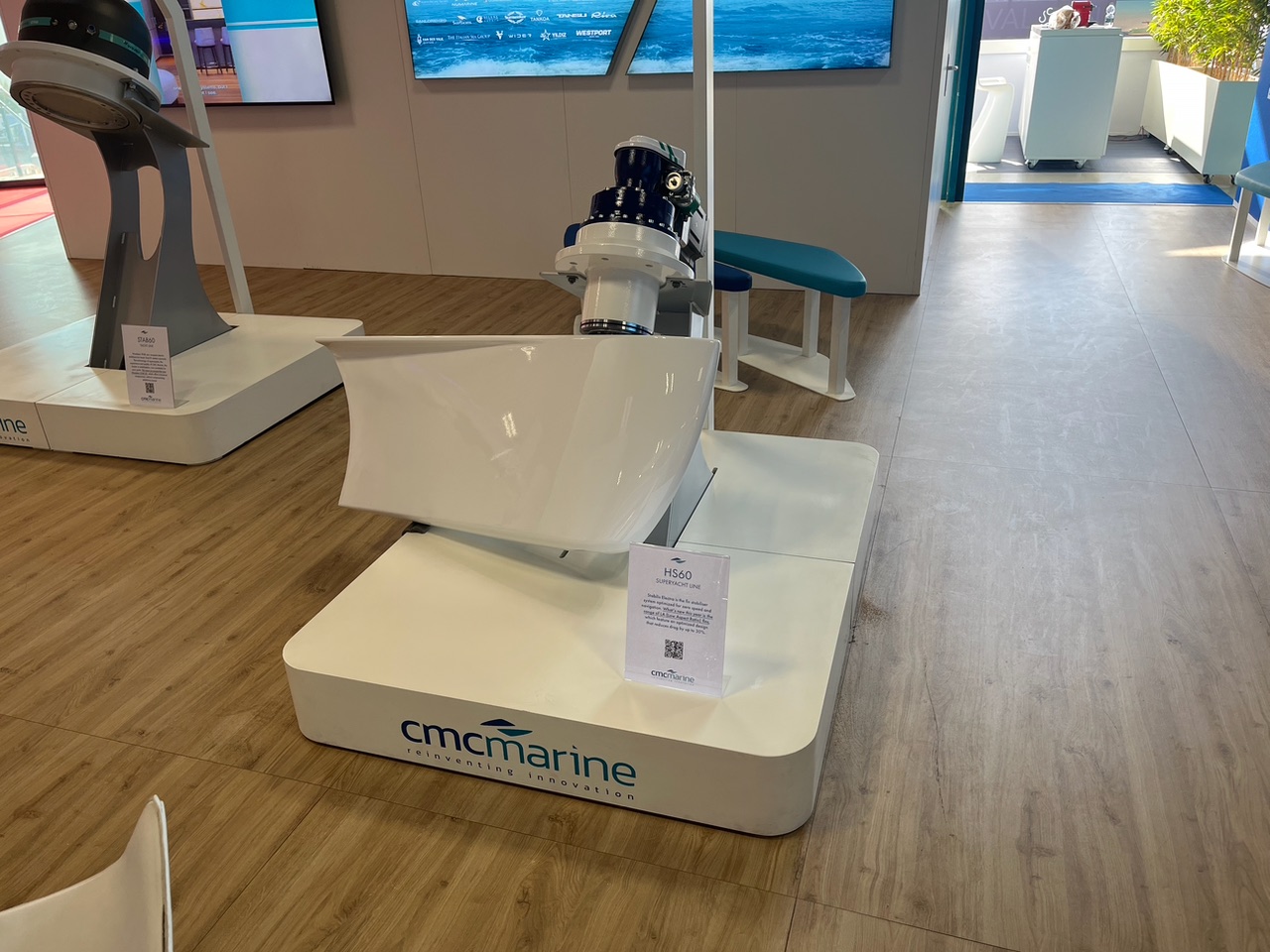
The process therefore starts with the data of the individual yacht. CMC Marine can simulate system behaviour, assess the most appropriate position for the fins and study possible interactions with the hull and other appendages.
“We don’t simply say: this is the product, take it. We try to understand what you need, what the boat is like and what you want to achieve.”
The difference is substantial. The component becomes the final result of an engineering process rather than the starting point for a simple configuration.
And as yachts become larger and more complex, this capability is likely to become increasingly important.
An Increasingly Integrated Technology Supply Chain
The ability to develop specific solutions is also linked to the progressive internalisation of expertise and production processes.
CMC Marine’s current industrial organisation allows the company to directly control an increasing part of the journey from the initial idea to the finished product: design, simulation, geometry development, dimensional verification and the production of components manufactured to its own specifications.
This does not necessarily mean producing every single element in-house. Rather, it means retaining within the company control of the know-how that determines how the system performs.
It is a model particularly suited to a market in which apparently minor modifications can have significant technical implications: a different geometry, a different distribution of surfaces, or a specific configuration dictated by the available space onboard.
From this perspective, a propeller is not simply a propeller. It is a design element that has to interact with the motor, tunnel, hull, operating conditions and acoustic objectives.
From Product to Solution
This is probably the common thread running through the innovations CMC Marine is bringing to Cannes in 2026.
On one side there are new products and new configurations. On the other, a development philosophy is emerging in which the product increasingly becomes the result of a problem that needs to be solved.
The Energy Recovery System stems from the evolution of generators and the need to manage energy differently. The new propellers originate from the search for a better combination of thrust and acoustic comfort. The ability to develop specific geometries responds to the growing complexity of hulls and onboard systems.
It is an approach that shifts the centre of innovation: not simply “what can we add to the range?”, but “what problem is emerging onboard, and how can we solve it?”
For a company operating in yacht technology and equipment, this is arguably one of the most important evolutions. Because when the architecture of the vessel changes, even systems that once seemed established have to be reconsidered.
And in this scenario, CMC Marine’s ability to combine design, simulation, energy management and application expertise could become a competitive advantage every bit as important as the individual product presented at the show.
Filippo Ceragioli
©PressMare - All rights reserved