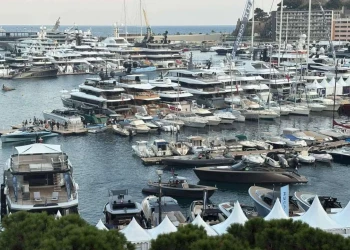
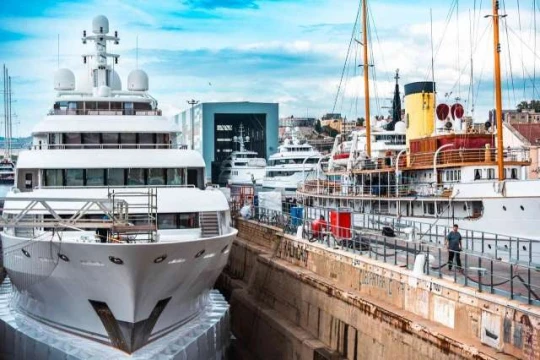
The Future of Yachting Through the Lens of Daron Acemoglu - Photo Palumbo Group
Who Will Be Able to Build the Yachts of the Future? The Future of Yachting Through the Lens of Daron Acemoglu
In the fourth instalment of “Oltre l’orizzonte”, Filippo Ceragioli continues his look at the future of yachting through some of the leading contemporary economic theories. With Branko Milanović he asked where wealth will be concentrated. With Kenneth Rogoff he looked at when that wealth will be ready to turn into a purchase. The series now turns to the work of Daron Acemoglu, MIT economist and 2024 Nobel laureate in economics together with Simon Johnson and James Robinson. The focus moves to shipyards, technology and production capacity, and to whether artificial intelligence, automation and digitalisation will actually make yards more productive.
The previous instalments can be read at the following links:
Beyond the Horizon: Economics as a Key to Understanding Yachting
The future of yachting will depend not only on how much wealth is created worldwide or on financial-market conditions. It will also depend on a much more industrial question: who will be able to build the yachts that future customers want to buy?
This is the third stage of our analysis.
With Branko Milanović, we asked where wealth will be concentrated. With Kenneth Rogoff, when that wealth will be ready to translate into a purchase. Through the lens of Daron Acemoglu, an MIT economist and joint recipient of the 2024 Nobel Prize in Economics with Simon Johnson and James Robinson, we now turn our attention to shipyards, technology and production capabilities.
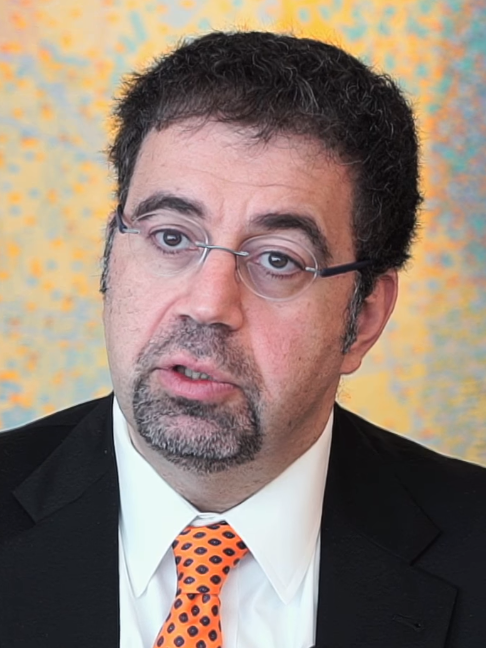
We do not attribute any forecasts about the yachting market to Acemoglu. Instead, we use central themes of his work — technology, productivity, labour and institutions — to interpret the industrial evolution of yachting.
The question can be summed up as follows: will artificial intelligence, automation and digitalisation really make shipyards more productive?
Technology Alone Is Not Enough
One of the most interesting aspects of Acemoglu’s recent work concerns the relationship between technology and productivity.
Introducing a new technology does not automatically increase productivity. The outcome depends on which tasks are transformed, how work is organised and whether people can make effective use of the new tools.
This distinction is particularly important in yachting.
A superyacht is not a car manufactured in hundreds of thousands of units. Even when a common platform exists, the product remains highly customised. Engineering, design, suppliers, components, craftsmanship and owners’ requirements must be coordinated within projects that can last for years.
AI can accelerate documentation, design, data analysis and procurement. Robotics can make certain operations more efficient. Digitalisation can improve production control.
But Acemoglu’s perspective suggests a different point:
what matters is not how much technology is introduced. What matters is how much productivity that technology actually generates.
Producing More or Producing Better?
The issue is already apparent in the industry’s figures.
In 2025, 204 new superyachts over 30 metres joined the global fleet, the third consecutive year above 200. At the beginning of 2026, 685 yachts were under construction. the-state-of-yachting-2026
Production has therefore increased compared with the previous decade. Yet construction times remain substantial: generally between two and four years and, for some of the largest projects, as long as five.
This raises a fundamental question: will the next challenge be to expand production capacity further, or to make better use of the capacity already available?
They are not the same thing.
Adding workshops, docks and personnel increases capacity. Reducing errors, engineering time, rework, supply-chain delays and the hours needed to complete the same project increases productivity.
And it is probably in this second area that technology and AI will deliver the most interesting results.
The Shipyard of the Future Will Not Necessarily Employ Fewer People
Automation is often associated with replacing human labour. An important strand of Acemoglu’s thinking instead suggests distinguishing between technologies that simply replace tasks performed by people and those that enable people to perform new, higher-value tasks.
In yachting, that distinction is crucial.
Automating a repetitive process can certainly reduce costs and time. Using artificial intelligence to manage technical documentation can free up engineers’ working hours. A digital system can identify supply-chain problems in advance.
But the benefit becomes greater when technology enables designers, technicians and skilled workers to create more value, rather than merely replacing them.
The most competitive shipyard of the future may therefore not be the one with the fewest people.
It may be the one where people work better thanks to technology.
A Particularly Italian Question
This perspective is especially relevant to Italy.
The strength of Italian yachtbuilding lies not only in its major brands. Around the shipyards are industrial clusters, designers, subcontractors, specialist companies and craft skills developed over decades.
In the 30–40-metre segment, The State of Yachting 2026 also highlights a strong concentration of production: eight of the ten leading builders are Italian.
This network represents a competitive advantage that is difficult to replicate quickly.
But it could also become a weakness if parts of the supply chain cannot sustain the investments required in digitalisation, training and new production processes.
The question, then, is not simply whether Italy knows how to build yachts. The figures show that it does.
The question is: can it turn the skills it already possesses into greater productivity?
It Is Not Enough to “Have AI”
The issue becomes even clearer when discussing artificial intelligence.
Saying that a company uses AI means little if its processes remain essentially unchanged.
In The Simple Macroeconomics of AI, Acemoglu takes a cautious position on the most enthusiastic forecasts of AI’s immediate impact on productivity.
Of course, we cannot apply his estimates directly to yachting. We can, however, apply the underlying principle.
For a shipyard, the interesting question is not:
“Do we use artificial intelligence?”
but:
“What can we do better thanks to artificial intelligence?”
Engineering, change-order management, documentation, procurement, planning and production control could be among the first areas in which to measure the answer in concrete terms.
Competition Will Be Between Ecosystems
Acemoglu’s work also introduces a second important element: institutions.
The 2024 Nobel Prize recognised Acemoglu, Johnson and Robinson for their research on how institutions influence countries’ prosperity. Applied to yachting, this means that a shipyard’s competitiveness does not depend solely on what happens inside its gates.
It depends on the availability of engineers and technicians, vocational training, supply-chain quality, infrastructure, access to capital, regulation and the ability to experiment with new technologies.
Future competition may therefore be not only between shipyards, but between industrial ecosystems.
Italy, the Netherlands, Germany and Turkey have developed different positions in yachting precisely because they have different production systems.
Italy combines production scale, industrial clusters and customisation capabilities. The Netherlands and Germany have developed strong specialisation in large custom yachts, where engineering and project management carry enormous weight. Turkey has grown rapidly through a combination of industrial capacity, expertise and cost competitiveness.
The challenge will be to understand which of these ecosystems can absorb new technologies most effectively.
The Coming Years
In the short term, over the next 12–24 months, AI and automation are unlikely to revolutionise the number of yachts produced. They are more likely to begin changing less visible activities: engineering, documentation, procurement, planning and supply-chain management.
Over the medium term, three to five years, the differences could become much more apparent.
Shipyards capable of integrating technology, skills and supply chains could reduce time and errors and generate more value with the same resources. Others may continue to receive orders but find themselves under increasing pressure from costs, staffing and delivery times.
And here the perspectives of our three economists begin to form a broader picture.
Milanović: who will hold the wealth?
Rogoff: when will they be willing to spend it?
Acemoglu: who will be able to turn technology, people and skills into the yacht that this wealth will want to buy?
The competitive advantage of the future may therefore not belong to the shipyard that uses the most technology.
It may belong to the one that is best able to turn technology into productivity, without losing the human expertise that continues to make a yacht difficult to build and difficult to copy.
Filippo Ceragioli
Sources and References
Daron Acemoglu, The Simple Macroeconomics of AI, NBER Working Paper 32487, 2024, for the relationship between artificial intelligence, automation and productivity.
Daron Acemoglu, Simon Johnson and James A. Robinson, research on the relationship between institutions and prosperity, 2024 Prize in Economic Sciences.
SuperYacht Times, The State of Yachting 2026 and the SuperYacht Times iQ database, for data on the fleet, construction, production and market segmentation. the-state-of-yachting-2026
©PressMare - All rights reserved