Schenker Watermakers: the evolution of watermakers and new industry trends


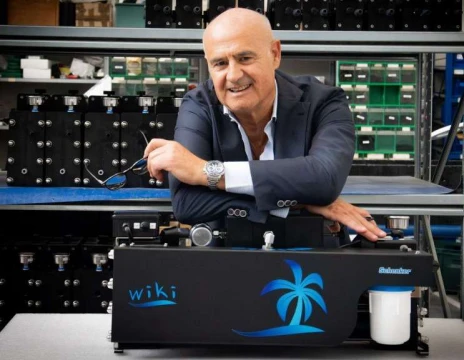
We interviewed engineer Riccardo Verde, sole director of Schenker Watermakers, an Italian company specialised in the production of energy-recovery marine watermakers. Founded in 1998, the company has consistently positioned itself on the market by offering solutions that are often innovative while maintaining a strong focus on reliability. During the interview, we discussed technological evolution and market trends within the yachting sector, including the segment of increasingly larger vessels. Verde shares insights into emerging innovations, onboard connectivity and demand dynamics between new builds and refit.
PressMare – Technological innovation: what do you see as the next step in desalination systems?
Riccardo Verde – In the medium to long term, technologies based on materials such as graphene could represent a breakthrough for reverse-osmosis membranes. Unlike traditional, multi-layer membranes with greater thickness, an atomic graphene membrane would allow water to pass with almost no resistance, significantly reducing operating pressure and overall energy consumption during the salt-water separation phase. In this sense, the adoption of next-generation membranes could make the desalination process “simpler” and less demanding in terms of power required by pumps and auxiliary systems. If implemented on an industrial scale, this development could lower the cost of producing fresh water from seawater, somewhat like the effect of an extremely efficient strainer.
Graphene therefore allows us to envisage ultra-thin membranes with a potentially significant reduction in energy demand compared to current technologies.
PM – What impact would this have on the onboard energy balance?
RV – Eliminating the need for high-pressure pumps, thanks to ultra-efficient membranes, would drastically reduce energy consumption. Fewer complex systems and lower power demand would result in more efficient fresh-water production, with benefits also for the vessel’s overall electrical load.
PM – IoT, the acronym for Internet of Things, is a technology that is rapidly spreading across onboard systems, which are increasingly integrated and interconnected, and capable of transmitting and receiving data, even remotely. Does this also apply to your watermakers?

RV – Yes. Advanced connectivity is an infrastructural driver for new Schenker systems. Today, for example, our latest-generation watermakers can already interface with the multifunction touch-screen displays of major players such as Garmin or B&G, enabling closer integration between machinery control and navigation instruments. On-screen visualisation includes machine status (on/off), operating pressure, salinity of the produced water, alarms and anomalies. The watermaker thus becomes part of the onboard ecosystem rather than a standalone unit.
The next step involves implementing cloud connectivity and advanced remote diagnostics systems based on artificial intelligence. These systems process large volumes of operational and historical data to optimise predictive maintenance, supporting both the owner and the manufacturer in managing wear-prone components.
PM – So the equipment will be fitted with sensors and a communication control unit…
RV – Exactly. This allows monitoring of pressure, flow rate, temperature, electrical absorption and operating hours, all connected to an electronic control unit capable of transmitting and receiving data via a network (onboard or external). As you mentioned earlier, the machine no longer operates in isolation but becomes an active node within a digital system.
PM – How does this connectivity translate into benefits for the end user, the owner and/or the vessel’s captain?
RV – Intelligent diagnostics and automated reporting improve the end-user experience and the operational efficiency of service activities, with positive effects on system reliability and lifespan. Our roadmap includes the implementation of direct cloud-based functionalities that facilitate human-machine interaction and preventive maintenance.

PM – The METS in Amsterdam has just concluded: how do you assess this year’s edition and the role of industry trade shows?
RV – METS remains an essential event for operators with a strategic outlook: it is a key meeting point with dealers, distributors and shipyards, as well as a showcase for technological innovations. Despite the high participation costs, the cost-benefit ratio remains very favourable,s and justifies direct company presence. The opportunity to engage with professional counterparts within a few days is a core asset in commercial and product management.
PM – From your privileged perspective as an industry operator, what is the current state of the yachting market?
RV – The situation is complex. The small-boat segment is struggling, partly due to global economic dynamics and the contraction of the middle class. Demand is shifting towards the high-end segment, both in terms of vessels and accessories, where the propensity to invest remains more resilient. This trend is evident across major European countries and is also reflected in emerging areas such as the Middle East, where, however, the end clientele includes many European operators, bringing similar market dynamics with them.
I believe that 2026 may show more positive signals, with a possible stabilisation after 2025, albeit within a still challenging environment.
PM – How is your business split between new installations and refit?
RV – The average lifespan of a watermaker is supported by a service life of around 15 years. During boom periods, the larger share is linked to first installation on new builds. In more difficult times, such as the current one, the refit segment grows, with owners investing in maintenance and upgrades of existing equipment. This is an indicator of the maturity of the vessel fleet and of how demand can shift depending on the economic context.
©PressMare - All rights reserved