CG30 Vento: the new 30-foot offshore racer by Cossutti-Ganz and Northern Light Composites


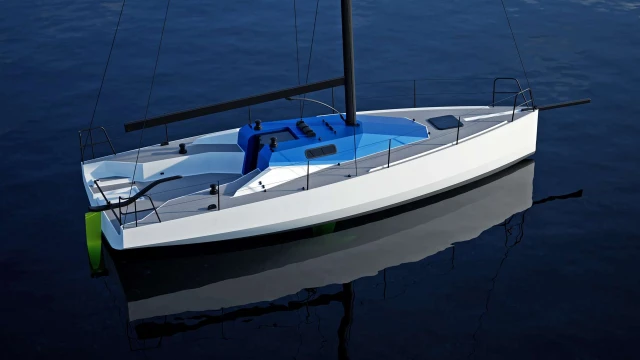
With the CG30 Vento, Cossutti-Ganz Yacht Design and Northern Light Composites introduce a 30-foot offshore racer conceived to combine performance, construction rationality and economic sustainability. The project stems from a short, fully North-Eastern Italian supply chain, in which design office and shipyard worked in an integrated way from the earliest stages, optimising production processes, lamination strategies and cost management.
The result is a yacht designed both for short-handed offshore racing and for fully crewed buoy racing, under ORC and IRC rules. Design choices take into account rating optimisation as well as the typical Mediterranean and European racing conditions, favouring high average speeds in light and variable airs without resorting to extreme hull shapes.
Hull and general trim
The CG30 Vento measures 9.01 metres LOA with a maximum beam of 3.00 metres. Displacement is 2,950 kg, with 1,350 kg of ballast and a draft of 1.96 metres. Stability is tuned to ensure a balanced compromise between double-handed sailing and full-crew racing, providing sufficient stiffness under sail while still allowing the crew to contribute dynamically to righting moment.
The standard configuration features a single externally mounted composite spade rudder, hung from the transom; a twin-rudder arrangement with lifting blades is available as an option. Specific structural solutions allow keel and rudder to be removed for easier road transport.

Deck and layout
The deck geometry is based on mainly flat panels, a choice driven by both aesthetic criteria and mould cost containment. The cockpit, wide and protected by two long shaped coamings, is designed to limit water ingress even in demanding conditions.
Forward there is a large forehatch that can also be used as a sail locker, while the liferaft compartment is integrated into the cockpit sole. Access to the interior is via a sliding companionway hatch with vertical washboards.
The deck layout is organised for single-handed or short-handed sailing: carbon tiller, two primary winches in the cockpit and two on the coachroof, running rigging led to the mast base, a central bank of ten rope clutches, a 3D jib sheet system and a complete gennaker circuit with aft turning blocks.
Sail plan
The mast is positioned approximately amidships. Two main sail plan configurations are available: square-top mainsail with double backstay, or semi-square-top mainsail with extended mast crane and single backstay. The rig is a 9/10 fractional with two swept spreaders deck-stepped.
Upwind sail area is 56.6 sqm, downwind 131 sqm. Mast and boom are standard in aluminium, with the option of a carbon boom or full carbon spar package. Standing rigging is Dyform stainless steel, with options in rod or composite. Gennaker and Code 0 are masthead-set on a retractable carbon bowsprit. All chainplates, as well as pulpits and stanchions, are in stainless steel.

Construction and keel
Hull and deck are built in sandwich with unidirectional and biaxial glass fabrics over PVC and PET cores, vacuum-laminated with vinylester resin in female moulds. Structural components are CNC-cut, bonded and laminated to the hull; marine plywood bulkheads are also CNC-cut and structurally integrated. The forward bulkhead is collision-proof, while all through-hulls are flush-mounted.
The keel consists of a high-strength steel fin and a lead bulb, faired in GRP. The “box” attachment system allows rapid removal of the fin for transport.
Interior
The interior follows an essential and functional philosophy, oriented towards offshore racing use. Two structural aft berths and two upper midship berths are provided. Above the keel line, a longitudinal bench faces the navigation table and can be converted into a table with an optional module.
Aft are two rigid seats and the galley and refrigerator modules. The forepeak is left free as a sail locker, while the toilet can be enclosed with an optional movable bulkhead. Systems include refrigerator, sink, Jetboil gimballed stove, two 55-litre flexible water tanks, 12V electrical system with twin batteries, USB sockets and internal lighting.
Engine, price and programme
The CG30 Vento is equipped with an 11 Hp diesel engine with saildrive and two-blade folding propeller. Fuel capacity is 40 litres. The preliminary price of the standard version is below €100,000.
Construction takes place at Northern Light Composites’ shipyard in Monfalcone. Sales are managed directly by the yard and through a network of specialised dealers. Delivery of the first unit is scheduled for autumn 2026.

Words from the protagonists
Maurizio Cossutti highlights how the project responds to the demand for a modern yacht around 9 metres in length, offering a strong performance-to-rating ratio and controlled construction costs without compromising build quality. Fabio Bignolini, CEO of Northern Light Composites, underlines the industrial and symbolic value of the CG30 Vento as the first yacht built at the new Monfalcone facility and as a starting point for relaunching small-scale boatbuilding in the Gulf of Trieste.
Main technical data (preliminary)
• Design: Cossutti-Ganz Yacht Design
• Builder: Northern Light Composites
• CE category: A
• Hull length: 9.01 m
• Beam: 3.00 m
• Displacement: 2,950 kg
• Ballast: 1,350 kg
• Draft: 1.96 m
• Engine: 11 Hp / 8 kW
• Upwind sail area: 56.6 sqm
• Downwind sail area: 131 sqm
• ORC APH Full Crew (est.): 556 s/m
• ORC APH Double Handed (est.): 563 s/m
With the CG30 Vento, the 30-foot offshore racing segment gains a technically oriented and versatile new contender, based on a design approach that balances performance with overall yacht management.
©PressMare - All rights reserved