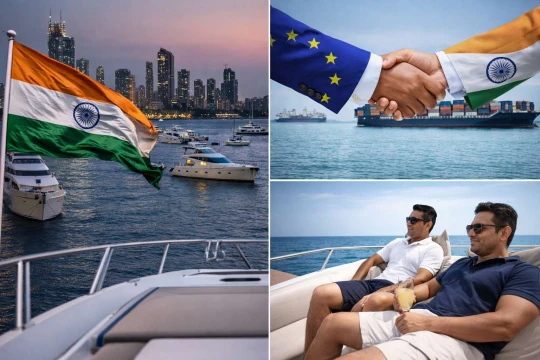
India and recreational boating: the outlook after the new EU trade agreement


In recent months, India has appeared more frequently in analyses of potential markets for recreational boating. This is not due to a sudden expansion of the fleet or dedicated infrastructure — which still remain limited compared with European and North American standards — but rather to changes in the country’s macroeconomic and trade framework.
The combination of sustained economic growth, rising private wealth in the upper brackets and the new free trade agreement with the European Union makes the Indian market an area worth monitoring for shipyards, engine manufacturers and component suppliers.
According to the latest international macroeconomic estimates, between 2025 and early 2026 India became the world’s fourth-largest economy by nominal GDP, overtaking Japan. Projections place nominal GDP at around USD 4.5 trillion in 2026, with real growth in fiscal year 2025–26 estimated at about 7.4%, above the global average.
Inflation is gradually trending back toward the 4% range, while nominal GDP per capita remains relatively low, just above USD 3,000 per year. This clarifies a key point: growth is solid, but the average income base remains limited, and recreational boating therefore continues to be a niche market.
Wealth distribution is highly asymmetric. The main inequality studies indicate that a large share of national wealth is concentrated within a small portion of the population. The number of very large fortunes is rising, and India consistently ranks among the countries with the highest number of billionaires worldwide, although totals vary depending on methodology.
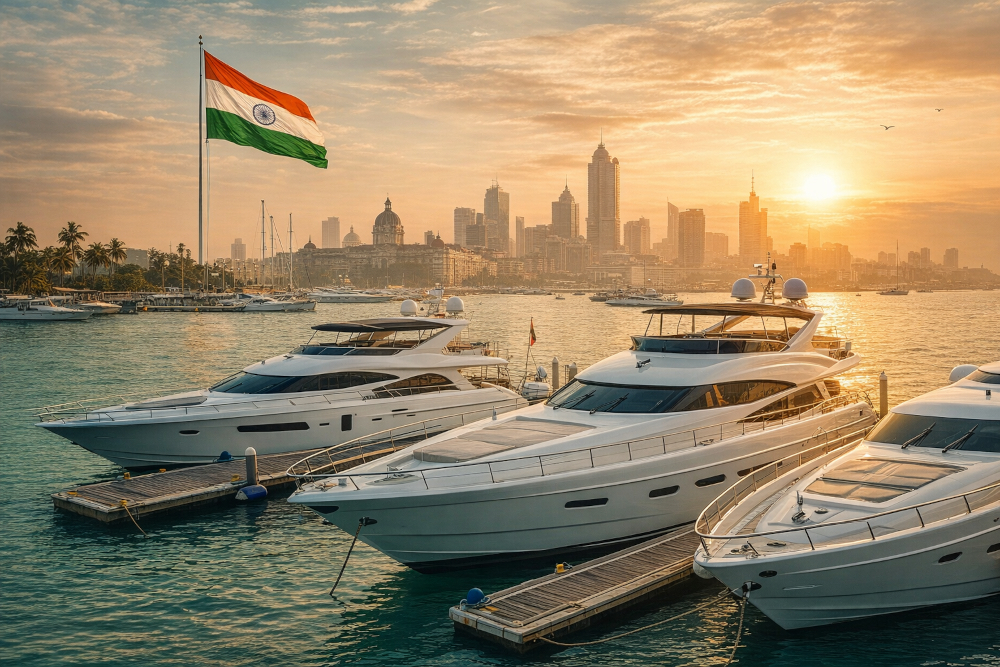
A relevant indicator for assessing the potential of the Indian boating market is the evolution of private wealth in the upper segments. According to Capgemini’s World Wealth Report 2025, India counted about 380,000 HNWIs (High Net Worth Individuals) in 2024 — individuals with more than USD 1 million in investable assets — up year on year. More selective is the UHNWI segment (Ultra High Net Worth Individuals), with net worth above USD 30 million: major international studies place this population in the range of several thousand individuals, while wealth rankings such as the Hurun Rich List list more than 280 Indian billionaires, placing the country among the global leaders in large fortunes. Differences between sources depend on whether calculations are based on investable financial wealth or total net worth, but the underlying trend is consistent: the ultra-wealthy segment is expanding within a country still marked by strong inequality.
Large fortunes are mainly generated in technology, pharmaceuticals, real estate and extractive industries. For boating, this means that the potential client base exists but is limited: yachts and premium boats address a numerically restricted audience concentrated in a few metropolitan and tourist areas.
Specific market data on Indian boating mostly come from market intelligence firms and international observatories, with not always homogeneous scopes. Estimates for the yacht and pleasure boating segment converge on still limited absolute values — in the range of a few hundred million dollars — with growth rates above average but calculated on a small base.
The number of registered and operational leisure boats is also low compared with mature markets. The marina and yacht harbour network is under development and represents one of the main enabling factors: without equipped berths, technical services and a refit supply chain, fleet growth remains structurally constrained.
Within this framework sits the new free trade agreement between the European Union and India, concluded at negotiation level and now moving through legal review and political approval. Official EU communications describe it as the broadest trade agreement ever reached by the two parties.
The agreement provides for the reduction or elimination of duties on about 96% of EU export lines to India, with estimated savings of several billion euros per year and the possibility of a significant increase in trade flows over the next decade. It also includes specific measures to facilitate SME access, with greater regulatory transparency and dedicated contact points.
For the European marine industry, the potential effect is clear: lower tariff barriers on boats, marine engines, navigation electronics, onboard systems and accessories can improve the competitiveness of imported products. Builders, outboard manufacturers, propulsion system suppliers, deck equipment and outfitting companies may find more favourable entry conditions.
However, the real impact will depend less on tariffs alone and more on operational variables: local import regulations, domestic taxation, registration procedures, and the development of marinas and technical services.
Lower duties can ease access, but they do not automatically create a market. Indian boating remains an emerging sector, with interesting dynamics but still structurally limited.
Macroeconomic signals and the new trade framework increase the country’s relevance in medium-term strategies, especially for the premium segment and technical components. Growth will depend on the local system’s ability to develop dedicated port infrastructure, services and stable boating regulations.
Only on that basis can expansion become structural rather than episodic. The agreement with the EU opens a door, but the evolution of India’s domestic market will determine how far that door will actually open.
©PressMare - All rights reserved