Besenzoni accelerates its Sustainability Commitment
Exactly halfway through the sustainable development plan adopted by the company in 2022, Besenzoni takes stock of the results achieved. From the fully electric BeElectric division to measurable emission reductions, including energy efficiency improvements and new production processes: the Italian company’s ESG journey integrates technology, environment and design into a concrete and already operational strategy.
In a sector called to confront the challenges of energy transition, Besenzoni demonstrates how industrial growth and reduced environmental impact can go hand in hand. As shown by the most recent consolidated data from the company’s sustainability program, Besenzoni has recorded a reduction of approximately 6% in greenhouse gas emissions, despite an increase in production.
In this regard, since 2022 the company has launched a sustainable development plan that cuts across products, processes and organizational structure, with the goal of concretely integrating environmental, social and governance criteria into its industrial model, following the Sustainable Development Goals of the United Nations 2030 Agenda.
The path translates into concrete and already active initiatives: energy efficiency improvements in production facilities, low‑consumption machinery, progressive electrification of the company fleet and optimization of the supply chain.
Parallel to this, the company has also strengthened its technological infrastructure by investing in cybersecurity and process digitalization, elements that are increasingly essential to ensure operational continuity and efficiency in an advanced industrial context.
The carbon footprint analysis also highlights an improvement in the use of energy resources, with an 8.4% reduction in the impact linked to natural gas and a decrease in energy intensity per unit of raw material used.
On the energy front, the installation of a photovoltaic system now covers around 10% of the company’s annual energy needs, while targeted interventions on buildings and machinery contribute to more efficient consumption management.
Significant results have also been achieved in resource management: water consumption has been reduced by approximately 19%, while the upgrade of the logistics fleet has led to a substantial decrease in transport‑related emissions, with a –48% reduction in gasoline use and –81% in bunker oil.
It is also worth recalling that Besenzoni was among the first companies in the sector to obtain ISO 9001 certification for quality management back in 1997 - later extended to the entire production system - and has progressively built a model based on process control and operational efficiency. Today, this is complemented by the ongoing process toward ISO 14001 environmental management certification, which consolidates and makes the initiatives launched in the field of sustainability measurable.
BeElectric: sustainability starts with the product
Alongside process transformation, Besenzoni has also developed a direct response on the design front with the creation of the BeElectric division, dedicated to fully electric handling systems.
A choice that has a concrete impact on environmental performance on board: eliminating hydraulic circuits reduces the use of oils, plastics and potentially polluting components, while ensuring lighter, quieter and more efficient systems.
The range, which includes gangways, ladders, tender lifts, windlasses and cover systems, represents a technological evolution that improves not only sustainability but also the user experience, with reduced energy consumption and lower maintenance requirements.
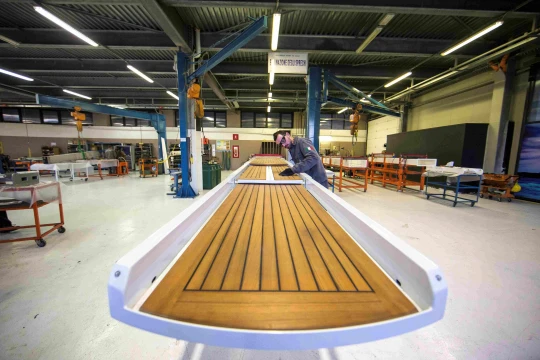
In this direction, material research also plays a role, with the introduction of high‑performance synthetic surfaces that are durable and maintenance‑free, designed to further reduce environmental impact throughout the product’s life cycle.
Industrial transition and long‑term vision
“Alongside traditional production, which remains our core business, we are approaching the shift toward increasingly eco‑friendly solutions with great determination. Sustainability is not only about the product, but about the company’s entire way of operating,” comments CEO Giorgio Besenzoni.
Among the projects currently under development are solutions for energy recovery and optimization of thermal consumption, such as the creation of a heat exchanger to reuse energy generated by industrial processes.
This direction confirms that sustainability, for Besenzoni, is not an accessory element but a strategic lever capable of guiding the company’s technological and industrial evolution in the long term.